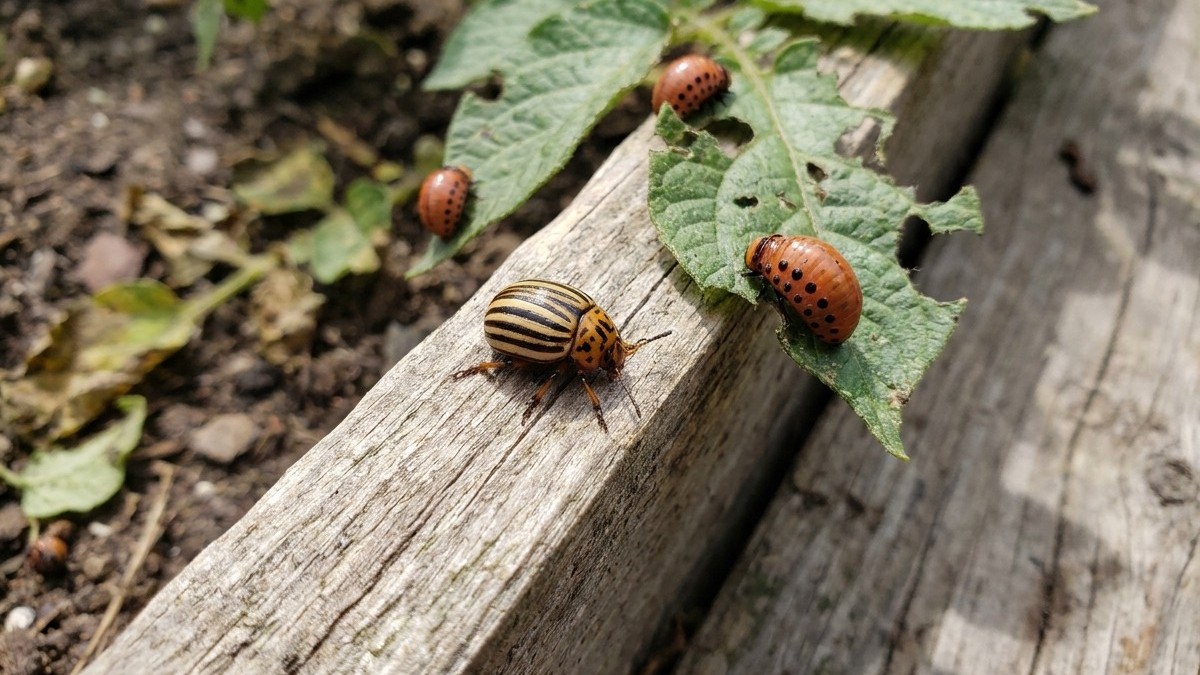

UGA Cooperative Extension documents ten insect pests on Georgia’s vegetable crops, but only four of them actually feed on potato: Colorado potato beetle, aphids, cutworms, and spider mites. The rest target beans, cowpeas, corn, and cucurbits. Timing on potato follows the state’s frost-free window, not a fixed month, which shifts the whole pest calendar depending on where in Georgia you garden.
Which pests attack potato in Georgia
UGA Cooperative Extension lists ten insect species across its vegetable pest records for the state: Aphids, Colorado potato beetle, Corn earworm, Cowpea curculio, Cutworms, Melonworm, Mexican bean beetle, Pickleworm, Spider mites, and Squash vine borer. That is the full documented set for this territory. Only some of them have any business on a potato plant.
Only four of the ten feed on potato foliage, stems, or the tubers underground: Colorado potato beetle, aphids, cutworms, and spider mites. The other six are pests of different crops entirely, and a gardener who spots one of them near potato rows is likely looking at damage to a neighboring plant, not to the potatoes.
Corn earworm targets corn ears and tomato fruit, not the leafy above-ground growth of a potato plant. Cowpea curculio is a pest of cowpeas and southern peas, feeding inside the pods, a structure potatoes don’t produce. Melonworm and pickleworm both bore into the fruit and vines of cucurbits like squash, melons, and cucumbers, crops with a completely different growth habit than potato. Mexican bean beetle skeletonizes bean leaves specifically. Squash vine borer tunnels into squash and pumpkin stems, which are hollow in a way potato stems are not.
So the working list for potato in Georgia is short: Colorado potato beetle chews leaves in a distinctive ragged pattern and can defoliate a plant fast when populations build. Aphids cluster on the undersides of leaves and along stems, sucking sap and, more importantly, spreading virus between plants. Cutworms work at the soil line, severing young stems overnight. Spider mites feed on leaf tissue and thrive when the weather turns hot and dry, which happens reliably in a Georgia summer.
That is not a long list, and UGA Cooperative Extension does not document a wider range of species feeding on potato in this state. A short list is still useful information: it means most of what shows up in a potato patch belongs to one of those four categories, and ruling out the other six saves time chasing the wrong problem.
When each one shows up, and what it does first
The frost-free window for the Atlanta reference station runs from March 11 to March 29, based on NOAA NCEI’s 30-year climate normals. That date matters more than any calendar month because it anchors when potato plants go into the ground and, in turn, when each pest becomes active. North Georgia and the mountains lose their last frost several weeks later than this window suggests, while the coastal plain tends to run milder and earlier. The sequence below follows planting relative to that frost date, not a fixed month.
What shows up first, and what you see
Cutworms are usually the earliest problem, active while young shoots are still soft and close to the soil. The first sign is a seedling that was standing one day and lying severed at the base the next, often with no plant visible nearby because the cutworm pulls it partway underground.
Colorado potato beetle follows once foliage has filled in, typically a few weeks after emergence. The first sign is small, ragged holes chewed into leaves, sometimes alongside clusters of bright orange egg masses on the leaf undersides. Left alone, the holes multiply fast because both the adults and the larvae feed.
Aphids tend to build gradually through the growing weeks that follow, favoring new growth at the tips of the plant. The first sign is often not the insect itself but curled, distorted new leaves and a faint sticky residue on the foliage below where aphids have been feeding above.
Spider mites arrive later, once the weather turns consistently hot and dry, a pattern that fits well into a Georgia summer. The first sign is a fine stippling or speckled look on the leaves, sometimes with faint webbing on the underside if you check closely, well before the leaves visibly yellow or drop.
Telling the damage apart from everything else
Insect feeding is not the only thing that makes a potato leaf look wrong. Nutrient shortages, uneven watering, disease, and simple mechanical damage from tools or foot traffic all leave marks that get blamed on bugs when no bug is actually there.
The detail that decides is usually whether you can find the insect, its eggs, or its feeding residue on the plant itself, not just the symptom. A ragged hole with no beetle, no larvae, and no egg cluster anywhere nearby is worth a second look before it gets treated as pest damage.
| What you see | Possible cause | What tells them apart |
|---|---|---|
| Chewed, ragged leaf edges | Colorado potato beetle | Adults or striped larvae present on the leaf, often with orange egg clusters underneath |
| Curled, distorted new growth | Aphids, or a nutrient imbalance | Aphids are visible in clusters on leaf undersides; a nutrient issue shows uniform, symmetrical curling with no insects present |
| Severed seedling at soil line | Cutworm | The stem is cut cleanly, not wilted, and the seedling often lies detached rather than drooping |
| Fine speckling or bronzing on leaves | Spider mites, or drought stress | Mites leave faint webbing on the underside; drought stress alone shows no webbing and improves after watering |
| Yellowing between leaf veins | Nutrient deficiency or virus | No insect presence at all; a pattern that follows veins rather than random holes points to deficiency or disease |
None of this replaces an actual look at the plant in front of you. When the symptom doesn’t clearly match one row of that table, that is the point to send a photo or a sample to a county extension office rather than guess.
What actually works here, and what is a waste of time
On a growing season shaped by an early frost-free window and a hot summer that follows fast, timing beats almost any other tool. Getting a physical barrier over young plants before Colorado potato beetle adults emerge from the soil does more than any treatment applied after the leaves are already chewed. Lightweight row covers, put down at planting and removed once plants flower, keep the earliest wave of beetles from ever landing.
Hand-picking adult beetles and crushing the orange egg clusters on leaf undersides is tedious but genuinely effective on a home garden scale, especially early when numbers are still low. Rotating potatoes away from last year’s potato or tomato bed also matters, since overwintering beetles emerge close to where they fed the previous season.
Starting with certified seed potatoes is worth stating plainly rather than burying in a caution paragraph: uncertified seed carries virus, and aphids are the insect that spreads that virus from plant to plant once it’s in the ground. Clean seed removes the source before aphids ever get a chance to move it around.
Keeping plants evenly watered through hot, dry stretches reduces spider mite pressure, since mites build fastest on stressed foliage. What doesn’t work is waiting until leaves are already skeletonized or stippled before doing anything: by that point the damage is done and reactive treatment mostly protects what’s left, not what’s lost. Broad, untargeted treatment applied without confirming which of the four pests is actually present is also a poor use of time, since it can knock back the beneficial insects that would otherwise keep aphid numbers in check on their own.
Where to check this for your own county
UGA Cooperative Extension is the authority for pest identification and current guidance in this state, and every county has a local extension office that can look at an actual plant, not just a description of one. That local step matters because presence and pressure from any of these four pests varies inside Georgia, not just across it.
The frost date used earlier in this article comes from a single reference station in Atlanta. A garden in the north Georgia mountains works on a meaningfully later frost-free start, while a coastal plain garden often gets going earlier and stays warm longer into fall. That difference shifts when cutworms are active in spring and how long spider mites stay a problem into late summer, even though the underlying list of four pests doesn’t change.
What’s documented at the state level tells you what’s possible, not what’s actually in a given garden this season. A county extension office can confirm which of the four is present, whether pressure is heavy enough to act on, and when local timing differs from the state-wide window described here. That’s the next call to make before deciding anything else about a potato bed showing damage.
Common questions
Do all four documented pests show up in every part of Georgia?
UGA Cooperative Extension documents these four as feeding on potato statewide, but local pressure differs. A county office can confirm which ones are actually active in a specific area and season.
Can Colorado potato beetle survive a Georgia winter?
Adults overwinter in the soil near where they fed the previous season, which is part of why rotating potatoes away from last year’s bed reduces the following season’s numbers.
Are aphids only a problem because of the virus they spread?
No, aphids also weaken plants directly through sap feeding, but the virus they can carry between plants is the reason certified, clean seed matters as a starting point.
Is spider mite damage worse in a dry year?
Spider mites build fastest on stressed, dry foliage, so consistent watering through hot stretches tends to keep their numbers down without any other intervention.