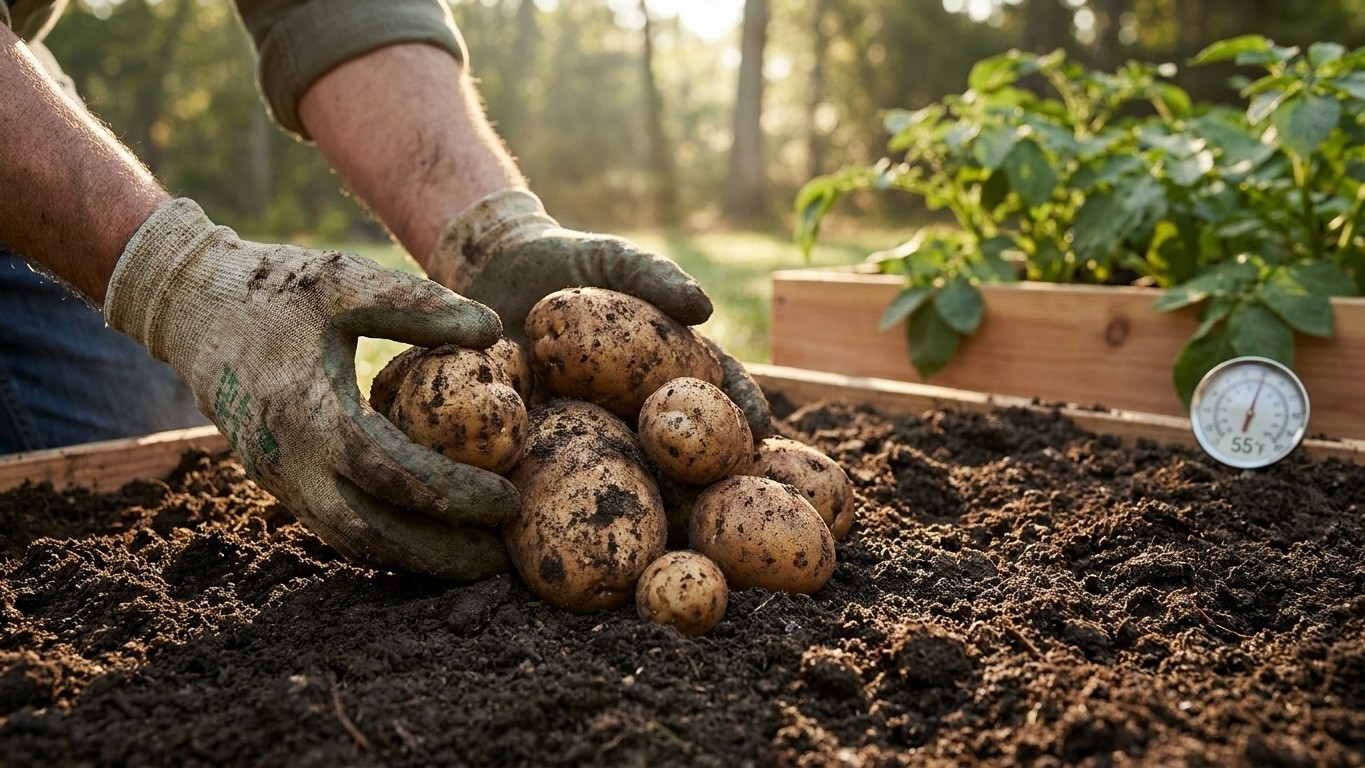

Georgia gardeners can grow potatoes successfully, but the state’s heat load rewrites the calendar. Atlanta averages 35.8 days a year at 90 F or higher, and the last spring frost typically falls between March 11 and March 29. That combination points to one strategy: a single spring crop, planted early and dug before the worst of summer heat arrives, rather than a season that stretches into July.
The short answer

Two numbers decide how potatoes perform in Georgia. The first is heat load: Atlanta averages 35.8 days a year reaching 90 F or more, according to NOAA NCEI Climate Normals for 1991-2020. The second is timing: the last spring frost at that same reference station falls somewhere between March 11 and March 29. Neither figure alone tells the whole story, but together they explain why potatoes here behave differently than they do in a cooler state.
Potatoes stop sizing tubers once the soil climbs above 90 F. That threshold comes from Utah State University Extension, and it’s the mechanism that decides the whole crop. With nearly 36 days a year crossing that mark in air temperature around Atlanta, and soil temperatures in an exposed, unmulched bed tracking close behind, a Georgia garden gives potatoes a window, not a full summer.
Why a spring crop, not a summer one
The practical answer is to treat Georgia potatoes as a spring crop. Plant as soon as soil reaches 50 F, let the plants bulk tubers through the mild weeks of April and May, and dig before June’s heat locks in. Wait too long, and the plant may still look green above ground while the tubers below have simply stopped growing. That’s not a disease or a pest. It’s the soil temperature doing exactly what Utah State University Extension describes: shutting down tuber set and fill once the ceiling is crossed.
Some Georgia gardeners attempt a second planting in late summer for a fall harvest, timed so the bulking period lands after the hottest weeks pass. That approach can work in the northern part of the state, where elevation trims a few degrees off the peak heat, but it depends heavily on local conditions rather than a statewide rule. For most of Georgia, the safer, better-tested path is the single spring crop, planted early and harvested before the 90-degree days pile up, ideally using Potato Varieties That Suit Georgia known for their quick bulking window, followed by careful attention to Harvesting and Storing Potatoes in Georgia once the tubers are ready to come out of the ground.
When to plant here
When to Plant Potatoes in Georgia isn’t chosen from a calendar. It’s counted backward from two things: the local last frost date and the soil temperature. Here’s how that arithmetic works for the Atlanta area, and how to redo it for any Georgia county.
- Start with the last spring frost window for the reference station: March 11 to March 29, per NOAA NCEI 1991-2020 Climate Normals.
- Potatoes go in the ground once soil temperature hits 50 F, which falls 14 to 21 days before that last frost date, according to Utah State University Extension and the University of Maine Cooperative Extension’s Bulletin #2077.
- Counting 14 to 21 days back from March 11 to March 29 places the planting window somewhere in late February through mid-March for the Atlanta area.
- Confirm with a soil thermometer rather than the date alone. A cold, wet spring can push that 50 F mark later even if the calendar says it’s time.
- Once planted, expect several weeks of cool-season growth before the plants need protection from a late frost, which is why timing this early still carries some frost risk to manage, not eliminate.
This same math applies anywhere in the state. Swap in the local last frost date, count back 14 to 21 days, and check the soil rather than trusting a fixed date. A gardener in the mountains of north Georgia will land on a planting window weeks later than one on the coastal plain, even though both are counting backward using the identical rule.
What the heat does to the crop
The mechanism is simple, and it’s the single most important fact on this page: once soil temperature climbs above 90 F, tuber set and fill stop. This comes directly from Utah State University Extension’s fact sheet on garden potatoes. It isn’t a gradual slowdown. It’s a ceiling.
Georgia’s climate crosses that ceiling regularly. With Atlanta averaging 35.8 days a year at 90 F or above, and many counties south of the city running warmer still, a potato crop left in the ground into midsummer is very likely to sit in soil that has already shut down tuber development. The plant can look completely healthy above the soil line while nothing useful is happening below it.
That’s the part gardeners get wrong most often: they assume more water will push the crop through the heat. It won’t. Watering keeps the plant alive and the foliage green, but it does nothing to reopen tuber set once soil temperature has crossed 90 F. The fix isn’t more irrigation. It’s timing the whole crop so bulking happens before that ceiling gets hit, which in Georgia usually means digging in early summer rather than waiting for a fall harvest from a spring planting.
For gardeners in the hottest parts of the state, especially south Georgia and the coastal plain, this means treating the growing window as short and fixed. The spring planting captures the mild weeks between the last frost and the arrival of sustained 90-degree days. Once that window closes, the crop needs to be out of the ground, not left to “catch up” later in the season.
What goes wrong here
- Uncertified seed potatoes. Seed sold without certification can carry viruses that stunt the whole crop before heat ever becomes a factor. Buying certified seed potatoes from a garden supplier eliminates this risk at the source, and it’s worth doing every season rather than saving pieces from a previous harvest.
- Planting into cold, wet soil. Pushing the planting date earlier than the 50 F soil mark to beat the heat backfires. Seed pieces rot in cold, waterlogged ground before they ever sprout. The fix is checking soil temperature directly rather than guessing from the calendar.
- Skipping hilling and getting green tubers. Tubers that get exposed to sunlight turn green and develop solanine, making them unfit to eat. Hilling soil up around the base of the plants as they grow keeps developing tubers covered and prevents this entirely.
- Digging too early. Pulling the crop before it’s finished bulking, out of worry over incoming heat, sacrifices yield that the plant would have added in its final weeks. Watching the foliage yellow and die back naturally is a better signal than a fixed date on the calendar.
Checking this against your own county
A statewide window is a starting point, not an instruction. Georgia stretches from mountain elevations in the north to the flat coastal plain in the south, and that range moves both the last frost date and the count of 90-degree days by weeks in either direction. A garden in the north Georgia mountains will see a later last frost and fewer scorching days than one near the coast, even though both sit in the same state.
Rather than treating the Atlanta figures as fixed for every county, use them as the reference point and adjust locally. The University of Georgia Cooperative Extension publishes county-level guidance that accounts for these differences, and it’s the resource to check before finalizing a planting date. Find it at extension.uga.edu.
Common questions
Can I grow a fall crop of potatoes in Georgia?
A fall crop is possible in cooler parts of the state where the bulking period can land after the hottest stretch of summer passes, but it depends heavily on local elevation and microclimate rather than a statewide rule. Check with your county extension office before planning around it.
Does mulching lower soil temperature enough to extend the season?
Mulch can moderate soil temperature swings and helps retain moisture, but it doesn’t reliably keep soil below the 90 F threshold once sustained heat sets in across the region. It’s a helpful practice, not a substitute for correct timing.
What potato varieties suit Georgia’s short cool window?
Early and mid-season varieties fit Georgia’s compressed spring window better than late-season types, since they complete more of their growth before the heat arrives. Choose by what the potato is best used for, baking or boiling, rather than by texture terms not published by the extension sources used here.
Is it worth planting potatoes at all in the hottest counties?
Yes, as long as the planting date is set early enough that bulking finishes before sustained 90 F days arrive. The crop that fails isn’t the one planted early and dug promptly. It’s the one left in the ground through summer expecting more time to help.