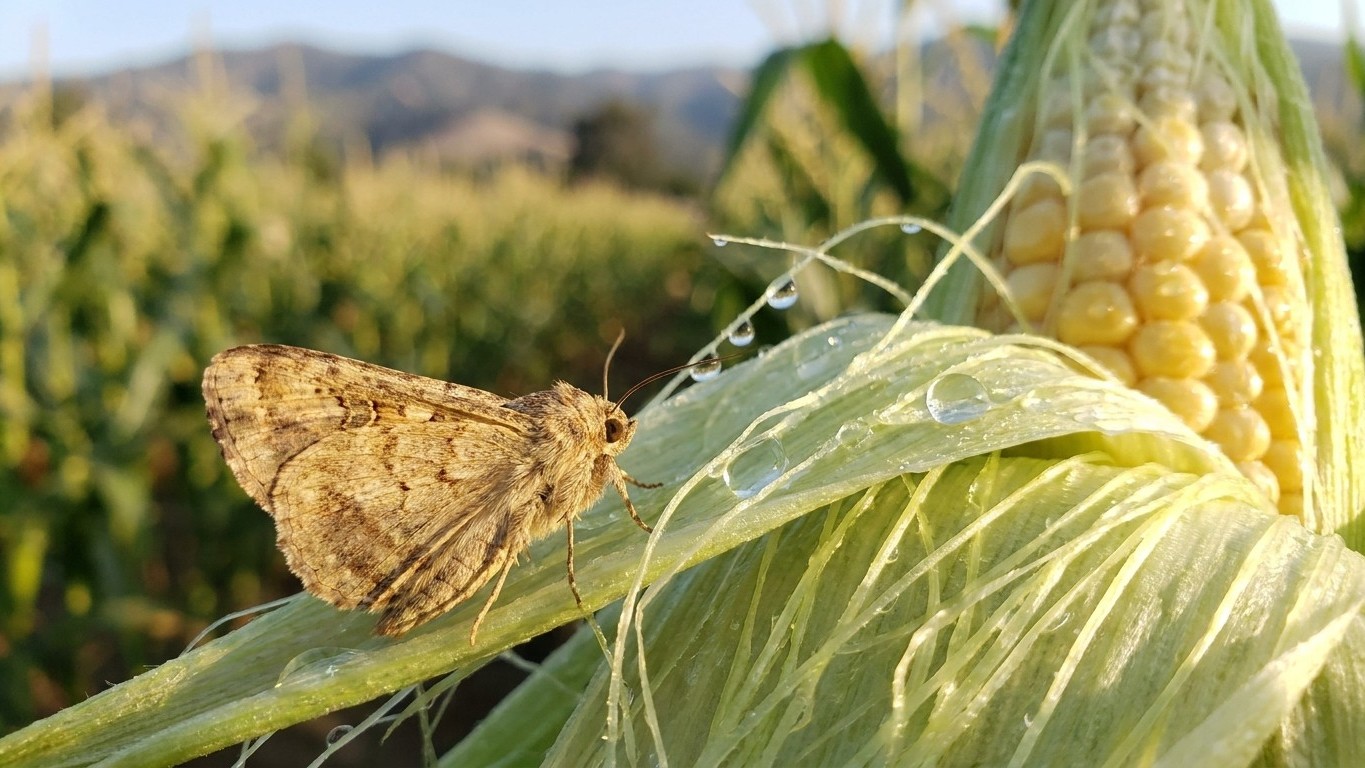

Four insects cause nearly all the documented corn damage in Georgia gardens: corn earworm, aphids, cutworms, and spider mites. Earworm hits the ear directly, arriving right as silks emerge. Cutworms attack seedlings within days of sprouting. Aphids and spider mites build up gradually as summer heat climbs, feeding on sap rather than tissue. None of them appear on a fixed calendar date, they track soil temperature, frost timing, and heat load instead.
Which pests attack corn in Georgia
UGA Cooperative Extension documents ten garden pests for this territory, but only four of them actually target corn. The rest belong to other crops entirely, and naming them here would be misleading.
- Corn earworm — the signature corn pest; larvae tunnel directly into the ear tip.
- Aphids — cluster on leaves and developing tassels, weakening the plant through sap loss.
- Cutworms — sever young seedlings at the soil line before the plant has a chance to establish.
- Spider mites — feed on leaf undersides, especially during long stretches of dry heat.
The other six pests on the UGA list don’t belong on a corn page. Colorado potato beetle targets potatoes and eggplant, not grasses like corn. Cowpea curculio is a pest of cowpeas and other southern peas. Melonworm and pickleworm are cucurbit specialists, drawn to squash and melon vines, not stalks. Mexican bean beetle, as its name suggests, sticks to bean foliage. Squash vine borer bores into squash stems, a completely different plant architecture than a corn stalk. Seeing any of these six in a garden bed is worth noting for whatever crop they’re actually feeding on, but they tell a gardener nothing about what’s happening to the corn planted a few feet away.
What matters for corn specifically is that the list is short. UGA Cooperative Extension documents four corn-relevant species for Georgia, and that’s the full picture this source provides. There’s no fifth insect waiting in the wings that simply didn’t make the list, if a gardener sees damage that doesn’t match one of these four, the next step is a call to the local extension office rather than a guess.
When each one shows up, and what it does first
Georgia’s last spring frost falls between March 11 and March 29 at the reference station, but that date doesn’t start the corn clock. Sweet corn needs soil above 60°F to germinate reliably, and that threshold arrives well after the frost has passed. Cutworms are the first threat once seedlings actually emerge from that warming soil. The first sign is blunt: a seedling snipped clean at ground level, sometimes toppled over with no chewing pattern on the leaves above. Because cutworms work at night and hide in soil during the day, the damage is usually discovered before the culprit is ever seen.
Aphids follow as the plant develops, and their arrival tracks less with a calendar date and more with heat. Georgia averages 35.8 days a year at 90°F or hotter, and that heat load is what pushes aphid populations upward. The first sign is a cluster of small, soft-bodied insects on the underside of leaves or around the base of developing tassels, often accompanied by a sticky residue on nearby foliage.
Corn earworm timing is tied to a different stage entirely: silk emergence. Moths lay eggs directly on fresh silks, and the larvae tunnel down toward the ear tip almost immediately after hatching. The first visible sign is often frass, a sawdust-like debris, pushed out at the tip of the ear where the silks have browned. Picking corn falls 17 to 24 days after silks first appear, which means earworm activity and the harvest window overlap almost exactly.
Spider mites show up during the driest, hottest stretch of the season, the same stretch driven by those 35.8 days above 90°F. Their first sign isn’t a visible insect at all but a fine stippling or bronzing on leaf surfaces, sometimes with faint webbing on the underside when populations are heavy. Drought-stressed plants are far more vulnerable than well-watered ones, which is why mite outbreaks often cluster in the same garden year after year if watering habits don’t change.
Telling the damage apart from everything else
Insect damage gets blamed for problems that have nothing to do with insects, and the mix-up usually costs a gardener a wasted trip to a garden center. The distinguishing signs matter more than the symptom itself.
| Symptom | Possible cause | What tells them apart |
|---|---|---|
| Seedling toppled, stem severed | Cutworm | Clean cut at soil line, no chewed leaves above |
| Seedling wilted but stem intact | Drought stress or transplant shock | Stem is soft or bent, not severed; soil is dry to the touch |
| Sticky residue, curled leaves | Aphids | Visible clusters on leaf undersides or tassel base |
| Yellowing between leaf veins | Nutrient deficiency | No insects visible; pattern is uniform across the plant, not clustered |
| Frass at ear tip, browned silks | Corn earworm | Sawdust-like debris pushed out at the very tip |
| Bronzed or stippled leaves | Spider mites | Fine webbing on leaf undersides, worse during dry heat |
| Torn or shredded leaves | Wind or hail damage | Damage appears suddenly after a storm, not gradually |
A gardener who spots yellowing leaves shouldn’t assume an insect is responsible before ruling out water and nutrients first. Checking soil moisture before reaching for anything else catches more false alarms than any other single habit. Disease also mimics insect damage closely, particularly leaf spot diseases that cause discoloration without any pest ever touching the plant. None of this replaces a proper look from someone trained to tell them apart. When the cause isn’t obvious from the table above, the local extension office is built for exactly that question.
What actually works here, and what is a waste of time
Timing beats treatment on a season as compressed as Georgia’s. Sweet corn needs 60 to 90 days from planting to harvest, and that whole window has to fit between soil hitting 60°F in spring and the first fall frost arriving between November 13 and December 1. A gardener who plants late and picks a slow-maturing variety is racing a clock that doesn’t leave much room for a second attempt if the first planting fails to pests or weather.
Physical barriers placed at planting time do more good than anything applied after damage appears. Collars around seedling stems block cutworms before they can do the one thing that kills a young plant outright. Once a stalk is a few inches tall and past that vulnerable stage, cutworm risk drops sharply on its own. For corn earworm, timing plantings so silks emerge outside the heaviest moth activity reduces exposure, though it doesn’t eliminate it, since moths are mobile and opportunistic. Watering consistently through the hottest stretch does more against spider mites than any treatment applied after webbing shows up, since drought-stressed plants are what mites prefer in the first place.
What doesn’t work is spraying on a fixed schedule regardless of whether a pest is actually present. This site doesn’t name products or active ingredients, because what’s legal and appropriate varies by state and changes over time; that decision belongs to the local extension service, which knows exactly what’s currently labeled for use in Georgia. Treating a nutrient deficiency as if it were an insect problem also wastes time and money, which is exactly why sorting out the actual cause first, using the distinguishing signs above, matters more than reaching for a solution before confirming the problem.
Where to check this for your own county
Everything above describes what’s documented at the state level by UGA Cooperative Extension, and state-level documentation doesn’t guarantee a match for any particular backyard. Pest pressure shifts across Georgia’s landmass: the coastal plain runs milder and holds heat longer into fall, while north Georgia and the mountains see frost several weeks earlier than the reference station used for the dates above. A garden in south Georgia might see corn earworm activity stretch later into the season than a garden near the mountains, simply because the frost that ends the season arrives at a different time.
The county extension office is the resource built for that gap between state data and a specific yard. Bringing an actual damaged leaf or ear, rather than just describing the symptom over the phone, gets a faster and more accurate answer. Extension agents see the same handful of corn pests repeatedly through a growing season and can often identify the cause on sight, something no general list can substitute for.
The next useful step isn’t more reading. It’s finding the extension office attached to the county where the corn is actually planted, since that office tracks what’s showing up locally in the current season, not what a state-wide document from a prior year recorded.
Common questions
Does every corn planting in Georgia get hit by earworm?
Not every planting, but earworm is the most consistently documented corn pest in the state, and pressure tends to be heaviest once silks emerge during the warmest part of the season.
Can cutworm damage happen after the seedling stage?
It’s far less common. Cutworms target young, tender stems, and once a stalk hardens past the seedling stage, the risk drops sharply.
Is spider mite damage reversible once leaves show stippling?
Affected leaf tissue doesn’t recover, but a plant can still produce a decent ear if the infestation is caught early and watering is corrected before damage spreads further.
Should sweet corn and other corn types be planted far apart?
The concern isn’t distance so much as timing. Sweet corn loses its sweetness if different sweet corn types tassel at the same time, so the practical fix is staggering plantings or choosing varieties that won’t tassel together, rather than measuring out a specific gap.