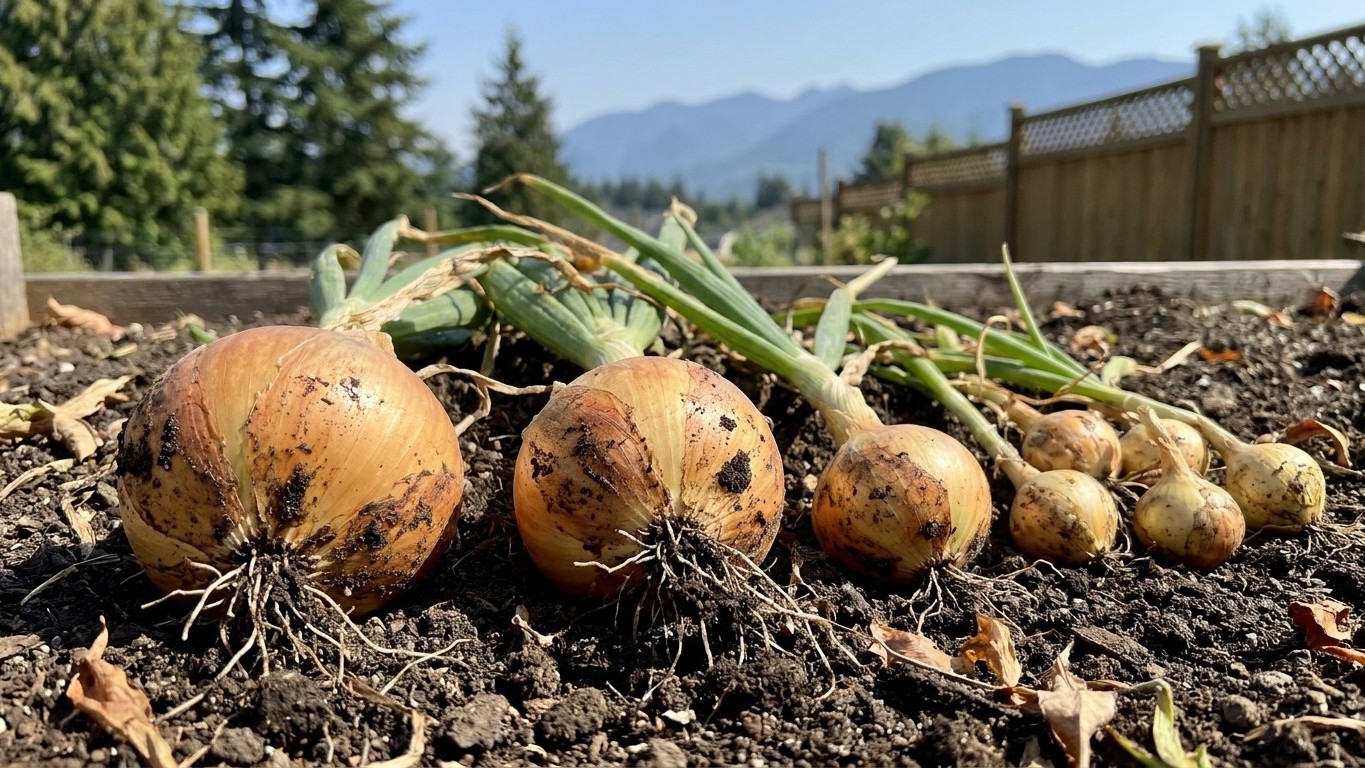

Georgia gardeners dealing with onion problems are working with a short list. UGA Cooperative Extension tracks only three insects on this crop with any regularity: aphids, cutworms, and spider mites. Cutworms hit first, right at transplanting, slicing seedlings at the soil line. Aphids follow as leaves fill out. Spider mites show up later, once the season turns hot and dry. Everything else people worry about in a Georgia vegetable patch usually belongs to a different plant entirely.
Which pests attack onion in Georgia
UGA Cooperative Extension documents ten pests it tracks across Georgia vegetable gardens: Aphids, Colorado potato beetle, Corn earworm, Cowpea curculio, Cutworms, Melonworm, Mexican bean beetle, Pickleworm, Spider mites, and Squash vine borer. That is the full state list this site draws from, and it is not a list built for any single crop. Only three of the ten actually feed on onion.
The rest are real problems, just not for this one. Colorado potato beetle is a nightshade specialist; it wants potato, eggplant, and tomato foliage, not the waxy, tubular leaves of an allium. Corn earworm targets corn ears and tomato fruit, structures an onion never produces. Cowpea curculio is built around southern peas and their pods. Melonworm and pickleworm both work cucurbit vines, cucumbers, squash, and melons, chewing leaves and boring into fruit that has nothing in common with a bulb crop. Mexican bean beetle, as the name gives away, feeds on bean foliage. Squash vine borer tunnels into squash and pumpkin stems, hollowing them from the inside, a feeding style that has no equivalent in an onion planting.
The three that actually matter
Aphids are generalists, and onions are on their menu along with dozens of other garden plants. They cluster on new leaf growth and around developing flower stalks, feeding on sap and leaving behind sticky honeydew that sooty mold grows on later.
Cutworms are soil-surface caterpillars that feed at night and hide by day, and they are not picky about which seedling stem they sever, onion transplants included. Spider mites are also generalists, thriving in hot, dry conditions and building populations fast on stressed onion foliage once summer heat sets in.
Anyone reading a pest label at a garden center and finding potato beetle or squash vine borer on it should recognize those products are aimed at different crops growing in the same yard, not at the onions themselves.
When each one shows up, and what it does first
Timing here follows the plant’s growth stage more than the calendar date. Cutworms do their damage in the window right after transplanting, while the stem is still thin and the roots haven’t anchored the seedling. The first sign is not a visible insect at all: it’s a seedling that stood up fine the evening before and is lying flat, severed cleanly at the soil surface, the following morning. Whole sections of a newly set row can disappear this way in a single night.
Aphids arrive next, as the surviving plants push out new leaf growth. The first sign is usually a cluster of small, soft-bodied insects tucked into the fold where a new leaf emerges, along with a faint stickiness on nearby foliage. Left alone, the colony grows, and sooty mold starts to darken the honeydew-coated leaves, which is often the symptom a gardener notices before spotting the insects themselves.
Spider mites show up later in the season, as onions move toward bulbing and the weather turns hot and dry. Georgia’s longest day tops out at 14 hours and 14 minutes, and bulbing in this climate is tied to that day-length threshold rather than to temperature, so by the time the plant is actively forming a bulb, the season has already turned toward the heat that mite populations favor. The first sign is a fine, pale stippling on the leaf surface, almost a dusty look from a distance, that thickens into bronzed, dried-out patches as feeding continues. A hand lens held to the underside of a leaf, or against a bit of fine webbing near the base, is usually how the diagnosis gets confirmed.
Read in sequence, the pattern is straightforward: a plant that vanishes at ground level is a transplant problem, sticky new growth is a colony problem, and dusty, bronzed leaves late in the season are a heat-and-drought pest problem.
Telling the damage apart from everything else
Onion foliage shows stress in a limited number of ways, and several unrelated causes can produce symptoms that look alike at first glance. Digging an inch of soil around a severed seedling settles the cutworm question before anything else does. A curled, grayish-brown caterpillar in the soil confirms the pest; an empty hole with no larva nearby usually means wind, hail, or a hoe did the damage instead.
| Symptom | Possible cause | What distinguishes it |
|---|---|---|
| Stippled, silvery or bronzed leaf surface | Spider mites, or plain heat/drought stress | Mite damage starts on a few plants and spreads outward, often with fine webbing near the leaf base; drought stress hits the whole bed evenly |
| Sticky leaves, small clustered insects on new growth | Aphids | The insects themselves are visible on close inspection; sticky residue with no insects present usually points elsewhere |
| Seedling cut off flat at the soil line overnight | Cutworms, or mechanical/wind damage | A larva found in the soil nearby confirms cutworm; a clean break with no larva suggests wind, hail, or tool damage |
| Uniform yellowing or thin growth across the row | Nutrient deficiency or watering issue | Even distribution across the whole planting, with no visible pests or feeding residue on individual plants |
None of this replaces a local look at the actual plants. A photo and a soil sample, or the wilted seedling itself in a plastic bag, are the kind of thing a county extension office can examine directly, which is a step better than guessing from a symptom list.
What actually works here, and what is a waste of time
A cutworm collar pushed an inch into the soil around each transplant at planting time stops the damage before it starts. Cardboard, a cut section of paper cup, or any stiff barrier that rings the stem and sits slightly below and above the soil line blocks the caterpillar from reaching the seedling. Put in place after the fact, once seedlings are already down, it does nothing; the barrier only works as prevention.
For aphids, a strong jet of water on the undersides of leaves and around new growth knocks colonies back without disturbing the rest of the bed, and it’s worth trying before reaching for anything stronger, since aphid populations in a home garden often collapse on their own once predatory insects find them. Broad-spectrum treatment aimed at a light aphid presence tends to remove those predators along with the aphids, which is part of why mite problems often follow right behind an unnecessary spray.
Spider mites are, in fact, the clearest case of a treatment doing more harm than good. Waiting until leaves are visibly bronzed before acting means the population has already exploded, and broad insecticide applications at that point tend to kill off the mites’ natural predators faster than the mites themselves, letting the outbreak rebound worse than before. Checking leaf undersides regularly during hot, dry stretches, and addressing water stress on the plants themselves, does more than any spray applied late.
This site doesn’t name specific products or active ingredients, because what’s legally labeled for home garden use changes and varies by state. That decision belongs with the county extension office, not a general gardening article.
Where to check this for your own county
Everything above comes from state-level tracking by UGA Cooperative Extension, and a state list describes what’s been documented across Georgia as a whole, not what’s actually present in any one backyard. A pest documented for the state does not mean it’s active in a given county this year, and the reverse is also true: local conditions, soil, prior plantings, and even the specific week of a wet or dry spell can push a pest problem earlier or later than what a general list suggests.
The county extension office is the resource built for that gap. Staff there can look at a photo, examine a soil or plant sample, and give an answer specific to conditions on the ground that week, something a statewide pest list was never designed to do. They also know which controls are currently labeled for use in Georgia, which changes over time in ways a static article can’t track.
For a gardener finding cut seedlings, sticky leaves, or bronzed foliage right now, the next move is straightforward: pull a sample, take a clear photo, and call or visit the local county extension office rather than guessing from a list of symptoms alone.