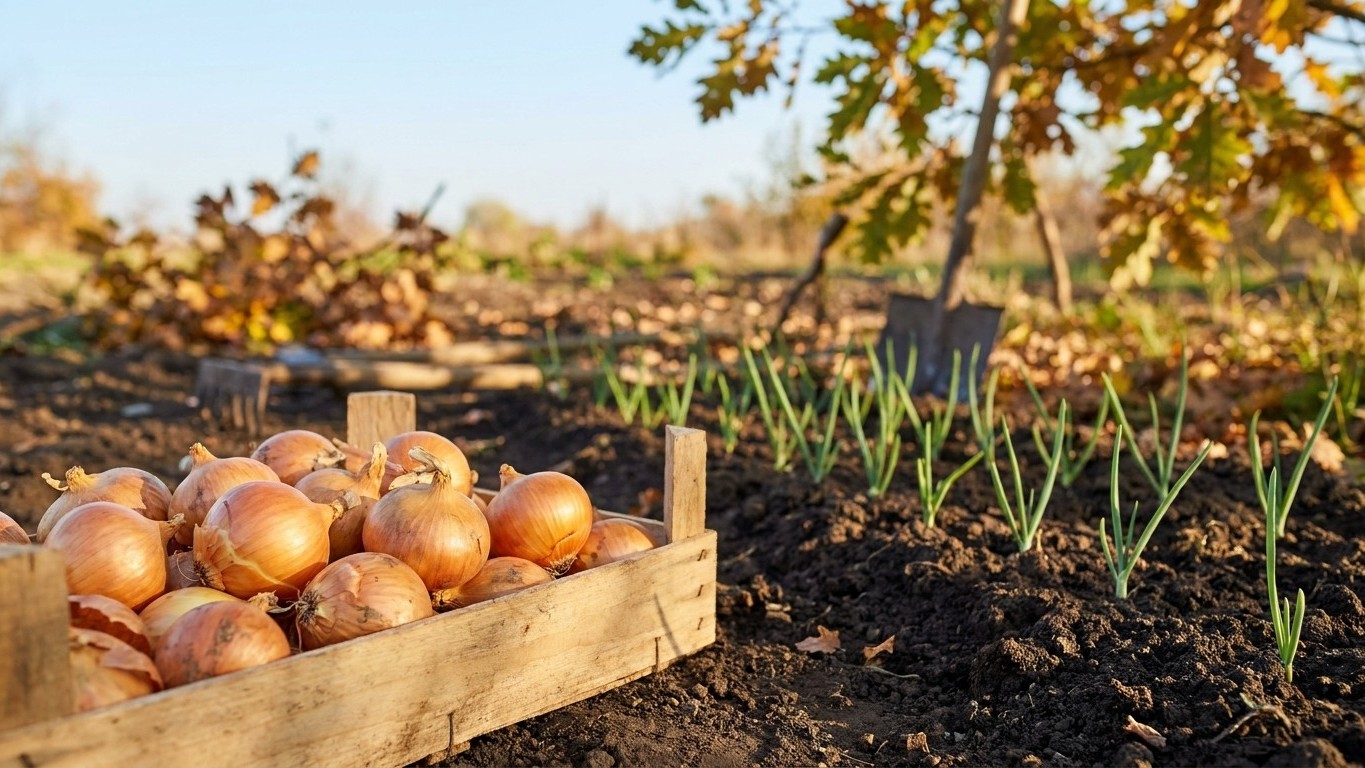

Georgia gardeners plant onions in fall, not late winter, and the reason has nothing to do with frost. At the reference latitude of 33.63°N, the longest day of the year brings just 14 hours and 14 minutes of daylight, enough to trigger bulbing in short-day and intermediate-day onions, but never enough for the long-day types northern gardeners grow. That single number decides both the planting window and the variety list.
The short answer for Georgia

Onions respond to day length, not to soil temperature or the calendar month on a seed packet. At 33.63°N, the summer solstice delivers 14 hours and 14 minutes of daylight. Short-day onions start bulbing once the day reaches about 12 hours, so they’ve already begun forming a bulb well before Georgia’s longest days arrive. Intermediate-day types wait a little longer, but they’re still comfortably inside the range this latitude reaches every summer.
That’s why the planting season here runs opposite to what a gardener in Minnesota or upstate New York would do. Georgia’s winters are mild enough that onion sets or transplants can go into the ground in autumn, usually starting in October and running through November depending on region, and spend the cold months building root and leaf growth before the days lengthen again. By the time spring day length climbs past the 12-hour mark, the plant already has size on it, and that stored growth becomes bulb.
Farther north in the country, where winters kill young onion plants outright, gardeners have no choice but to wait until late winter or early spring to set transplants, racing to build leaf growth before the long summer days force bulbing regardless of size. Georgia skips that race. The mild winter is an advantage here, not an obstacle, and it’s the entire reason the planting calendar looks different from a garden three states north.
So the short answer: plant short-day or intermediate-day onions in the fall, let them overwinter, and let the increasing daylight of spring finish the job the plant already started. Anything planted here expecting a long-day trigger simply won’t get one, no matter how good the soil or how much fertilizer goes into the bed.
What will not work here
Planting a long-day onion in Georgia doesn’t produce a smaller bulb. It produces no bulb at all. Long-day varieties are bred to wait for 14 to 16 hours of daylight before they’ll start converting leaf growth into a bulb, and Georgia’s longest day tops out at 14 hours and 14 minutes, which is at the very bottom edge of that range or below it entirely for most long-day types. The plant keeps making leaves all summer, gets no signal to stop, and then rots in the ground or in storage without ever forming the onion the gardener was waiting for.
Based on published latitude ranges, the following varieties are listed for latitudes above 33.63°N and will not bulb reliably in a Georgia garden:
- Ailsa Craig (long-day, 38-60N): needs day lengths far beyond what Georgia’s summer provides.
- Barolo (long-day, 38-55N): bred for latitudes well north of the Georgia line.
- Blush (long-day, 38-55N): same threshold problem as Barolo.
- Frontier (long-day, 40-50N): requires day length Georgia never reaches.
- New York Early (long-day, 38-50N): a northern-climate variety by design.
- Patterson (long-day, 38-55N): storage-focused type built for shorter growing regions.
- Powell (long-day, 43-47N): needs a narrow, far-northern day-length window.
- Red Carpet (long-day, 40-45N): another variety with a threshold Georgia can’t clear.
- Red Long of Florence (intermediate-day, 38-50N): despite the intermediate label, its published range starts well north of 33.63N.
- Redwing (long-day, 43-65N): built for the far north, not the Southeast.
- Rossa di Milano (long-day, 38-50N): same story as the other long-day types on this list.
- Safrane (long-day, 42-50N): requires day length Georgia summers don’t offer.
- Talon (long-day, 42-50N): another far-north long-day type.
There’s a second, quieter way this problem shows up even among varieties that can bulb here: planting late. A short-day or intermediate-day onion doesn’t wait for the gardener to catch up. It bulbs the moment day length crosses its threshold, using whatever leaf and root growth it has at that point. Set transplants out three or four weeks behind schedule, and the plant simply bulbs smaller. It doesn’t harvest later. It harvests the same week as everything else, at a fraction of the size.
What changes across Georgia
Georgia isn’t one climate. The state stretches from roughly 30.5°N near the Florida line up to about 35°N at the Tennessee border, a span of nearly five degrees of latitude. The 33.63°N figure used above belongs to a weather station in the north-central part of the state, which puts most of the Piedmont and metro region close to the reference point. Gardeners near the coast or deep in south Georgia sit a degree or more south of that, while anyone gardening in the north Georgia mountains sits a degree or more north.
| Region | Approximate latitude | What it changes |
|---|---|---|
| South Georgia (near Florida line) | ~30.5°N | Slightly less summer daylight than the reference point; short-day varieties bulb reliably, and fall planting can often start a bit later since winters run milder still. |
| Reference point (central Georgia) | 33.63°N | 14h14 of daylight on the longest day; the baseline for this page’s short-day and intermediate-day recommendations. |
| North Georgia (mountains, near Tennessee line) | ~35°N | Slightly more summer daylight than the reference point; intermediate-day varieties near the 35N edge of their published range become more likely to bulb well, and some varieties normally considered marginal further south fit more comfortably here. |
That five degrees matters more than it sounds. A handful of varieties fall into what’s genuinely a blurred zone at this latitude, since published ranges are a continuum rather than a hard cutoff. Bridger (long-day, 35-50N), Cabernet (intermediate-day, 35-45N), Calibra (intermediate-day, 35-45N), Monastrell (intermediate-day, 35-46N), Red Long of Tropea (intermediate-day, 35-48N), and Walla Walla Sweet (long-day, 35-55N) all list a lower bound right around 35°N. For a gardener in the far north Georgia mountains, these may bulb; for a gardener near Macon or the coast, they’re a poor bet. Anyone near either edge of the state should treat the numbers above as a starting point, not a guarantee, and check their own coordinates before choosing seed.
Sweet now, or onions that last
Georgia’s climate pushes gardeners toward sweet onions almost by default, and that’s a chemistry problem as much as a taste preference. The compounds that give an onion its sharp bite are volatile sulfur compounds, and those same compounds double as the onion’s natural defense against rot in storage. Fewer of them means a milder onion on the cutting board today, but a shorter shelf life in the pantry. More of them means tears while chopping, and an onion that’s still good in March.
Short-day and intermediate-day types, the ones that actually bulb at Georgia’s latitude, tend to run lower in these sulfur compounds than the long-day onions grown farther north. That’s not a flaw in the varieties; it’s a direct consequence of the growing conditions that produce them. Georgia’s own famous sweet onion crop, grown around Vidalia in the southeastern part of the state, is the clearest regional example of this trade-off in action: prized for eating fresh, not for lasting through winter.
A Georgia gardener planning a harvest for fresh eating through fall and early winter is working with the climate, not against it. But anyone hoping to fill a pantry with onions that last into spring needs to understand the ceiling this creates. Long-day onions from a northern garden might still be sound in March. A short-day Georgia harvest, picked in late spring or early summer, is realistically eaten, cooked, or given away well before then, since it was never bred to outlast the sulfur compounds it doesn’t have.
Checking this against your own garden
Before committing a bed to a specific variety or a specific planting week, it’s worth confirming a few things locally.
- Look up your own latitude if you’re gardening well north or south of central Georgia; a degree or two shifts which day-length group actually fits.
- Check your local average first and last frost dates rather than assuming a statewide date applies to your yard.
- Call or visit your county extension office, which tracks soil and climate conditions specific to your area and can confirm planting windows down to the county level.
- If you’re near the state’s northern edge, weigh whether a blurred-zone variety like those listed above is worth the gamble versus a variety with a published range that clearly covers your location.
- Note your garden’s microclimate, since a south-facing slope or a low frost pocket can shift effective timing by a week or more even within the same county.
The Moon calendar is a separate, older custom: see when to plant onions by the moon, written as tradition rather than fact.