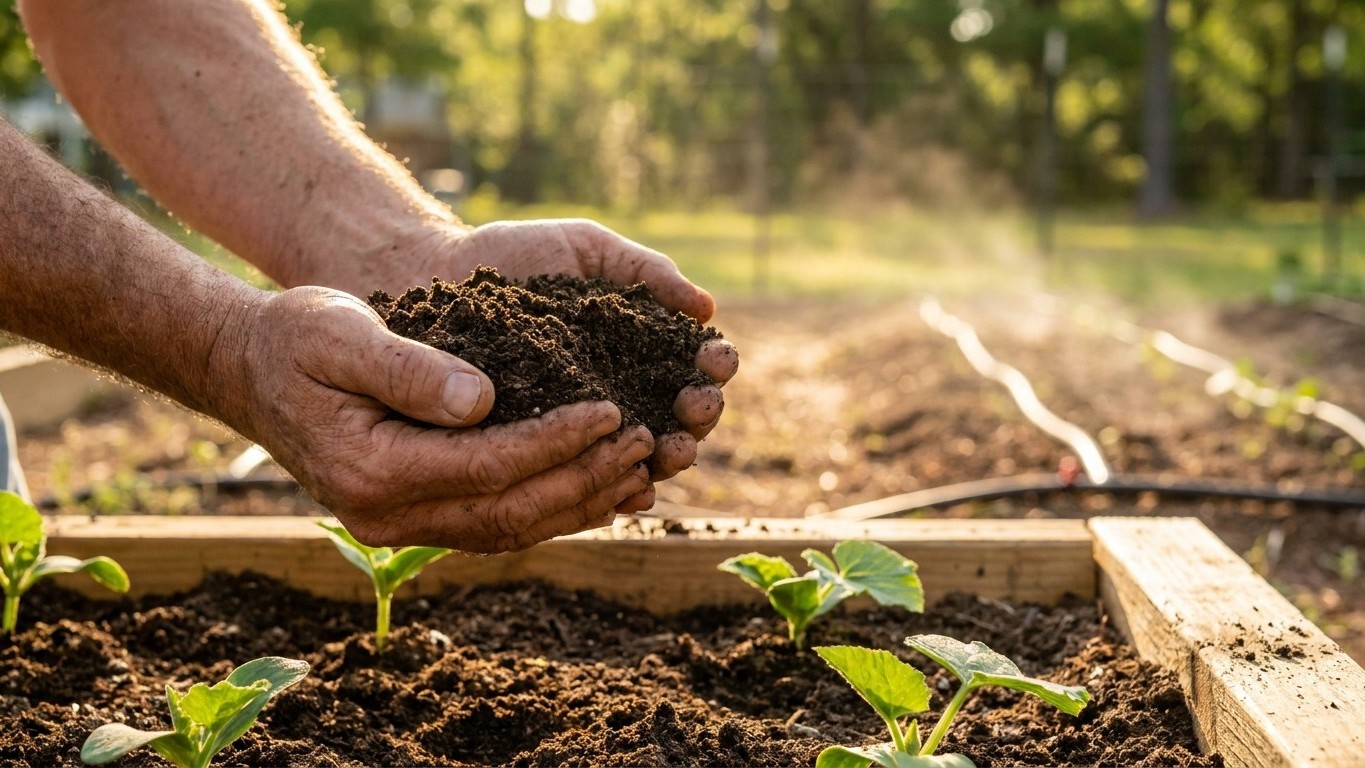

Summer squash goes into North Carolina ground once soil, not just air, has warmed past that spring frost risk. At the Piedmont reference station, that means transplanting or direct-seeding from late March into early April, but a Blue Ridge garden or a coastal plain bed will run on a different clock entirely.
When the soil is warm enough in North Carolina
NOAA’s 1991-2020 climate normals put the Piedmont’s last spring frost, the 32°F freeze with a 30 to 70 percent chance of occurring, somewhere between March 23 and April 5, based on the Charlotte station record. That’s the frost window as measured, and it shouldn’t get rounded to “early April” or nudged toward a friendlier date. It’s also worth saying plainly: a frost date is a probability, not a promise. Some years the last freeze lands well outside that band, in either direction.
Frost is a useful marker because it’s the number every almanac and seed packet prints, but it’s a proxy for the thing that actually matters to summer squash: soil temperature. These plants germinate and root poorly in cold ground, and a soil thermometer pushed a few inches down will tell you more than the calendar does. Soil warms on a lag behind air temperature, often by a week or two after the frost risk has cleared, especially in clay-heavy Piedmont ground that holds cold longer than sand does. Waiting until the soil itself feels workable and warm to the touch, rather than racing the frost date, is what keeps young squash from sulking in place for weeks.
Why location inside the state changes the date
The Charlotte numbers describe the Piedmont. North Carolina’s geography stretches from sea level to well over a mile high, and that spread bends the frost calendar hard in both directions.
| Region | How it compares to the Piedmont date |
|---|---|
| Coastal plain | Last frost tends to arrive earlier, milder maritime air holds off the hardest freezes |
| Piedmont (Charlotte reference) | March 23 to April 5, per NOAA normals |
| Blue Ridge mountains | Last frost runs several weeks later, elevation keeps cold air pooling into spring |
A gardener in the mountains who plants on the Piedmont’s schedule risks losing tender seedlings to a freeze that’s already passed a hundred miles east. This is exactly the kind of local variation that a soil thermometer and a call to the county extension office settle faster than any statewide date ever could.
How long the season lasts here
Run the two ends of the frost calendar together and North Carolina’s frost-free window comes out to roughly 217 to 221 days, depending on which edge of each range you use: from the earliest last-frost date of March 23 to the earliest first-fall-frost date of October 30 spans 221 days, while the later pairing of April 5 to November 8 spans 217. Either way, that’s close to seven months of frost-free ground, drawn from the same Charlotte-station normals covering 1991-2020.
A window that long changes the math on planting. Seven months is enough room to sow summer squash early, harvest through the first heat of summer, then pull tired plants and start a second round in mid-summer for a fall harvest before the November frost closes things out. That’s not guesswork; it’s simple arithmetic against the frost dates NOAA publishes for the region. Squash plants also decline after eight to ten weeks of heavy picking, so a long season isn’t just about avoiding frost, it’s about having enough calendar left to replace worn-out plants with fresh ones.
What a shorter local season changes
Not every North Carolina garden gets the full 217-plus days. A mountain garden with a late last frost and an earlier fall frost than the Piedmont figure will see a noticeably tighter window. In that situation, the first sowing often has to be the only one, which raises the stakes on getting it right: starting seedlings indoors and transplanting them out becomes worth the trouble, since a purchased or homegrown transplant buys back two or three weeks that direct-seeding would spend on germination alone. Where the season stretches longer, direct-seeding a second round in place is usually simpler than juggling a fresh set of transplants.
Anyone weighing whether their local window supports two sowings, or just one done well, should work through the succession sowing guide on this site, which lays out the timing math in more detail than frost dates alone can.
Heat and water in North Carolina
Charlotte’s normals show 35.0 days a year at or above 90°F, a heat load that lands squarely in the range where summer squash starts to struggle. Pollen loses viability fast once daytime highs push into the high 90s, and a plant that flowers heavily during a hot stretch can drop blossoms or set fruit poorly even while the vines look healthy. That’s not a disease or a pest problem; it’s heat doing exactly what heat does to short-lived pollen.
Squash leaves are enormous relative to the plant’s root system, and on a 90-plus-degree day they lose water through those leaves faster than a comparatively shallow root plate can pull it back from the soil. Summer rainfall at the same reference station averages about 12.1 inches across June, July, and August, with July the driest of the three at 3.74 inches, June at 3.99, and August at 4.35. That’s a moderate summer rainfall total, not a drought-level one, but it rarely arrives as steady, gentle moisture. Much of it lands as thunderstorms that dump water fast and run off before it soaks in, especially on compacted or clay-heavy ground.
Reading the numbers against your own soil
Thirty-five hot days and a middling rainfall total together mean irrigation planning matters more in a North Carolina garden than the rainfall figure alone suggests. Sandy coastal-plain soil drains that same inch of rain within a day, while Piedmont clay can hold it for a week, so two gardens under identical weather can need completely different watering schedules. Afternoon shade over the root zone, mulch to slow evaporation, and a rain gauge on the actual plot (rather than trust in the regional average) are what turn these normals into a workable routine. None of this describes a punishing desert climate; it describes a summer where the heat and the rain arrive unevenly, and the gardener has to smooth that out by hand.
Which summer squash suit North Carolina
Match the type of squash to what this state’s calendar and climate actually hand a gardener, rather than to a name on a seed rack. A shorter local season, the kind found at higher elevation where frost lingers into spring, rewards the earliest-maturing types, since they leave enough of the frost-free window for a second sowing or at least a full harvest before fall frost arrives. Where the season runs the full seven-month Piedmont length, maturity speed matters less than stamina through the hot middle stretch.
The 35 days a year above 90°F push heat tolerance and airflow to the top of the list. Vining or bush types planted with real space between them, rather than crowded together, dry out faster after a thunderstorm and hold up better through a hot stretch than plants packed tight. Humidity from that same summer rainfall, arriving as it does in bursts rather than steady drizzle, makes disease resistance, particularly against powdery mildew, a practical first filter rather than a nice-to-have.
None of that adds up to a specific variety name, and this page won’t invent one. Cultivar performance shifts from one seed lot and one season to the next, and the trials that actually mean something happen at the state level, not on a general gardening page. North Carolina State Extension runs exactly those trials across the state’s coastal, Piedmont, and mountain regions, comparing squash types under North Carolina’s own heat, humidity, and disease pressure. That’s the source worth checking before buying seed, because it reflects a hardiness range of 5b to 8b across the state, per the USDA Plant Hardiness Zone Map, meaning a variety proven in the mountains isn’t automatically the right pick for the coastal plain. Sending the reader there isn’t a dodge; it’s the only recommendation this page could make that would actually hold up in their specific garden.