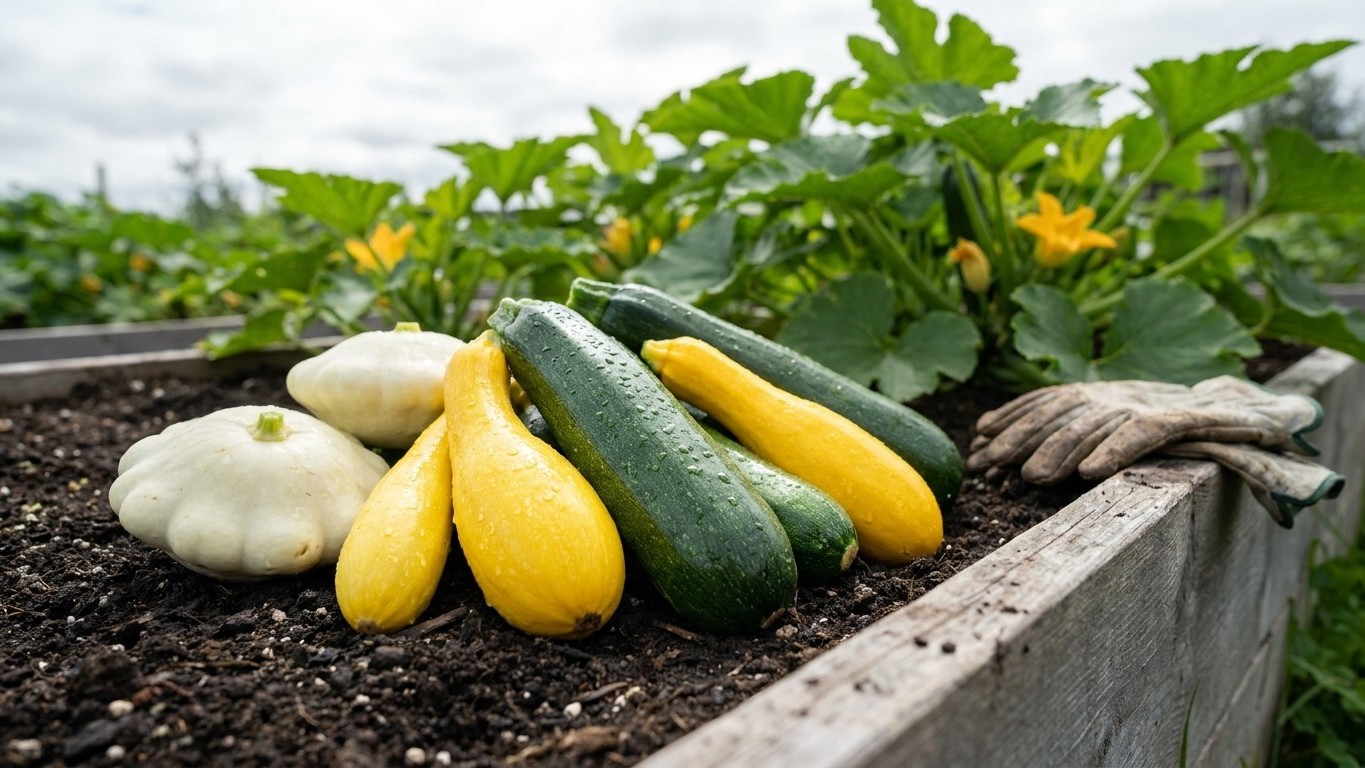

Arizona’s answer depends entirely on where you garden. In the low desert around Phoenix, heat tolerance and a short time to maturity beat everything else, since summer temperatures shut down pollination for months. Bush zucchini, yellow crookneck and pattypan varieties bred for quick harvest work best, planted to dodge the worst heat rather than endure it.
The short answer for Arizona
Frost is not the problem here. NOAA’s 30-year record for the Phoenix reference station shows 32F showed up in only 6 of 30 springs, and the frost-free season runs a full 365 days. That number alone tells you something most planting guides get backwards: in low-desert Arizona, the calendar is not built around a last-frost date. It is built around a heat shutdown.
The station averages 168.9 days a year at or above 90F. That is the fact that should drive variety selection. Squash pollen loses viability and blossoms drop when daytime highs sit consistently in the 95F to 100F-plus range, which in Phoenix starts as early as May and does not let up until September. A summer squash variety with a long, leisurely fruiting window simply runs out of usable days before that heat block arrives, or it sits dormant through the middle of the season waiting for temperatures to drop again.
The decision, then, is by type and by days-to-maturity, not by frost tolerance. Bush-type zucchini and yellow crookneck varieties bred for fast production, generally in the 45 to 50 day range, fit a narrow spring window before the heat load climbs and a second narrow window in late summer once it starts to break. Compact scallop and pattypan types work the same way and take up less bed space while they’re at it, which matters when you’re planting twice in one year rather than once.
Sprawling, vining summer squash varieties that need a longer, steadier season to hit peak production are a poor match here. They’re built for regions with a single long growing stretch, not two short ones bracketing a heat wall. If the goal is a reliable Arizona harvest, the variety needs to sprint, not cruise.
This also means Arizona gardeners often get two separate summer squash crops rather than one continuous one: an early sowing timed to finish before the 90F-plus days pile up, and a second sowing once that heat load starts to ease in late summer. Fast varieties make both windows workable. Slow ones make neither.
What will not work here
Start with the number that breaks most transplanted garden advice: 168.9 days a year at or above 90F. That is nearly half the calendar year spent at temperatures where squash blossoms abort and pollen goes sterile. A variety selected because it did well in a cooler, shorter-summer state will often flower heavily in Arizona and set almost no fruit during the peak months, because the heat itself, not the plant’s health, is stopping pollination.
Long-season vining varieties are the clearest failure case. If a variety needs 60-plus days of steady fruiting to hit its stride, it collides directly with the heat block. It might survive the summer as a plant, green and sprawling, but the harvest gap in the middle of the season can stretch for weeks with almost nothing to show for it. That’s not a disease problem or a watering mistake. It’s a mismatch between the plant’s clock and the region’s thermometer.
Water is the second failure point
Summer rainfall across June, July and August averages about 1.9 inches total, and June itself averages just 0.02 inches, essentially nothing. A watering routine that assumes even occasional rain will carry a squash bed through summer is a routine built for somewhere else. Squash roots are shallow and thirsty, and combined with 168.9 days of 90F-plus evaporation pressure, a plant left to rain-fed watering in a Phoenix-area June will wilt and stall regardless of variety. This is an irrigation-dependent garden for most of the growing season, not a rain-dependent one.
Even July and August, the wetter summer months at roughly 0.91 and 0.93 inches respectively, deliver that moisture mostly as brief, intense monsoon storms. Water that arrives all at once on hot, often compacted or sandy desert soil tends to run off rather than soak in deeply, so the total rainfall figure overstates how much actually reaches squash roots. A variety that needs consistent, even soil moisture to avoid blossom-end rot or splitting will struggle here regardless of how heat-tolerant its foliage is, unless watering is scheduled by hand rather than left to the sky.
What changes across Arizona
Arizona is not one growing climate, and the numbers make that obvious fast. The state’s USDA hardiness zones span 4b to 10b, one of the widest ranges of any state in the country, built on the average annual extreme minimum temperature. That spread runs from low-desert conditions around Phoenix, where a hard freeze is a rare event, to high-country terrain near Flagstaff and the northern plateau, where winters are genuinely cold and the growing season is short by comparison.
What that means for summer squash choice is close to a reversal of the low-desert advice above. In the high country, the limiting factor is not 168.9 days of 90F-plus heat killing pollination, it is a shorter frost-free window and cooler summer nights that slow fruit development. A gardener at higher elevation may find that a fast, heat-dodging bush variety still performs well, simply because most short-season squash varieties are also compact and quick, but the reason for choosing it flips entirely: it’s about beating an early fall frost, not dodging a summer heat wall.
Given a 4b to 10b range packed into one state, there is no single Arizona answer to “when do I plant” or “how much water does this need.” A recommendation dated to Phoenix’s frost-free, heat-dominated pattern would badly mislead a gardener working a mountain-elevation plot with real winter freezes and a much shorter window. This page can only speak to the pattern, not pin a single zone number onto every reader.
Rather than guess which of those zones applies to a given yard, the more reliable move is checking the current USDA Plant Hardiness Zone Map directly for the specific location, since elevation changes within short distances can shift the zone number noticeably in Arizona’s mountain and high-desert terrain.
Where to check this for your own county
Everything above describes Arizona as a whole, built from a single reference station’s data. That is useful for understanding the pattern, but it is not a substitute for what your specific county has actually tested. The University of Arizona Cooperative Extension, at extension.arizona.edu, is the place to look for that finer detail, and it’s worth treating as a required stop rather than an optional one.
Two things to look for once there. First, a county-level planting calendar rather than a statewide one. Maricopa County’s low-desert calendar and a calendar built for a Coconino County high-elevation garden will not look alike, and the extension office typically breaks these out separately because the growing conditions genuinely differ that much within the state. Second, look for variety trial results or recommended-variety lists specific to your county’s agricultural extension office. Local extension agents often test summer squash varieties against local heat, soil and pest pressure, and their picks can differ meaningfully from a generic seed catalog recommendation written for a national audience.
A county recommendation beats a state one, plainly. This page describes what the statewide numbers, the 168.9 days above 90F, the roughly 1.9 inches of summer rain, the 4b to 10b zone spread, mean for Summer Squash in general terms across a state with wildly different microclimates. Your county extension office translates that into something calibrated to your actual soil, elevation and local pest pressure, which is a level of precision no statewide page can honestly claim to offer. If the two disagree on a detail, like the ideal planting window or a specific variety pick, defer to the county source.
Checking this against your own garden
Every fact in this article comes from 30-year averages at one reference station. Your own yard is not an average, and three simple observations will tell you more about your actual planting window than any calendar date.
Feel the soil before you trust the thermometer. Squash seed wants warm soil to germinate reliably, and a quick hand-check, pushing a couple of inches down at midday, tells you whether the bed has actually warmed through or is just warm on the surface from direct sun. Cold soil that feels warm on top is a common trap in Arizona’s intense daytime light.
Watch for the first flush of male flowers. Squash plants reliably produce male blossoms first, often by a couple of weeks, before the female flowers with the tiny fruit swelling behind the petals show up. Seeing only male flowers for a stretch is normal, not a failure, but a long gap before females appear can be a signal that heat stress or uneven watering is delaying fruit set in your particular spot.
Note when the first true leaves appear, the second set that shows up after the initial seedling leaves. Slow, stunted true-leaf growth in a bed that should be past its warm-up point often points to a local microclimate issue, a shadier corner, compacted soil or wind exposure, that the county averages simply can’t capture. Your plant’s own pace is the most current data you have.