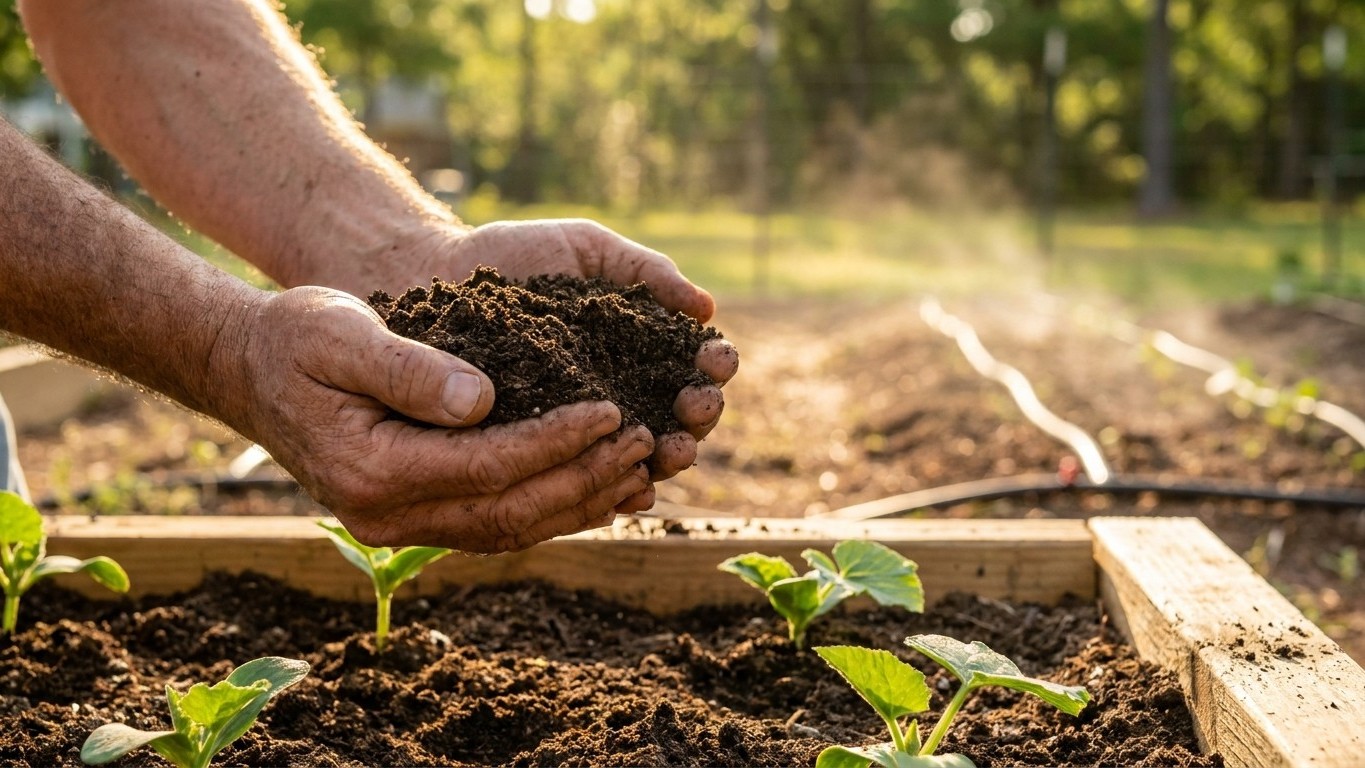

Arizona’s low desert almost never sees a killing frost, so the planting question isn’t “when does spring arrive” but “when does the ground stay warm enough, and how fast can a squash plant finish before summer heat shuts pollination down.” That reframe changes everything about scheduling this crop here, from the low desert around Phoenix to the pine country near Flagstaff.
When the soil is warm enough in Arizona
Most gardening guides tell you to count backward from the last spring frost. In the Arizona low desert, that date barely exists. At the reference station used for these normals (Phoenix, station USW00023183), NOAA’s 1991-2020 climate data shows a 32F freeze occurred in only 6 of the last 30 springs, and NOAA lists the frost-free season at that station as a full 365 days. When a cold snap does show up, it lands between late December and mid-January, not in a tidy “spring frost” window at all.
That single fact should stop anyone from building a frost-based planting calendar for the low desert. Frost is a proxy for soil warmth everywhere else in the country; here it’s barely a variable. The real question is whether the soil has warmed enough for squash seed to germinate reliably (summer squash wants genuinely warm ground, not just frost-free ground) and whether you can get a plant through flowering before the heat itself becomes the limiting factor. Soil temperature lags behind air temperature by a few weeks in spring, so even in a place with no frost risk, jumping the gun on a cold February soil often costs more time than it saves through rot and weak germination.
One state, several climates
Arizona spans USDA Plant Hardiness Zones 4b through 10b, built on the average annual extreme minimum temperature. That is an enormous range for one state. The low desert around Phoenix sits at the warm end and essentially never freezes hard. Flagstaff and the high country sit at the cold end, and they do freeze, sometimes severely, on a schedule that looks nothing like what’s described above. If you garden in the high country, the frost-based approach that doesn’t apply to Phoenix applies squarely to you, and the numbers here won’t help you set a date.
Because the range is this wide, a single statewide planting date is close to useless. The University of Arizona Cooperative Extension (extension.arizona.edu) publishes county-level guidance and keeps track of which squash types have performed well in local trials. That’s the resource worth checking before seed goes in the ground, especially if you’re outside the low desert.
How long the season lasts here
Here’s where Arizona breaks the usual math. In most of the country you subtract the last spring frost date from the first fall frost date and get a season length in weeks. At the Phoenix reference station, both of those dates are effectively absent: NOAA records no reliable spring or fall freeze in most years, and lists the frost-free season as 365 days. There’s no gap to subtract because there’s almost no cold to define the edges.
That doesn’t mean squash grows year-round without interruption, though. A frost-free calendar of that length allows something most gardeners never get to try: two separate squash seasons in one year, planted around the heat rather than around the cold. The first sowing goes in once the soil has warmed in spring, aiming to set and finish fruit before the worst of summer arrives. The second goes in later, timed so the plants flower after the peak heat has broken but while there’s still enough warm season left to mature a crop before whatever mild cold does eventually show up in December or January.
This is the opposite problem from a short-season northern garden, where a single sowing is often the only shot and transplanting (to save a few weeks) makes real sense. In Arizona’s low desert, the near-absence of frost means the calendar isn’t the constraint. Heat is, and it closes a window in the middle of summer rather than at the edges of the year. Gardeners who plan for two sowings, rather than one long continuous crop, tend to get more usable fruit out of the year here. For the mechanics of staggering plantings so you’re not left with a gap or an overlap, the succession sowing guide on this site walks through the timing logic in more detail.
Anyone gardening in the higher elevations should treat this section as describing a different place. Flagstaff’s frost dates are real, seasonal, and limiting in the conventional sense, and a two-season approach built around desert heat doesn’t translate there.
Heat and water in Arizona
The number that matters more than frost, in this state, is 168.9. That’s the average number of days per year the Phoenix reference station reaches 90F or higher, based on NOAA’s 1991-2020 Climate Normals. Spread across a year, that’s roughly five and a half months where daytime highs are in a range that starts to work against summer squash rather than for it.
Squash pollen loses viability fast once temperatures push into the high 90s and beyond, which is routine, not exceptional, in a Phoenix summer. Flowers can open, look healthy, and still fail to set fruit because the pollen simply didn’t survive long enough to do its job. At the same time, squash carries some of the largest leaves of any common garden vegetable, and that leaf area loses water through transpiration at a rate a shallow, spreading root system struggles to keep up with once afternoon temperatures climb. The combination (heat-damaged pollen above, water-stressed roots below) is what actually stalls fruit production here, not cold.
Rainfall doesn’t rescue the situation. Summer rain at the reference station totals about 1.9 inches across June, July and August, out of roughly 7.2 inches for the entire year. June is nearly bone dry at nine hundredths of an inch on average, and the monsoon pattern that follows delivers 0.91 inches in July and 0.93 in August, typically as short, intense thunderstorms rather than steady soaking rain. Rain that arrives that way tends to run off hard-baked desert soil instead of sinking in, so the seasonal total overstates how much water actually reaches the root zone.
In practice, that combination of heat load and thin, erratic summer rain means irrigation isn’t an optional boost here, it’s the deciding factor in whether a planting survives July at all. Deep, consistent watering scheduled for early morning, along with afternoon shade over the hottest weeks, are the two practices growers in the low desert rely on to get plants through the worst stretch rather than losing them to heat stress before the second sowing even has a chance.
Which summer squash suit Arizona
Given everything above, the type of summer squash that suits Arizona best isn’t defined by days-to-maturity the way it would be in a short northern season. It’s defined by how well a plant tolerates heat stress at flowering and how well its root system holds up under an irrigation schedule rather than natural rainfall.
That points toward types bred or selected for heat tolerance and reliable fruit set under high temperatures, since pollen viability is the weak link identified above. It also favors types that respond well to being grown with some afternoon shade and consistent deep watering, since the leaf-to-root water balance is the second weak link. Where a brief monsoon humidity spike follows a dry June, disease resistance (particularly against powdery mildew, which can appear even in a mostly arid climate once humidity ticks up during storm season) becomes a real consideration too, more than it would in a drier, more stable summer elsewhere.
What this page won’t do is hand over a specific variety name. Doing that without local trial data would be a guess dressed up as a recommendation, and it’s the kind of guess an experienced Arizona gardener notices immediately. The University of Arizona Cooperative Extension (extension.arizona.edu) tracks which types actually hold up to a Phoenix summer or a high-country season, county by county, because trial results from Maricopa County don’t necessarily apply in Coconino County given how wide that 4b-10b hardiness range really is.
The honest answer, then, is to choose by category (heat-tolerant, disease-resistant, suited to irrigation rather than rainfall) and confirm the specific varieties with the extension office covering your part of the state. That’s not a dodge. In a state where the growing conditions swap almost entirely between the low desert and the high country, it’s the only recommendation that actually holds up.