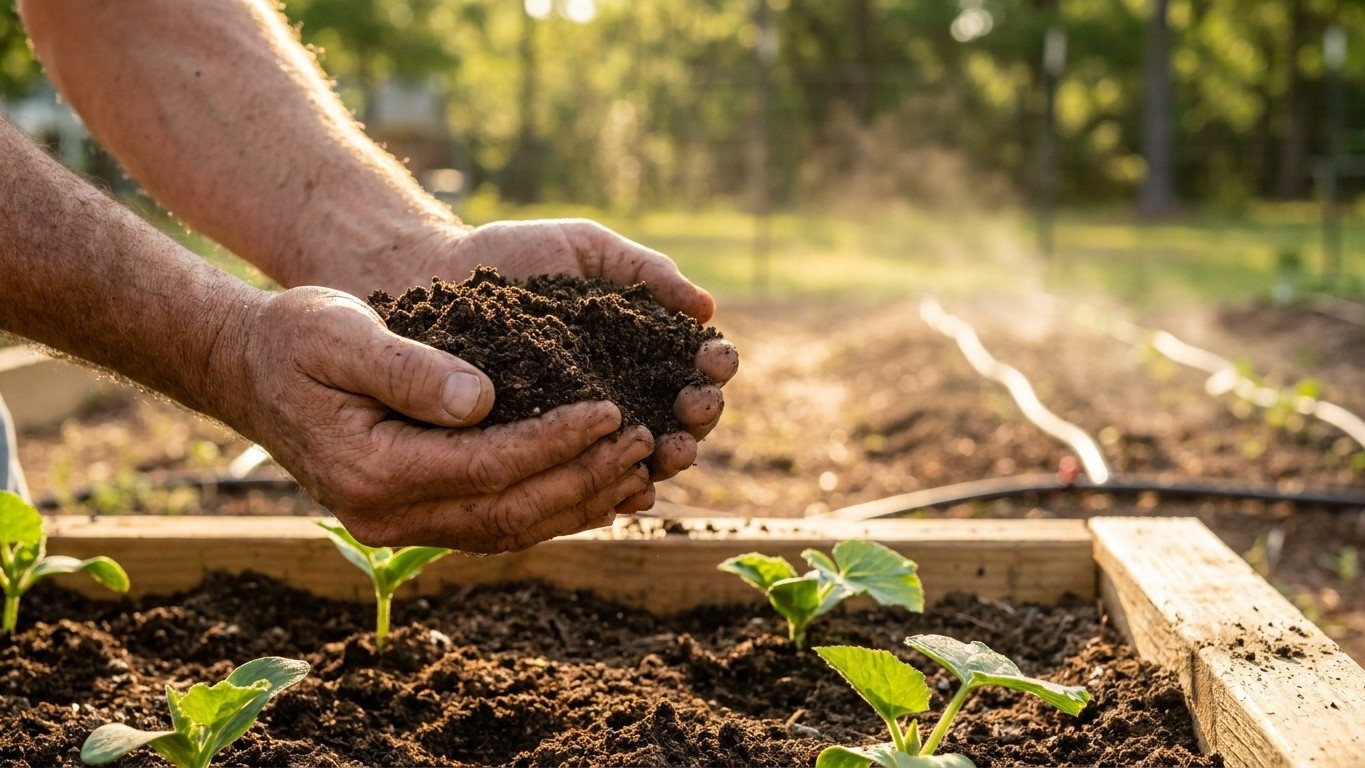

Summer squash goes into Nova Scotia gardens once the soil itself has warmed, not on a fixed calendar date, and that usually lands in the first half of June for most of the province. The growing window runs roughly 164 days between the mean frost dates at the Halifax reference station, cool and short enough that disease resistance and airflow matter more here than heat tolerance ever will.
When the soil is warm enough in Nova Scotia
The question every Nova Scotia gardener asks is simple: when can I put seed or transplant in the ground? The honest answer starts with a number that gets misused constantly. Environment and Climate Change Canada puts the average last spring frost at Halifax Stanfield Int’l A at May 7, based on the 1981-2010 Canadian Climate Normals. That date is a mean, not a guarantee. In one year out of two, frost arrives after May 7, sometimes well after. Treat it as the middle of a window, not a green light.
Frost itself is also the wrong thing to watch for summer squash. What the plant actually needs is warm soil, and soil lags behind air temperature by days, sometimes weeks. A morning with no frost risk can still sit over ground barely above 50°F, and squash seed sown into cold, wet soil rots more often than it germinates. The practical move is to wait until the risk of frost has clearly passed the May 7 midpoint and the soil has had a stretch of settled warmth, rather than counting days from a single date on a chart.
Zone and local variation
Natural Resources Canada places the Halifax area in Canadian hardiness zone 6b, a rating built from seven climate variables and not comparable to the American USDA system that grades on temperature alone. It describes the reference city only. Nova Scotia is not one climate: the Annapolis Valley warms earlier than the Atlantic coast, and inland or elevated districts can run one to two weeks behind Halifax on soil warming. A gardener in Yarmouth or on the South Shore, working under a slower spring, has every reason to wait longer than a gardener in the Valley.
None of this changes with variety selection, and it shouldn’t. What changes from one county to the next is when the ground is actually ready, and that is a local judgment call best checked against a soil thermometer or a call to a neighboring grower, not a printed date. For the types and timings trialled specifically for Nova Scotia conditions, the Nova Scotia Department of Agriculture is the source built for that job, not a generic seed packet written for a different climate.
The takeaway for planting day is unglamorous but reliable: let the mean frost date mark roughly when the risk starts falling away, then give the soil time to catch up before it does the real work of germinating seed.
How long the season lasts here
Subtract May 7 from October 18, the average first fall frost at the same Halifax Stanfield station, and the frost-free window comes out to about 164 days, a little under five and a half months. That is the span between two averages, so both edges carry the same caution as before: real years run shorter or longer, and a garden a few miles inland or at higher elevation should expect the edges to close in from both sides.
What matters is what that length of season allows a squash grower to do with it. A 164-day window is generous enough to support one solid planting with room to spare, but it is not the kind of stretch that makes a second full sowing an automatic win the way it might further south. Summer squash from seed typically needs roughly two months from sowing to first harvest, then keeps producing for weeks after that. In Nova Scotia’s window, a single well-timed June sowing can occupy the plant’s most productive stretch through the warmest part of summer and still finish well ahead of the October frost, without forcing a race against the calendar at the far end.
Is a second sowing worth it?
A succession sowing, planted a few weeks after the first, is more of a hedge than a routine here. It can replace a planting lost to a cold snap, slugs, or squash vine borer, or extend harvest into early fall for a household eating squash all season. But because the fall frost date is itself a mean, a late-July or early-August second sowing runs a real risk of losing its last few weeks of production if October 18 arrives early. The math favors a strong, well-spaced first planting over a gamble on a second one, unless there’s a specific reason, like replacing a failed row, to try it.
The decision also touches how the crop goes in. In a shorter window, starting seed indoors and transplanting after the frost risk has passed buys back time the direct-seeded plant would otherwise spend germinating in cool soil, though summer squash resents root disturbance and needs a careful, minimal-disturbance transplant if that route is chosen. Readers weighing when and how to stagger plantings can work through the details in this site’s succession sowing guide, which covers spacing sowings for continuous harvest rather than a single flush.
Heat and water in Nova Scotia
Here is where Nova Scotia’s climate departs sharply from what a lot of summer squash advice assumes. The Halifax reference station records an average of 0.0 days per year above 90°F. That is not a rounding error; it is the defining fact of the province’s summer for this crop. Squash pollen loses viability in extreme heat, and gardeners in hot US states spend real effort managing poor fruit set once temperatures push into the high 90s. Nova Scotia gardeners essentially never face that problem. Heat stress, blossom drop from scorching afternoons, and the need for shade cloth over the root zone simply aren’t part of the calculus here.
Rainfall tells the other half of the story, and it points toward a different set of risks entirely. Summer rainfall across June, July, and August averages about 11.2 inches at the Halifax station, split fairly evenly at 3.79 inches in June, 3.76 in July, and 3.68 in August, the driest of the three. That is a meaningfully wet summer by comparison with many squash-growing regions, and it changes what actually threatens the crop.
What a cool, damp summer brings instead
With negligible heat stress and steady summer rain, the practical challenges for Nova Scotia squash growers are dampness and slow ripening rather than drought and sunscald. Powdery mildew, which thrives in humid air moving slowly across broad squash leaves, becomes the more likely disease to watch for than anything heat-related. Fruit can also mature more slowly in a summer that never gets genuinely hot, stretching out the wait between flowering and a squash ready to pick.
The response is about airflow and moisture management rather than irrigation planning. Spacing plants generously, watering at the soil line instead of overhead, and clearing old leaves as the plant matures all reduce the humid microclimate around the foliage where mildew takes hold. A rain gauge on the actual plot is still worth having, since a summer thunderstorm can dump rain that runs off a slope rather than soaking in, but the underlying story for this territory is dampness management, not drought defense.
Which summer squash suit Nova Scotia
Given a roughly 164-day season with no meaningful heat load and a wet summer, three qualities matter more than any brand name on a seed packet: how early a type sets fruit, how well it tolerates humid, low-airflow conditions, and how it responds to a cool start rather than a hot one. Earlier-maturing types make the most of a season that, while adequate, isn’t long enough to waste on a slow starter. Types bred or selected for open, upright growth habits get more air moving around their leaves, which matters directly in a climate where powdery mildew, not sunscald, is the recurring threat. And varieties carrying documented resistance to common squash diseases carry more weight here than they would in a hot, dry climate where those diseases barely take hold.
What this page deliberately will not do is name a specific variety. That is not an oversight. Seed catalogs and general gardening advice are written for national or even continental audiences, and a cultivar praised for heat tolerance in a Georgia garden solves a problem Nova Scotia doesn’t have, while saying nothing about the mildew resistance that actually matters at Halifax’s rainfall and humidity. The varieties genuinely worth planting are the ones already trialled under Nova Scotia’s own conditions, and that information sits with the people who run those trials.
The Nova Scotia Department of Agriculture maintains current guidance on vegetable varieties suited to the province’s growing conditions, updated as new cultivars are tested locally rather than fixed to whatever was popular when a general gardening article was written. A recommendation built on this page’s facts alone, without that local trial data, would be a guess dressed up as advice. Choosing by type, then confirming the specific variety with a source that actually tests plants in Nova Scotia soil, is the only approach that holds up once the seed catalog closes and the squash is in the ground.