
Ohio gardeners can Plant Summer Squash once the soil sits reliably warm, generally after mid-May in most of the state, and expect to harvest into early October. The window runs roughly five months, but heat spikes in July and August, plus uneven rainfall, do more to shape the outcome than the calendar alone.
When the soil is warm enough in Ohio
The Ohio State University Extension’s Ohio Gardening Calendar puts the last spring frost at May 5 to May 15 across zone 6a. That date gets treated like a starting gun, but it’s really a proxy for something else entirely: summer squash germinates and grows on soil temperature, not air temperature, and soil lags behind the air by days or weeks depending on how wet and shaded it stays through spring.
A frost date is also a probability, not a promise. “Last frost May 5 to May 15” means the odds of a damaging frost drop sharply somewhere in that window, not that frost stops on a fixed day. A gardener who sows the moment the calendar clears that range is betting on the early side of a probability curve, and squash seedlings are tender enough that a late frost snap wipes them out fast.
Reading the soil, not just the calendar
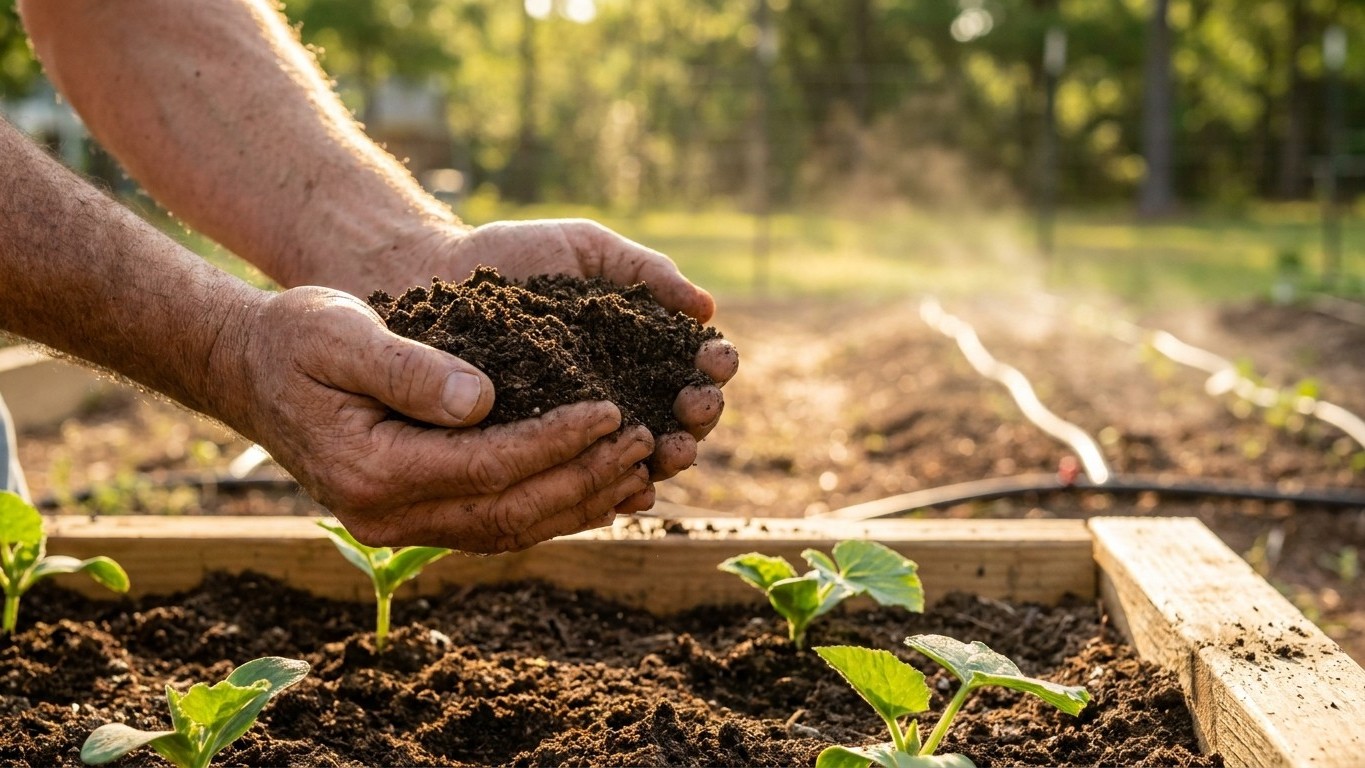
Summer squash seed wants warm soil to germinate reliably and grow without stalling. Rather than count days from frost, many gardeners wait until the soil feels warm to bare skin a few inches down and stays that way for several consecutive days. In a cool, wet Ohio spring that point can land well after the last frost date; in a dry, sunny one it can arrive close to it.
Raised beds and black plastic mulch warm faster than open clay ground, which matters more in the heavier soils common across much of Ohio. Direct-seeding into cold, saturated soil tends to produce weak stands and slow starts even when frost risk has passed.
Because seed catalogs and box labels cover a huge range of squash types bred for different regions, this page won’t name specific varieties. The Ohio State University Extension (extension.osu.edu) publishes locally trialed variety recommendations that reflect Ohio’s actual growing conditions, which is a far more useful starting point than a name picked at random.
How long the season lasts here
Stack the two frost windows and Ohio’s frost-free season runs from roughly mid-May (May 5 to May 15) to roughly mid-October (October 5 to October 15), both figures from the OSU Extension’s Ohio Gardening Calendar for zone 6a. That’s close to five months of frost-free growing, comfortable territory for summer squash, which typically needs a stretch of consistently warm weeks from sowing to first harvest and then keeps producing for weeks after that.
A season this length changes the math on how many rounds of squash a garden can realistically carry. Five months is enough room for a first planting once soil warms in mid-to-late May, a harvest period running through summer, and a second sowing in early-to-mid summer timed so the plants mature well before the October frost window closes. That second sowing matters because summer squash plants often decline in vigor and pest resistance after eight to ten weeks of heavy production, so a fresh planting can replace a tiring one rather than nursing it along.
Direct-seed or transplant, given the window
With a season this long, the case for Transplanting rather than direct-seeding gets weaker for the first planting. Squash roots resent disturbance, and transplants need a careful root check before going in the ground; if that check goes badly, the plant sets back and loses time it didn’t need to lose in a five-month window. Direct-seeding once soil is warm is usually the simpler, lower-risk path for that first round.
A second, later sowing is a different case. By early-to-mid summer, gardeners with limited bed space sometimes start replacement squash indoors or in a nursery bed to shave a week or two off the timeline, since the window to reach maturity before fall frost is tighter than it was for the first planting. For the mechanics of timing a second round, including how to figure the cutoff date, the succession sowing guide on this site walks through the calculation in more detail.
Heat and water in Ohio
Columbus, the NOAA reference station for this region, averages 15.3 days a year at or above 90°F, per NOAA NCEI Climate Normals for 1991-2020. That’s a moderate heat load, not the punishing stretch of a Deep South garden, but it’s also not nothing: those days concentrate in July and August, right when squash plants are flowering and setting fruit.
Heat above the high 90s causes real trouble for squash because pollen loses viability quickly in extreme temperatures, and flowers that don’t get pollinated in time simply drop without setting fruit. Ohio’s 15.3-day average keeps that risk lower than in hotter regions, but a run of 90-plus days during peak bloom can still stall production for a stretch even here.
Water tells a more complicated story. Summer rainfall at the same reference station averages about 12.7 inches across June, July and August, broken down as 4.33 inches in June, 4.67 in July, and 3.74 in August, the driest of the three months. Squash plants carry broad leaves that lose water fast under summer sun, while their roots stay relatively shallow, so the plant depends on a steady water supply rather than deep reserves it can draw on during a dry stretch.
Why the rainfall number needs a second look
Almost 13 inches over three months sounds generous, and on paper it usually is enough to carry squash through summer without constant intervention. But that figure is a monthly average built from NOAA’s 1991-2020 normals, not a description of how rain actually falls. A single thunderstorm can dump an inch in an hour and run off a compacted or sloped garden bed rather than soaking in, leaving the soil dry again within days.
Soil type changes the equation further. The same inch of rain drains through sandy soil within a day, while Ohio’s more common clay-heavy soils hold moisture for the better part of a week. A garden on sandy ground can need supplemental watering every couple of days during a hot stretch even in a summer that meets the seasonal average, while a clay bed spread over the same rainfall might need far less. August’s lower rainfall, combined with any run of 90-degree days, is the point in the Ohio season most likely to call for irrigation. A rain gauge on the actual plot, not the seasonal average, is what settles whether a given week needs water.
Which summer squash suit Ohio
Ohio’s conditions point toward a few broad priorities rather than a single answer. The state’s roughly five-month frost-free window is generous enough to accommodate the standard maturity range for summer squash types without forcing a rush toward the earliest options, though a shorter local season further north or at higher elevation within the state could tighten that math.
The moderate heat load, 15.3 days a year above 90°F at the Columbus reference station, means airflow and afternoon shade at the root zone matter during the hottest stretch of July and August, but Ohio isn’t fighting the relentless heat stress of a Deep South garden. Spacing plants to let air move between them helps regardless of type, since it also reduces the humidity that builds around dense foliage.
Humidity and rainfall patterns push disease resistance toward the top of the list of things worth checking on a seed packet or plant tag. With summer rainfall arriving unevenly, sometimes in heavy bursts that leave leaves wet for extended periods, powdery mildew and other fungal issues are a realistic risk across much of Ohio’s growing season, more so than heat stress on plants themselves.
This page deliberately stops short of naming a specific variety, and that’s a choice, not an omission. Seed companies breed summer squash for an enormous range of regional conditions, and a cultivar performing well in a trial garden in one part of the country can underperform in Ohio’s particular mix of clay soils, moderate heat and uneven summer rain. The Ohio State University Extension (extension.osu.edu) runs and publishes variety trials specific to Ohio conditions, and that local trial data is the only variety recommendation actually grounded in how a plant performs here rather than somewhere else entirely.