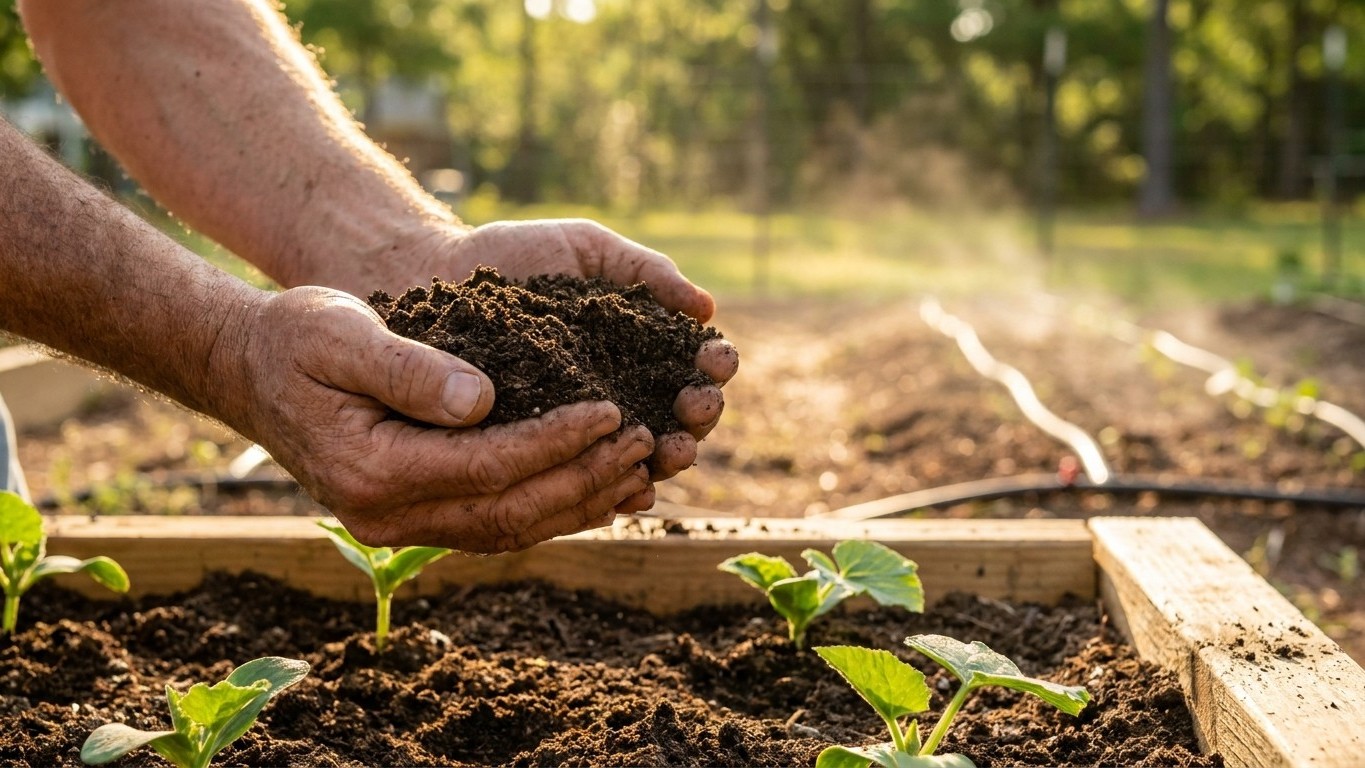

Soil in southeastern Pennsylvania near Philadelphia typically warms enough for summer squash by early-to-mid May, once the last frost risk has passed and nighttime lows hold above 50°F. Gardeners in the northern tier and the Alleghenies should wait two to four weeks longer, since spring arrives on its own schedule up there.
When the soil is warm enough in Pennsylvania
The last spring frost at the Philadelphia reference station falls between March 29 and April 6, according to NOAA’s 1991-2020 climate normals for the 30-70% freeze probability band. That’s the date most gardeners circle on the calendar, but it’s the wrong number to plant by. Frost dates track air temperature at a specific hour on a specific morning. Summer squash doesn’t care about air temperature at 6 a.m. It cares about soil temperature, and soil lags behind air by two to three weeks in spring because it takes that long for the ground to shed the cold it stored over winter.
What that means in practice: the frost date tells you when it’s probably safe to stop worrying about a plant dying. It doesn’t tell you when the seed will actually germinate or the transplant will actually grow. Summer squash seed sits nearly dormant in soil below 60°F, and can rot before it sprouts in a cold, wet spring. The safer marker is soil that’s stayed reliably above 60°F for several consecutive days, which around Philadelphia usually lands two to three weeks after that late-March or early-April frost date, putting most direct sowing in the third or fourth week of April at the earliest, and more comfortably into May.
One caution worth repeating: a frost date is a probability, not a promise. The 30-70% band NOAA uses means there’s still meaningful odds of a freeze on either side of that window. Treat it as a planning tool, not a guarantee, and keep something to cover young plants if an odd cold snap rolls through in mid-April.
Pennsylvania’s USDA Hardiness Zones run from 5a in the state’s coldest pockets to 7b around Philadelphia, based on the 2023 map’s 1991-2020 average extreme minimum temperatures. That’s a single-variable measure built for perennials and overwintering, not a squash-planting calendar, but it does underline how differently the seasons open depending on where in the state you’re gardening. A grower outside Erie or up in the Poconos is working from a colder baseline than one in the Philadelphia suburbs, and should push planting dates back accordingly rather than trust a single statewide answer.
Raised beds and black plastic mulch both speed up that soil-warming clock by a week or more, which matters more in the state’s cooler corners than it does near Philadelphia, where the ground is already warming on its own by early May.
How long the season lasts here
Run the two frost dates together and Pennsylvania’s frost-free window comes out to roughly 213 to 232 days, depending on where in each date range a given year lands: from an April 6 last frost to a November 5 first frost, that’s 213 days; from March 29 to November 16, it stretches to 232. Either way, that’s more than seven months of frost-free ground, a season long enough that squash, a crop that typically needs somewhere in the range of six to nine weeks from sowing to first harvest, isn’t really pressed for time in most of the state.
That length changes the decisions worth making. In a short-season territory, growers are stuck with one shot: sow as early as soil allows, and hope the harvest wraps before fall frost cuts it short. Pennsylvania’s window is generous enough that a second, even a third, sowing is realistic for most of the state, at least outside the coldest northern and mountain counties where the effective season shrinks closer to that 213-day floor. A planting in mid-May and another in early July can both mature well before the November frost risk sets in, spreading the harvest out and giving a fresh stand of plants to replace ones that squash vine borer or powdery mildew have worn down by midsummer.
Transplanting versus direct seeding is worth a second look here too. Squash roots resent disturbance, so direct seeding is usually the default advice. But in a season this long, starting seedlings indoors three to four weeks before the soil-warmth date and transplanting them out, carefully, without disturbing the root ball, buys an earlier first harvest without meaningfully risking the back end of the season. That trade-off makes less sense in a short-season territory where every week of headstart matters more than the risk of transplant shock.
For the mechanics of spacing out multiple sowings so the harvest doesn’t come in one overwhelming wave, the succession sowing guide on this site walks through timing a second and third planting against your own local frost dates.
Heat and water in Pennsylvania
The Philadelphia reference station averages 24.0 days a year at or above 90°F, per NOAA’s 1991-2020 climate normals. That’s a moderate heat load, real but not extreme, well short of what growers deal with in the Deep South or the desert Southwest. Summer squash actually sets fruit poorly once temperatures push into the high 90s and above, because pollen loses viability fast in that kind of heat and blossoms drop without setting fruit. At 24 days a year, most of Pennsylvania sees stretches of that stress but not the relentless run of 90-plus days that shuts pollination down for weeks at a stretch.
Summer rainfall tells a similar story of moderation. The reference station logs about 12.7 inches of rain across June, July and August, broken down as 4.04 inches in June, 4.38 in July, and 4.29 in August, with June the driest of the three. That’s a reasonably steady supply by national standards, spread fairly evenly across the summer rather than concentrated in one wet month and one bone-dry one. Squash’s huge leaves lose water fast in heat and sun, and its root system stays fairly shallow, so even a summer with decent average rainfall can leave plants stressed between storms, especially if that rain falls as a hard thunderstorm that runs off rather than soaks in.
What this combination means for a Pennsylvania garden
Put the two numbers together and the picture is neither the punishing heat-and-drought scenario that demands shade cloth and daily irrigation, nor the cool, damp climate where mildew and slow ripening are the main threats. Pennsylvania sits in between: warm enough, often enough, to need supplemental water during dry stretches in July and August, but not so consistently hot or dry that irrigation becomes non-negotiable. Where the real risk shows up is humidity. Warm days combined with regular rain and heavy dew create ideal conditions for powdery mildew and downy mildew on squash leaves, which is a bigger practical threat here than heat stress or drought.
None of these are forecasts for a specific backyard. A slope, a city heat island, or sandy versus clay soil changes how far that 12.7 inches actually goes, and a rain gauge on the actual plot settles the question better than any regional average.
Which summer squash suit Pennsylvania
Given a frost-free season running roughly 213 to 232 days, a moderate 24-day count of 90-plus heat, and summer rainfall that runs steady rather than scarce, the types of summer squash best suited to Pennsylvania aren’t the fastest-maturing types bred for short Northern seasons, since the length of the window isn’t the limiting factor here. The bigger consideration is disease pressure. In a climate where humidity and regular rain create good conditions for powdery mildew, types bred or selected for disease resistance and open, airy growth habits have a real practical edge over dense, sprawling types that trap moisture around the leaves.
Growers dealing with the state’s humid pockets, river valleys and the wetter western counties in particular, benefit from spacing plants generously and choosing growth habits that keep foliage off the ground and open to airflow, since that does more to slow mildew than any product applied after the fact. In the drier stretches of central Pennsylvania, water management during July and August dry spells matters more than disease resistance, though the two aren’t mutually exclusive concerns.
This is deliberately where this page stops naming specific varieties. Cultivar performance depends on trial data collected under local disease pressure, local soil, and local season length, all of which vary meaningfully between Philadelphia’s mild corner and the colder northern tier and Alleghenies. A variety that performs well in a university trial plot near State College may behave differently on a humid, poorly-drained lot in the Delaware Valley. Penn State Extension runs exactly these trials and publishes results specific to Pennsylvania growing conditions, and its extension service is the source worth checking before choosing seed, rather than any general list that isn’t testing against this state’s actual soil, humidity and frost patterns.