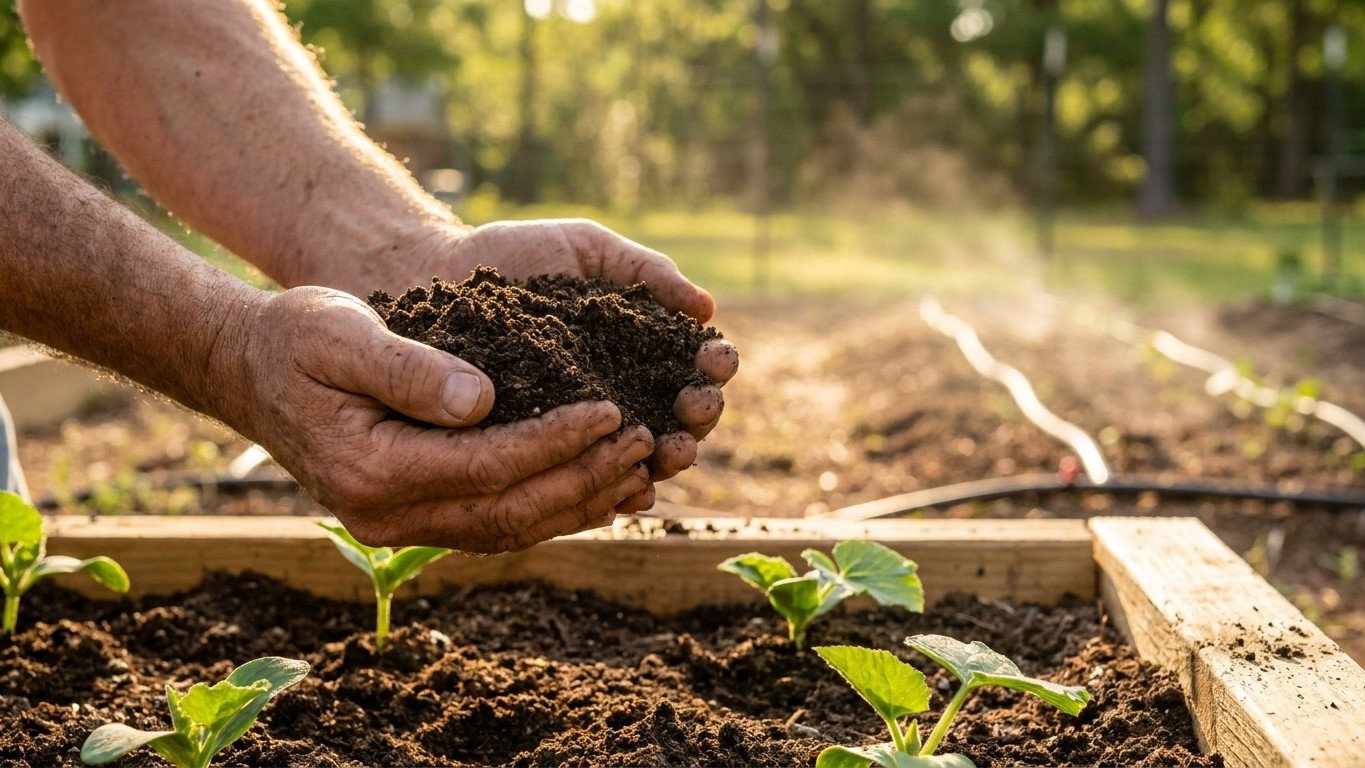

Summer squash goes into Oregon soil once that soil holds steady warmth, not simply once the last frost has passed. West of the Cascades, that generally means Transplanting or direct-seeding sometime after mid-to-late spring; east of the mountains, the high desert compresses the whole calendar into a shorter run. The dates below come from a single NOAA reference station, so treat them as a starting point for the Willamette Valley, not a rule for the whole state.
When the soil is warm enough in Oregon
NOAA’s 1991-2020 Climate Normals put the last spring frost, defined as the 30 to 70 percent probability band for a 32°F freeze, between March 6 and March 21 at the reference station behind these normals. That’s a probability, not a promise: even inside that window, a late cold snap can still nip young plants, and the safest approach is to watch the local forecast rather than circle a single date on the calendar.
Frost is only a proxy for what summer squash actually needs. The plant germinates and grows on soil temperature, and soil warms on its own schedule, usually well after the air has stopped freezing at night. A garden bed can sit at frost-free air temperatures for weeks while the top few inches of soil are still too cold for squash seed to sprout evenly. That lag is why so many failed spring sowings have nothing to do with frost damage at all: the seed simply sat in cold, damp ground and rotted before it could push up.
The practical fix is patient waiting rather than a fixed date. Raised beds, black plastic mulch, or simply holding off another week or two after the frost risk has passed all give the soil time to catch up. Gardeners who transplant rather than direct-seed get some insurance here, since a started plant tolerates slightly cooler ground better than a seed does, though summer squash resents root disturbance and prefers to go into its final spot without much handling.
None of this applies evenly across the state. Portland sits west of the Cascades, in a mild marine-influenced climate, and the frost window above reflects that location specifically. Central and eastern Oregon are high desert, with colder nights, a shorter frost-free stretch, and growing conditions that don’t resemble the Willamette Valley at all. A gardener in Bend or Burns should pull local frost data for their own area rather than borrow the Portland numbers, and Oregon State University Extension is the source built for exactly that kind of local detail.
How long the season lasts here
Pairing both frost dates from the same NOAA normals gives a sense of how much growing time is actually on offer. The last spring frost falls between March 6 and March 21, and the first fall frost arrives between November 11 and November 27. Taking the more conservative combination, from the later spring date to the earlier fall date, yields a frost-free stretch of roughly 235 days. Stretching to the earlier spring date and later fall date pushes that up toward 266 days. Either way, that’s somewhere between seven and a half and nearly nine months without a killing freeze, for the location behind this reference station.
A window that long changes the math on how summer squash gets planted. Instead of treating the first sowing as the only shot at a harvest, a gardener working within this frost-free stretch has room to plant again in early or midsummer, replacing plants that have slowed down, gotten leggy, or picked up disease with a fresh batch that will still finish before fall frost. The site’s succession sowing guide walks through timing a second or third planting so the harvest doesn’t stall out in late summer.
It also loosens the pressure on the direct-seed-versus-transplant decision. With months of frost-free time in hand, there’s little downside to starting the first planting from seed directly in the ground and saving transplants, with their root-disturbance risk, for a later succession sowing if the first one falters. That calculation flips in the shorter-season parts of the state: central and eastern Oregon’s high desert climate compresses the frost-free period enough that the first sowing may be the only one that has time to mature, which is exactly when a careful transplant, started indoors and moved with minimal root disturbance, buys back days that a direct-seeded planting can’t afford to lose.
Heat and water in Oregon
At the reference station behind these normals, days reaching 90°F or higher average just 11.9 a year. That’s a small number, and it matters because summer squash pollen loses viability once temperatures climb into the high 90s for extended stretches, which causes blossoms to drop without setting fruit. With fewer than a dozen days a year even touching 90°F, heat-driven pollination failure is a rare event here, not the defining risk it would be in a hotter inland climate.
Rainfall is the more decisive number. Summer totals only about 2.7 inches across June, July, and August, out of 36.9 inches for the year, meaning nearly all of the region’s precipitation falls outside the growing season. July is the driest month at just 0.51 inches, with June at 1.63 and August at 0.54. That pattern, wet winters and largely dry summers, is the real story for squash here: the plant’s broad leaves transpire heavily, its roots stay shallow, and a July delivering barely half an inch of rain can’t come close to covering that demand on its own.
That gap has to be closed with irrigation, and how often depends on more than the rainfall figure alone. The same half inch of rain soaks in and disappears within a day on sandy soil, while clay holds it for the better part of a week, so two gardens a few miles apart under identical rainfall can need very different watering schedules. Heat pushes the same equation the other way: even without frequent 90-degree days, warm afternoons increase evaporation, and rain that arrives as a single downpour tends to run off rather than soak into the root zone. Mulching the soil surface and watering at the base rather than overhead both help close that gap without relying on any specific product or schedule that this page can’t verify for an individual yard. A rain gauge on the actual plot, tracked over a season, tells a gardener more than any regional average can.
Which summer squash suit Oregon
The type of summer squash worth choosing follows directly from the numbers above, not from a brand or variety name. With fewer than 12 days a year above 90°F at the reference station, heat-driven blossom drop isn’t the main hurdle west of the Cascades, so the wide range of open-pollinated and hybrid types sold for home gardens all have a realistic shot at producing here, given the long frost-free window already described.
What actually shifts the choice
Dry summers change the calculus in a different way. Because irrigation, not rainfall, carries the crop through June, July, and August, disease pressure tends to show up less from summer humidity and more from cooler, damp shoulder seasons in spring and fall, when nights lengthen and moisture lingers on leaves. Types bred for stronger resistance to powdery mildew and similar fungal issues hold up better as the season stretches into that cooler, damper tail end.
Season length matters too, but unevenly across the state. West of the Cascades, the roughly 235- to 266-day frost-free stretch gives even later-maturing types plenty of time to produce across one or two sowings. In central and eastern Oregon’s high desert, where the season runs considerably shorter, earliest-maturing types become the safer default, since anything slower risks running into fall frost before it produces much of a harvest. The USDA Plant Hardiness Zone Map places Oregon anywhere from 4a to 9b, a range wide enough that a gardener’s own zone, not a statewide average, should guide the decision.
This page isn’t naming specific cultivars, and that’s deliberate. Variety trial results are local by nature, tested by state researchers against the actual soils, pests, and weather patterns of a given region, and Oregon State University Extension maintains exactly that kind of locally trialled variety information at extension.oregonstate.edu. A name picked at random for this article would carry no more weight than a guess, and a guess isn’t worth planting a season around.