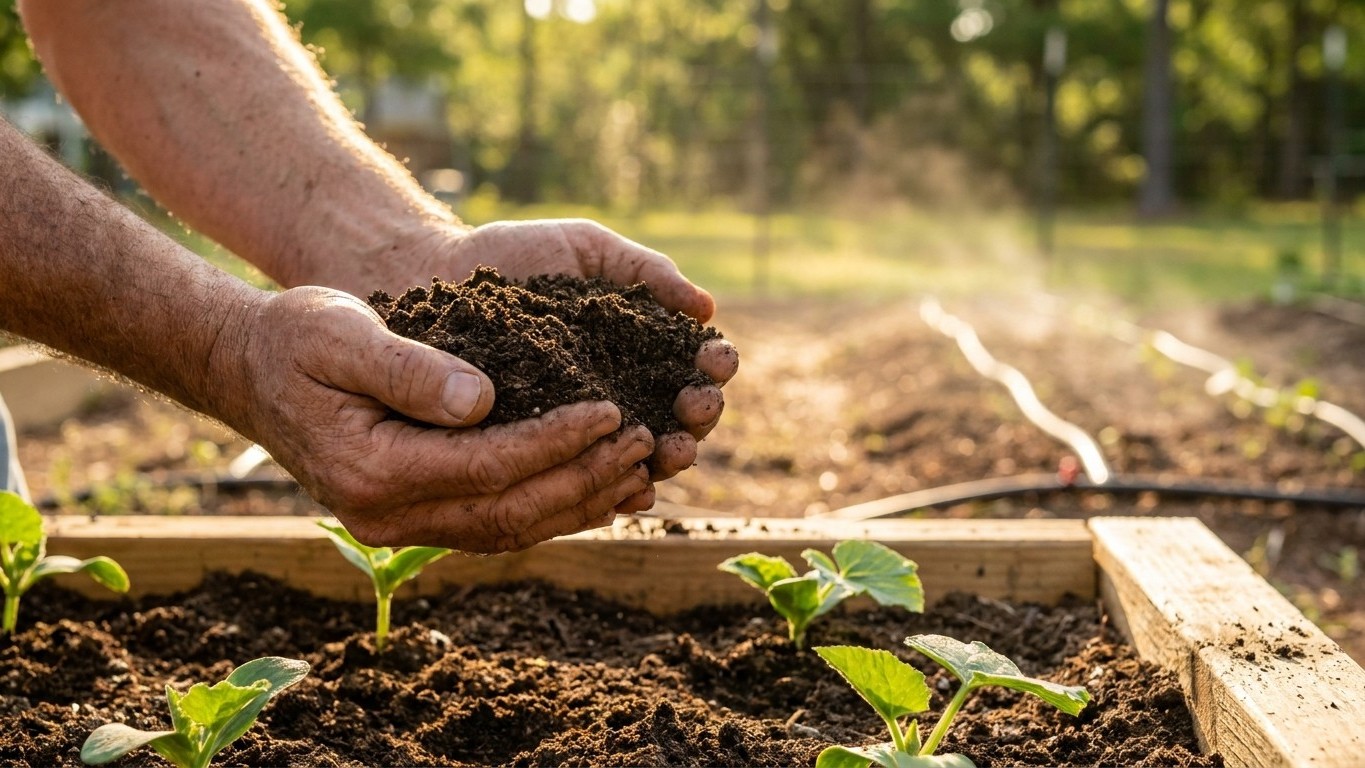

Summer squash goes in the ground in South Carolina once the soil itself has warmed, which for most of the state falls in the weeks after the last spring frost risk clears, typically from mid-March in coastal counties to early April upstate. The growing window then runs long enough, close to eight months in favorable years, that a second planting is often worth the trouble.
When the soil is warm enough in South Carolina
The number gardeners actually want is a frost date, and for the reference station used by NOAA (USW00013880), the 1991-2020 Climate Normals put the last spring freeze at 32°F somewhere between February 28 and March 17. That’s the 30-70% probability band, meaning frost has a real but shrinking chance of showing up anywhere in that stretch. It is not a guarantee that March 18 is safe, only that the odds have shifted.
Frost is a proxy, and a slightly misleading one. Summer squash seed doesn’t care whether the air dipped below freezing last week. It cares whether the soil a couple of inches down has climbed into the 60s. Cold, wet soil rots squash seed before it germinates, or lets it sit dormant and vulnerable to soil fungi. That soil warm-up usually trails the last frost date by one to three weeks, depending on how much sun the bed gets and whether it’s covered in mulch that’s still shading the surface from spring sun.
This is also where the caution in the NOAA data matters. Peninsular Charleston, sitting near the coast with water moderating its temperature swings, tends to warm up milder and earlier than the airport station the normals are drawn from. Upstate South Carolina, up around Greenville and Spartanburg, runs several weeks tighter on both ends of the frost calendar. A planting date that works in Beaufort County can be two or three weeks premature in Oconee County.
The state falls across USDA Hardiness Zones 7a to 9a, a range built entirely on one number: the average annual extreme minimum temperature. That’s useful for deciding whether a perennial survives winter, but it says nothing about summer squash timing, which is a frost and soil-temperature question, not a hardiness-zone one. What it does confirm is that South Carolina is not a single climate. A grower in the Upstate should treat their local extension office’s planting calendar as the real answer, not a statewide average.
How long the season lasts here
Run the two frost windows together and the frost-free season in South Carolina stretches somewhere between roughly 248 and 280 days, depending on where within each band the actual frost lands in a given year. Take the tighter, more conservative pairing (last spring frost on March 17, first fall frost arriving as early as November 20) and you still get 248 days clear of frost. Take the more generous pairing (spring frost gone by February 28, fall frost holding off until December 5) and the window opens to 280 days.
Either way, that’s a long season by national standards, and it changes the calculus for how a squash bed gets planned. A frost-free window under four months forces a grower into a single planting and makes every week of delay costly. South Carolina’s window is roughly double that, which means there’s real room for a second sowing once the first planting starts to decline from vine borer damage, powdery mildew, or simple exhaustion around midsummer.
It also changes whether starting seed indoors and Transplanting is worth the extra step. Squash resents having its roots disturbed, so most growers direct-sow when they can. With a season this long, there’s little pressure to gain two or three weeks by starting transplants, unless a gardener is specifically trying to dodge the worst of the July heat by getting an early crop finished before the hottest stretch arrives. In a short-season territory that root check would be a bigger trade-off; here it’s optional.
The practical move is staggering plantings roughly three to four weeks apart through late spring and into midsummer, so a fresh stand of plants is always coming into production as an older one fades. For the mechanics of spacing those sowings and reading when a stand has passed its productive peak, the succession sowing guide on this site walks through the timing in more detail.
Heat and water in South Carolina
The reference station at Charleston averages 55.1 days a year at or above 90°F, and that number matters more to a squash plant than the average summer temperature does. Squash pollen is short-lived once temperatures climb into the high 90s; flowers open, but fruit set fails because the pollen simply doesn’t stay viable long enough to do its job. A South Carolina summer with 55 days that hot is one where blossom drop and misshapen fruit are a normal midsummer event, not a sign anything’s gone wrong with the plant.
Water compounds the problem. Summer squash carries enormous leaves relative to a shallow, spreading root system, and on a 95°F afternoon those leaves are pulling moisture out faster than the roots below can replace it. That’s why squash wilts dramatically by early afternoon even in soil that isn’t actually dry, then recovers by evening. It’s a warning sign worth watching, not necessarily an emergency, but it does mean irrigation timing counts as much as irrigation amount.
What the rainfall numbers actually say
Summer rainfall at the same reference station averages about 19.8 inches across June, July, and August combined, out of 52.5 inches for the full year. Broken down by month, the pattern looks like this:
| Month | Average rainfall |
|---|---|
| June | 6.21 inches |
| July | 6.6 inches |
| August | 6.97 inches |
Nearly 20 inches over a summer sounds generous, and on paper it is. But that rain rarely arrives as a gentle, soaking week. Coastal Plain and Midlands summers deliver a lot of it as single afternoon thunderstorms, the kind that dump heavily for twenty minutes and mostly run off a hot, crusted surface rather than soaking down to root depth. Combine that with 55 days of 90°F-plus evaporation demand, and a gardener can be standing in a summer with respectable total rainfall on the books while the squash bed is still bone-dry three inches down. A rain gauge on the actual plot, checked weekly, tells a grower far more than the seasonal average does. Where June runs on the drier side of the three months, that first month after transplanting or germination is often the one where supplemental watering matters most, before root systems have spread wide enough to hunt for moisture on their own. Afternoon shade over the root zone, whether from nearby taller crops or simple shade cloth, takes some of that evaporation pressure off without blocking the sun the leaves themselves need.
Which summer squash suit South Carolina
The honest answer to “which variety” is that this page can’t give you one, and shouldn’t try. Naming a specific cultivar without knowing which strains have actually been trialled against South Carolina’s disease pressure and heat load would be a guess dressed up as advice. What the state’s climate data can do is point to the right type to look for, and let Clemson Cooperative Extension fill in the name.
Given the length of the frost-free window here, close to eight months in a good year, an early-maturing type isn’t the constraint it would be farther north. There’s room to prioritize other traits over speed. Given the heat load, with 55 days a year pushing past 90°F, types bred for better fruit set under heat stress and grown with generous plant spacing for airflow tend to hold production longer into July and August than tightly packed, heat-sensitive stock. Given the humidity that comes with nearly 20 inches of summer rain arriving in short, intense bursts, disease resistance, particularly to powdery mildew and downy mildew, becomes the first thing worth checking on a seed packet or plant tag, ahead of fruit shape or color.
Clemson’s extension service runs variety trials specific to South Carolina’s growing conditions, and their extension office is the source that actually knows which named cultivars performed well in this year’s Upstate trial versus the Coastal Plain one. That’s not a dodge. It’s the difference between a page that talks about climate mechanics honestly and one that hands out a variety name it has no way of standing behind for a Charleston backyard versus a Spartanburg one.