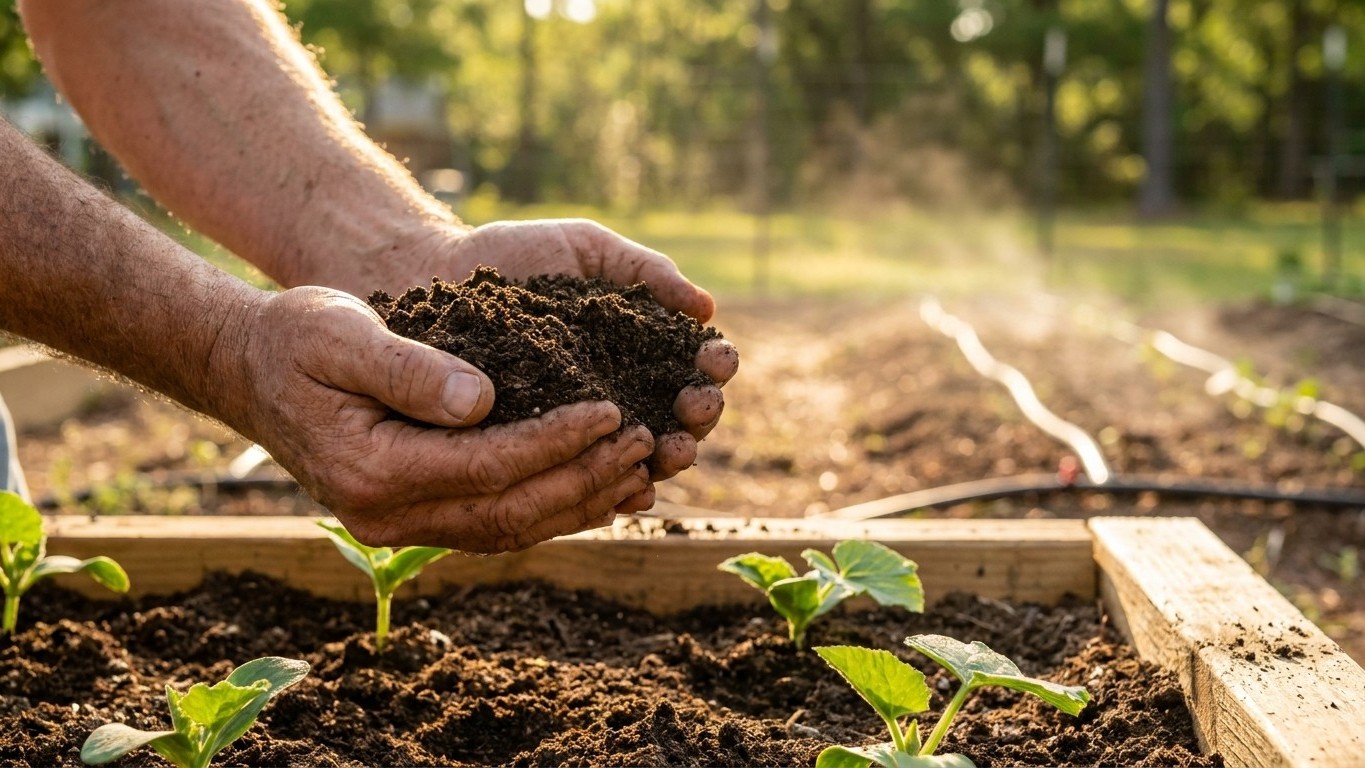

Summer squash grows in the Yukon, but on a tight calendar: soil rarely warms enough before early June, and the frost-free window runs barely twelve weeks. The practical answer is transplants started indoors, black plastic or row cover to build soil heat fast, and one sowing rather than a string of them, since a second planting has almost nowhere to ripen before the cold returns.
When the soil is warm enough in Yukon
The mean last spring frost at Whitehorse A is June 5, according to Environment and Climate Change Canada’s 1981-2010 Climate Normals. That date is a mean, not a guarantee: in roughly half the years on record, frost has landed later than June 5. Treat it as the middle of a window, not a green light, and hold back on setting squash outdoors until you’ve watched the forecast for a settled stretch.
Frost date and soil temperature are two different things, and squash cares about the second one. Air can clear of frost risk while the ground underneath is still cold from a long winter, and squash seed rots rather than germinates in cold soil. In a territory sitting in Canadian hardiness zone 1b, at the reference city named in that rating, the ground typically needs another week or two past the mean frost date before it’s genuinely warm at seed depth. That zone number comes from a seven-variable Canadian system and does not translate to a USDA zone, so don’t try to match it against ratings on seed packets built for the US scale.
Two habits close that gap. Laying black plastic over the bed two to three weeks before you plan to plant pulls extra heat into the soil during the Yukon’s long June daylight hours. A floating row cover set over the row after Transplanting traps a few more degrees at night, which matters more here than almost anywhere else in this series, since Yukon nights stay cool even at the height of summer. Starting squash indoors under lights three to four weeks before your planting date and moving it out as a transplant, rather than direct-seeding, buys back most of the days that a slow-warming soil would otherwise cost.
Skip guessing at variety names for this. The types that actually perform at this latitude are trialled and tracked by Canada’s own agriculture department, and the right move is checking their current recommendations rather than relying on any list built for a warmer province.
How long the season lasts here
Run the two mean dates together and the frost-free window at Whitehorse A comes to about 81 days, from June 5 to August 25. That’s a short season by any measure on this site, and it changes the whole approach to planting rather than just the calendar.
Eighty-one days doesn’t leave room for a second sowing. Summer squash from seed typically needs somewhere in the range of six to eight weeks just to reach first harvest under good conditions, and Yukon’s conditions, cool nights, a soil that’s slow to warm, aren’t the best-case scenario. Sow once in early June, and that planting is carrying the whole season on its own. A failed or delayed first sowing here has no backup the way it might in a territory with a four-month window.
That’s also the argument for transplants over direct seeding. In a long-season territory, direct-seeding and transplanting end up close in final yield, since there’s time for a slow start to catch up. In Yukon, every week spent germinating in cold soil is a week that never gets returned, so starting seed indoors and setting out a stocky four-week-old transplant, checking that the root ball isn’t pot-bound before it goes in the ground, is close to mandatory rather than optional.
Because there’s no room here for the staggered plantings that stretch a harvest over months, the succession approach used in longer-season territories doesn’t apply in the same way. It’s still worth understanding how that method works and why it fails in a short window like this one; the site’s succession sowing guide lays out the timing math and where it does and doesn’t fit.
Heat and water in Yukon
The heat side of this equation is almost a non-issue. Whitehorse A records a mean of 0.0 days a year above 90°F. Summer squash pollen loses viability in extended heat above the high 90s, and it’s a real problem in hotter parts of this series, but it simply doesn’t apply here. Blossom drop and poor fruit set from heat stress aren’t a Yukon concern.
What replaces it is the opposite failure mode. Squash flowers and fruit development slow down in cool conditions, and a summer with essentially no hot stretch tends to run behind on ripening compared with a warmer territory planted the same week. Cool, damp air sitting on broad squash leaves overnight is also exactly the setup powdery mildew favors, so airflow around the plants, spacing them wider than a seed packet suggests and resisting the urge to crowd a short bed, does more work here than any fungicide would.
Rainfall doesn’t offset that risk much, because there simply isn’t a lot of it. Summer rainfall at the station totals about 4.2 inches across June, July and August, out of 10.3 inches for the year. June, right when transplants are trying to root, is the driest of the three:
| Month | Average rainfall |
|---|---|
| June | 1.28 in |
| July | 1.5 in |
| August | 1.41 in |
With no hot days pulling moisture out of the soil, that modest rainfall goes further than the same total would in a warmer territory. But squash roots sit shallow and wide, not deep, and a dry stretch in a low-rainfall June can still stall a young transplant before it’s established. A hand on the soil two inches down, watering when it’s dry rather than on a fixed schedule, tells you more than the monthly average ever will. These are normals for one reference station; a garden on sandier ground or in a more exposed spot will dry out faster than the figures above suggest.
Which summer squash suit Yukon
Reasoning from the numbers above points toward a fairly narrow profile: the earliest-maturing types available, given the 81-day window, with airflow-friendly, open habits rather than dense sprawling ones, and disease resistance rated for powdery mildew as the first thing to check, ahead of size or shape, since cool damp nights make mildew the likelier problem here rather than heat.
What this page won’t do is hand you a cultivar name. Every seed catalog lists dozens of summer squash varieties, and the ones that actually perform at Yukon’s latitude and soil conditions are the ones tested by trial programs run for this climate specifically, not picked from a general national list. Naming one here would be a guess dressed up as a recommendation, and that’s the one kind of gardening advice that backfires the moment a reader plants it and watches it underperform.
Canada’s federal agriculture department maintains current guidance and trial results, and it’s the resource worth checking before buying seed: agriculture.canada.ca. The provincial site would normally be the first stop, but it isn’t reliably reachable through automated checks at the time of writing, so the federal page is the dependable link.
The short version for a Yukon garden: start indoors, choose the fastest type you can find with mildew resistance built in, give it room to breathe, and expect one harvest window rather than a rolling one. That’s a smaller ask than a Zone 6 garden faces, but it’s a more forgiving crop to get right than most people assume a subarctic vegetable garden can be.