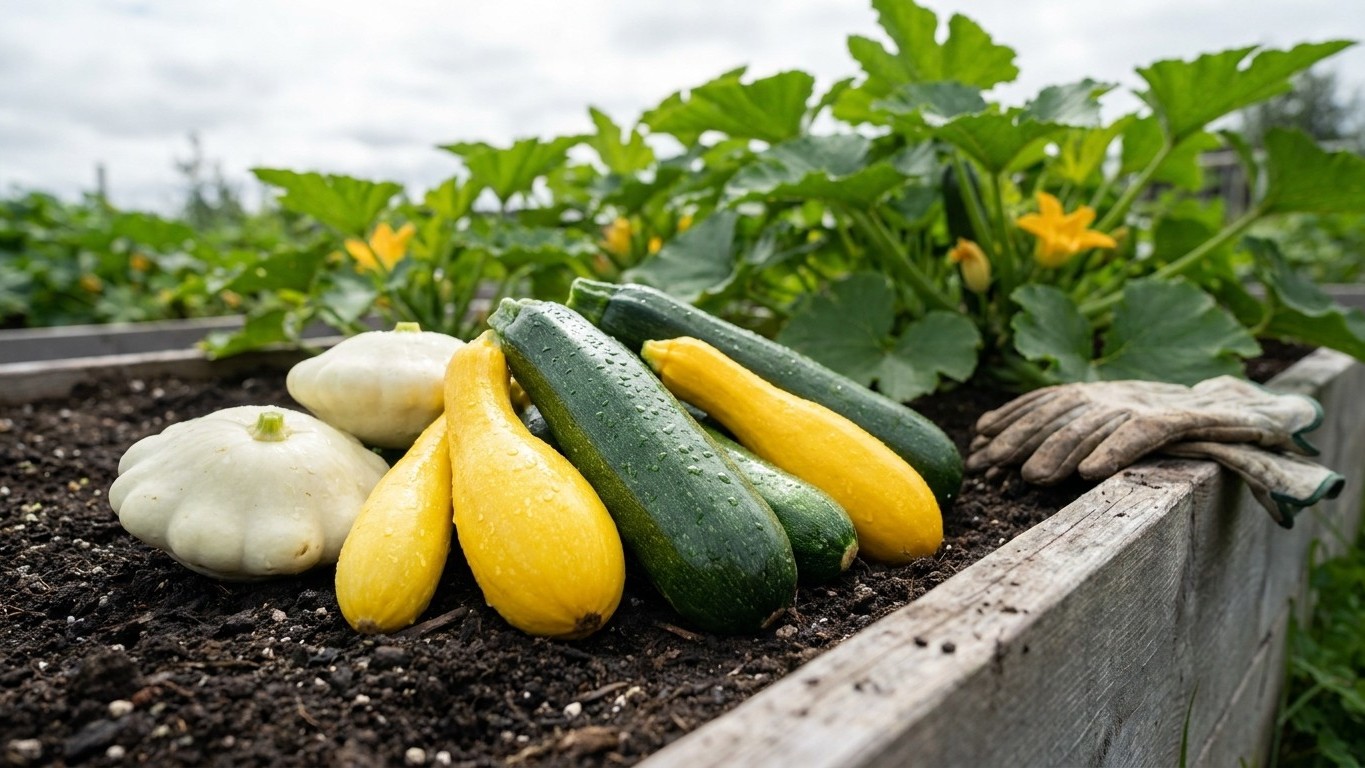

Bush zucchini, yellow crookneck and pattypan varieties all fit Colorado’s growing window with room to spare. The real decision here isn’t about days to maturity, it’s about which types shrug off 39.6 days a year above 90F on barely 5.7 inches of summer rain. Heat and drought tolerance beat speed as the deciding factor.
The short answer for Colorado
Start with the math most gardeners skip. Using the conservative end of the frost dates (last spring frost by May 11, first fall frost by September 30), the Front Range plains around Denver get roughly 141 frost-free days. Nearly every summer squash variety on the market, bush or vining, matures in 45 to 65 days. That means season length is not the limiting factor for a Denver-elevation garden. The limiting factor is what happens during those 141 days: a reference-station average of 39.6 days at or above 90F, paired with only about 5.7 inches of rain across June, July and August (1.94 in June, 2.14 in July, dropping to 1.58 in August, the driest month).
That combination, high heat load stacked on low summer rainfall, rewards squash that hold up under water stress and keep producing when the soil dries fast between waterings. Bush-type zucchini and bush yellow crookneck are the safest starting point because their compact root systems and shorter vines need less total surface area to keep moist. Pattypan and scallop types perform similarly and tend to signal drought stress early through visible leaf wilt, which gives a gardener a warning before yield drops.
How the types compare on Colorado’s numbers
| Type | Fit for 141-day window | Fit for 39.6 days above 90F / dry summer |
|---|---|---|
| Bush zucchini | Comfortable margin | Good, responds well to deep, infrequent watering |
| Yellow crookneck / straightneck | Comfortable margin | Good, tolerates heat spikes |
| Pattypan / scallop | Comfortable margin | Good, shows stress visibly and early |
| Vining/trailing summer squash | Fine at Denver elevation, tighter at altitude | Needs more consistent soil moisture across a larger root zone |
Vining types aren’t ruled out at Denver’s elevation, but they demand more consistent moisture across a larger root spread, which is harder to deliver on 5.7 inches of summer rain without supplemental irrigation on a regular schedule rather than an occasional deep soak.
What will not work here
Weekly watering schedules borrowed from a wetter climate fail here, and the numbers explain why. With 39.6 days a year pushing past 90F, soil moisture that a once-a-week soak might sustain in a cooler, cloudier region evaporates faster on the Front Range, especially in the sandy, fast-draining soils common along much of the Colorado piedmont. A single generous watering on Sunday can leave squash roots dry by Wednesday if a 90-degree stretch hits midweek. Varieties bred and marketed for consistent, evenly moist soil conditions, some heirloom vining types among them, are the ones most likely to disappoint under this pattern, showing blossom drop and stunted fruit rather than steady production.
The advice built for humid states doesn’t transfer either. Guides written for the Southeast or Midwest often stress wide spacing to fight fungal disease pressure driven by humidity, but Colorado’s problem runs the other direction. Summer here is dry, not wet, so the diseases that show up tend to be powdery mildew triggered by dusty conditions and temperature swings between hot days and cool nights, plus spider mites that thrive in dry heat. Spacing squash extra-wide to chase airflow, a humid-climate fix, does little for either of those problems and just wastes garden space that could go to more plants or companion crops.
Season length only becomes the enemy in the mountains, not on the plains. A gardener in a high-altitude valley working with a dramatically shorter frost-free window than the Denver-area normals cited here can find that a slow-maturing vining variety, fine at 5,280 feet, simply runs out of season before it sets a meaningful harvest. That’s a different failure mode than the heat-and-drought story on the plains, and it’s covered in the next section.
What changes across Colorado
Colorado is not one growing zone, it’s a stretch of the USDA hardiness map running from 3b to 7b. That’s a five-and-a-half zone spread inside a single state, built on the USDA Plant Hardiness Zone Map’s single measure: average annual extreme minimum temperature. There is no single answer for “when to plant” or “which variety” that covers a 3b mountain valley and a 7b pocket on the western slope or southeastern plains equally well. The frost dates and heat-day figures cited on this page are tied to the Denver-area reference station at 5,280 feet on the plains; they describe that location, not the whole state.
A gardener working land at higher elevation or farther north than the reference station should expect a shorter frost-free window than the 141 days calculated here, sometimes dramatically shorter in mountain towns that can see frost even in July. That reality argues for leaning toward the fastest-maturing bush varieties, starting transplants indoors rather than direct-seeding, and treating any vining type as a gamble unless the local season is confirmed to run long enough to finish it.
A gardener at lower elevation or in a warmer pocket of the state, meanwhile, may see more heat days than the 39.6 average cited for Denver and an even smaller water budget relative to demand. That pushes the drought-tolerance question from “worth considering” to “non-negotiable,” and makes mulching and deep, infrequent watering less optional than they are on the plains proper.
This page can’t tell an individual reader which of those zones they’re gardening in. The USDA hardiness zone map is the tool for that, and it’s worth checking directly rather than guessing from a county name or an elevation estimate.
Where to check this for your own county
Colorado State University Extension is the state’s land-grant extension service, and it’s the next stop for anyone who wants numbers specific to their own ground rather than the Denver-area normals used throughout this page. The address is extension.colostate.edu.
Two things are worth looking for once there. First, a local planting calendar, since county-level offices often publish dates adjusted for local elevation and microclimate rather than the statewide reference figures. Second, any list of summer squash varieties that have actually been trialed in that county’s demonstration gardens or through master gardener programs, which carries more weight than a seed catalog’s general claims about heat or drought tolerance.
A county recommendation beats a state one every time, and it’s worth saying plainly: this page is the state-level view, built from a single reference station’s climate normals. It’s a reasonable starting point for a Front Range garden at something close to Denver’s elevation, but it isn’t a substitute for what a county extension office knows about frost pockets, soil type, and local pest pressure. Someone gardening in a mountain county, on the western slope, or in the southeastern plains should treat the county office as the tie-breaker whenever its guidance differs from the general figures cited here, because that office’s numbers are drawn from conditions closer to the actual garden in question.
Checking this against your own garden
None of the dates or averages on this page beat what the garden itself is showing on a given morning. Three signs are worth tracking, and each one answers a different question about the specific plot being worked.
Soil warmth by feel, checked by pushing a hand a couple of inches into the bed, tells whether the ground has actually caught up to the calendar. Summer squash seed germinates poorly in cold soil regardless of what the frost-date normals suggest, and a bed in shade or heavy clay can lag well behind one in full sun on sandy loam, even a few yards away.
The first flush of male flowers, the ones on thin stems without a tiny fruit behind them, signals that the plant has shifted into reproductive growth. It’s an early read on whether the season’s heat and light have been enough to push growth along, useful for comparing one year’s timing against another in the same yard.
The first set of true leaves, the ones that look like miniature squash foliage rather than the rounded seed leaves, marks the point where a seedling is running on its own photosynthesis instead of stored seed energy. Slow or pale true leaves after that stage often point to a nutrient or watering gap specific to that bed, something no regional average can diagnose. Watching these three signs over a season builds a better local calendar than any date range, because it’s built from the one microclimate that actually matters: the one behind the house.