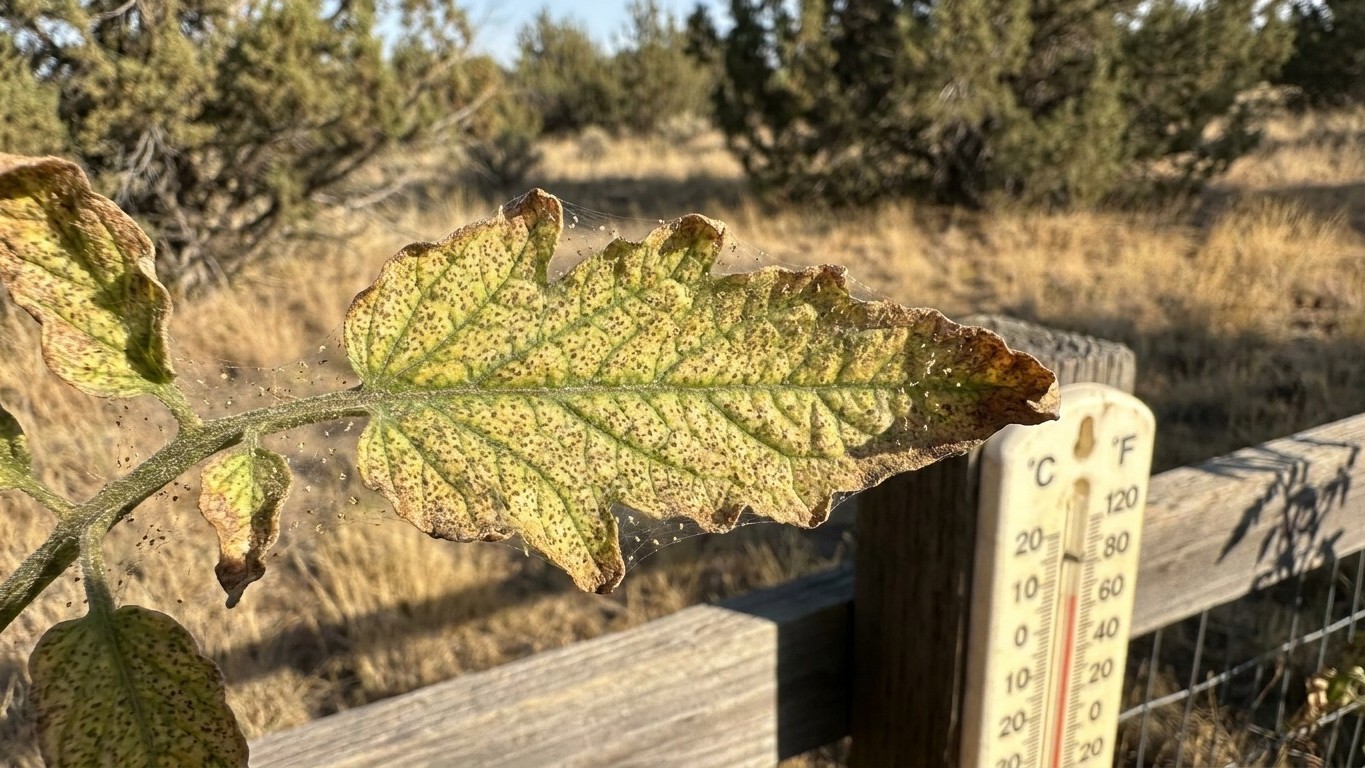

Spider mites become active in Colorado as early as April on the Western Slope and typically peak across the Front Range from late June through August, when daytime humidity drops below 30 percent and temperatures climb past 85°F. Indoors, they can show up any month of the year on houseplants near dry heating vents. The mites themselves don’t cause the damage that stops them, dry conditions, dusty foliage, and water-stressed plants do the setup work, and once you address those factors along with targeted treatment, populations crash fast.
When Spider Mites Show Up in Colorado

Colorado’s spider mite season doesn’t follow a single calendar. It splits by elevation, region, and even by which plants you’re growing. On the Western Slope, orchards around Palisade and the Grand Valley often see two-spotted spider mites establish on peach and apple trees by late April, well before Front Range gardeners notice anything on their tomatoes.
Along the Denver-Boulder corridor and out toward Colorado Springs, the real explosion happens in July and August. That’s when the combination of low relative humidity, intense high-altitude UV exposure, and dust from dry landscaping creates ideal breeding conditions. A single female two-spotted spider mite can lay over 100 eggs in her short lifespan, and at 90°F that egg-to-adult cycle can complete in less than a week. Do the math over a six-week hot spell and a handful of mites on one juniper branch becomes a full-blown infestation.
Mountain towns and higher-elevation communities, think Evergreen, Estes Park, or Durango’s surrounding foothills, tend to see spider mite pressure shift toward late summer, since cooler spring temperatures delay the population buildup. Spruce spider mites, a cool-season species distinct from the two-spotted mite, actually behave in reverse: they’re most active in Colorado during spring and fall, going dormant during the hottest weeks of summer. That’s an important distinction for anyone managing blue spruce or other evergreens along the Front Range foothills, where spruce spider mite damage is one of the most common tree health complaints reported to county extension offices.
Indoor Infestations Don’t Follow the Weather
Houseplants and greenhouse-grown starts create their own microclimate, and Colorado homes running forced-air heat from October through April often drop indoor humidity into the teens. That dry air is exactly what spider mites want, which is why a fern or a citrus tree brought indoors for winter can suddenly show stippled, bronzed leaves in February even though it’s freezing outside.
Why Colorado’s Climate Is Practically Custom-Built for Mites
Spider mites aren’t insects, they’re arachnids, and unlike most garden pests they actively prefer hot, dry conditions over humid ones. Colorado’s semi-arid climate, with statewide average relative humidity often sitting between 20 and 40 percent during summer afternoons, removes one of nature’s biggest natural checks on mite reproduction: fungal pathogens that thrive in moisture and normally keep populations in check.
Add in the dust factor. Unpaved rural driveways, gravel landscaping (a popular xeriscaping choice statewide), and roadside vegetation all generate fine particulate that settles on leaf surfaces. Dust interferes with a plant’s natural defenses and gives mites extra grip and shelter from predators. Colorado State University Extension entomologists have long pointed to dusty, water-stressed plants along field edges and unwatered borders as the first place outbreaks take hold before spreading into gardens and ornamental beds.
Drought years amplify all of this. During the dry stretches Colorado experienced in 2020 and 2021, extension offices across the Front Range and Western Slope fielded a noticeable jump in spider mite calls, tied directly to water-stressed junipers, arborvitae, and vegetable gardens running on reduced irrigation. A plant that’s already struggling to pull moisture from dry soil has less capacity to fend off mite feeding, which explains why the worst outbreaks tend to cluster on the same properties dealing with underwatering or root stress.
Recognizing an Infestation Before It Spreads
The damage almost always shows up before you spot the mites themselves. Two-spotted spider mites are barely visible to the naked eye, roughly the size of a period on a printed page, so most homeowners notice the symptoms first.
- Fine, pale stippling or speckling on leaf surfaces, especially on the upper side of foliage
- A bronze or grayish cast across leaves that can be mistaken for drought stress or nutrient deficiency
- Delicate webbing near leaf joints, stem nodes, or the undersides of leaves, most visible in bright morning light
- Leaf drop that starts at the bottom of the plant and moves upward
A quick field test works well in Colorado’s dry climate: hold a sheet of white paper under a suspicious branch and tap it firmly. If tiny specks fall and start moving, you’ve got mites. This works on everything from tomato plants to spruce trees and takes about ten seconds.
Spruce spider mites leave a slightly different signature. Rather than stippling, affected evergreen needles often turn a dull yellow-brown starting on interior and lower branches, sometimes accompanied by fine webbing between needles. Because the damage resembles winter desiccation, a common issue on Colorado evergreens exposed to drying winter winds, it’s frequently misdiagnosed until the webbing gives it away.
What Actually Stops Spider Mites in Colorado Conditions
Effective control here has to work against the same dry, dusty conditions that let mites thrive in the first place. That changes the priority order compared to advice written for humid states.
Water Is the First Line of Defense
A strong spray of water directed at leaf undersides, done every few days during a hot dry spell, physically dislodges mites and washes off the dust layer they depend on. This single step, free and low-effort, resolves a surprising number of light infestations on vegetable gardens and ornamentals without any product application. It also addresses the underlying water stress that invited the mites in the first place, so keep an eye on irrigation schedules for anything showing early stippling, particularly juniper, arborvitae, and marigolds, three plants that show up repeatedly in Colorado extension mite reports.
Biological Control Works Well in Colorado’s Growing Season
Predatory mites, particularly species in the genus Phytoseiulus, are commercially available and well suited to greenhouse and high tunnel operations, which are common across Colorado’s shorter growing season. They need somewhat higher humidity than outdoor two-spotted mites prefer, so they perform best in irrigated garden beds, greenhouses, or shaded areas rather than open, dusty, xeriscaped yards. Releasing them early, before populations explode in July, gives them a fighting chance to establish and keep pace with mite reproduction.
Miticides and Horticultural Oils, Used Correctly
When populations have already exploded, insecticidal soap or horticultural oil applied directly to infested foliage, with thorough coverage of leaf undersides, knocks back active mites and eggs. Standard broad-spectrum insecticides are largely ineffective and can actually make infestations worse by killing off the predatory insects and mites that would otherwise help control the population. This is a documented pattern called secondary pest outbreak, and it’s one of the more common mistakes homeowners make when they reach for an all-purpose bug spray instead of a product labeled specifically for mites.
For spruce spider mites on evergreens, timing matters more than product choice. Because this species is most active in cool spring and fall weather, treatments applied during peak summer heat, when the mites are naturally dormant, waste time and money. Spring dormant oil applications, timed before new growth emerges, tend to be far more effective on Colorado’s spruce and juniper plantings.
Cultural Practices That Prevent Repeat Outbreaks
Consistent deep watering during dry stretches keeps plants less vulnerable, and reducing dust exposure near vulnerable plants, whether that means adjusting gravel mulch placement or hosing off nearby hardscaping, removes one of the environmental advantages mites rely on. Avoiding late-season nitrogen-heavy fertilization also helps, since it tends to push out tender new growth that mites prefer to colonize.
Rotating houseplants away from forced-air vents and running a humidifier nearby during Colorado’s dry winter heating months addresses the indoor version of the same problem. A relative humidity increase from the typical winter indoor reading of 15-20 percent up to 40 percent makes a measurable difference in how fast an indoor mite population can rebound after treatment.
None of these tactics require chemical-heavy intervention, which matters given how many Colorado properties border open space, irrigation ditches, or shared xeriscape common areas where drift and runoff concerns are real. The mites showed up because the conditions favored them. Change the conditions, and the population has nowhere left to build.
Related guides
- Spider mites in Oklahoma: When It Shows Up and What Stops It
- Spider mites in Utah: When It Shows Up and What Stops It
- Spider mites in Georgia: When It Shows Up and What Stops It
- Spider mites in Missouri: When It Shows Up and What Stops It
- Seedcorn maggot in Colorado
- Potato psyllid in Colorado
- Cutworms in Colorado