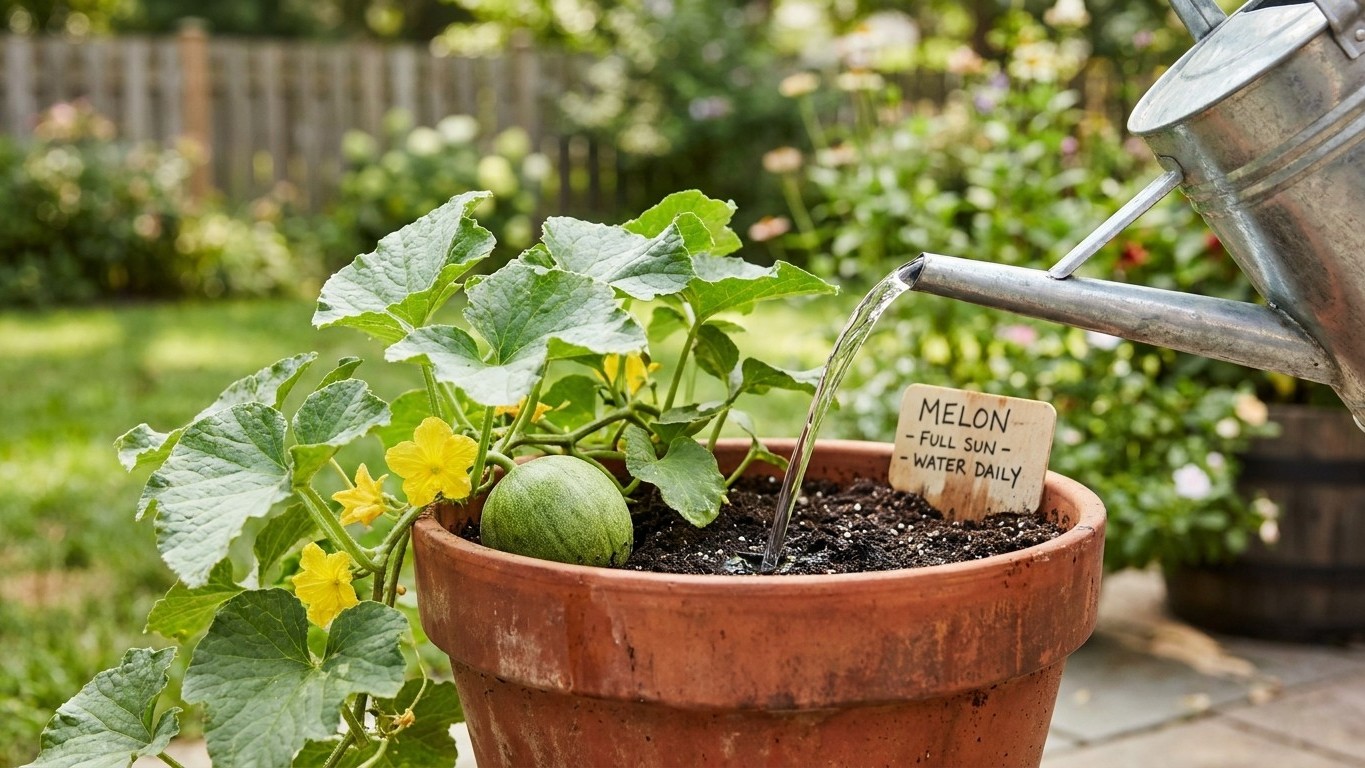

Yes, melons can grow in containers, but only certain types, in pots far larger than most gardeners expect, with a watering routine that doesn’t forgive missed days. Get the pot size and the water schedule wrong and the vine will limp along, flower, and drop fruit before it ever sizes up.
What is actually going on

The thing to understand here is water and leaf area. A melon vine large enough to carry even one fruit to maturity is pushing a surprising volume of water out through its leaves every warm afternoon, and in open ground its roots can chase moisture two feet down and several feet sideways. A container cuts that root run off at the walls of the pot. On a 90-degree day, a five-gallon container of potting mix can run dry by early afternoon, and a vine that dries out even once during fruit sizing will often abort that fruit rather than push through the stress.
That’s the real ceiling on containers melons, not the shape of the pot or how cute the setup looks on a patio. The plant’s demand for water scales with its leaf area, and leaf area scales with the size of vine needed to ripen fruit. Undersize the container and you’re not making the plant “compact,” you’re rationing it, and it responds by shedding flowers and fruit to match what its roots can actually supply.
Why size and heat interact
Potting mix also heats up faster than garden soil, since a black plastic or dark ceramic pot sitting in full sun can push root-zone temperatures well above what roots in the ground ever experience. Warmer soil means faster water loss and, past a certain point, root stress that shows up as wilting even when the mix isn’t dry yet. That’s part of why container growers see wilting at 2 p.m. on a mix that still feels damp at the surface: the top inch is fine, the root zone is cooking.
Ripeness is where a lot of that effort gets wasted anyway. A melon builds its sugar while it’s still attached to the vine, and the sugar stops arriving the moment the stem parts. There is no windowsill fix for a melon picked early. It will soften over the following days, and it may even smell sweeter as the skin’s aromatic compounds develop, but the internal sugar content is fixed at harvest. That’s true whether the plant grew in a raised bed, an in-ground row, or a half whiskey barrel on a deck. Containers don’t change the biology of ripening; they just make it easier to lose a fruit to drought stress before it ever gets there.
In the garden
Not every melon type is a fair fight for a container. Vine size, fruit weight, and root aggressiveness all vary by type, and those differences decide whether a pot experiment ends in actual melons or in a sad, sprawling vine with nothing to show for it.
| Melon type | Minimum container size | What goes wrong when the pot is too small |
|---|---|---|
| Small icebox-type watermelon | Roughly 15-20 gallons per plant | Vine stalls mid-season, fruit stays baseball-sized and never fills out |
| Muskmelon/cantaloupe type | Roughly 10-15 gallons per plant | Heavy flowering but poor fruit set; the plant can’t support more than one or two fruit |
| Honeydew and other winter melon types | Roughly 15-20 gallons per plant | Fruit sizes slowly and skin toughens before flesh sweetens, since these types need a longer, steadier season |
| Compact or “bush” melon types bred for small spaces | Roughly 7-10 gallons per plant | Still wilts hard in heat; smaller vine size doesn’t mean smaller water need per leaf |
Ask your state extension service which of these types has actually been trialled in your region before you commit a season to one. Extension programs run variety trials specifically because a type that thrives in one climate can underperform badly two states over, and they publish results by type and by region rather than guessing.
The daily rhythm containers actually demand
Once fruit starts sizing, a container melon needs checking daily, not every few days like an established in-ground planting might tolerate. Morning is the time to check, because a wilted vine at 3 p.m. on a hot day may just be responding to heat, but a vine still wilted at 8 a.m. is telling you the roots ran dry overnight. Mulching the surface of the pot cuts evaporation meaningfully, and a saucer or tray underneath helps catch water so the mix rehydrates evenly instead of channeling straight through and out the drainage holes, which is a common failure with fast-draining potting mixes.
Feeding matters too, since a container’s mix has a fixed nutrient supply that gets used up or washed out faster than garden soil. A steady, moderate feeding schedule through fruit set and sizing keeps the vine from running out of steam halfway through, but heavy nitrogen late in the season pushes leafy growth at the expense of fruit and can delay ripening rather than help it.
What it depends on where you are
How well any of this works depends heavily on season length, summer heat, and how much rain falls on your own patio or deck. A container melon in a short-summer, cooler climate is racing the calendar in a way that a grower in a long, hot summer simply isn’t, and that changes which types are realistic and how much margin there is for a slow start.
Rainfall pattern matters just as much as heat. In a region with regular summer thunderstorms, a container can get overwatered from above even while you’re also hand-watering, and soggy roots invite the same rot problems that affect in-ground melons in wet years. In a dry summer climate, the opposite risk dominates: containers dry out fast and the watering schedule becomes the single biggest factor in whether fruit sizes properly at all.
You can check your general growing zone through the USDA Plant Hardiness Zone Map, which is a useful starting point, though it describes winter minimum temperatures and doesn’t by itself tell you much about summer heat load or rainfall pattern, which matter more for melons than winter cold ever does. For anything more specific, your state’s cooperative extension service is the better resource, since extension offices track local season length, typical summer conditions, and which melon types have performed well in trials run in your actual climate, not a national average. Some of the other guides on this site break down growing conditions state by state; check those alongside your local extension office rather than relying on either alone.
The mistake that costs the most
The single costliest mistake with containers melons is picking a container that looks generous but is actually undersized for the type of melon planted in it, then compensating with more frequent watering instead of more root room. Watering can mask a too-small pot for a few weeks, right up until the vine sets fruit and demand spikes past what even attentive watering can supply. That’s the point where growers usually see fruit stall or drop, and by then the season is often too far along to recover.
The fix isn’t a watering trick. It’s sizing the container to the type of melon before planting, using the ranges extension trials suggest for that type, and treating anything smaller as a bet against the plant’s basic water math. If space genuinely won’t allow a large enough container, a compact or bush-type melon bred for small spaces is a more honest choice than trying to force a full-size vining type into a pot it was never going to support.
And whatever type ends up in the pot, the harvest decision deserves the same care as the planting decision. Since sugar stops accumulating the instant the stem parts, picking a day or two early to “be safe” locks in a less sweet melon permanently. Learning the ripeness signs for the specific type you’re growing, rather than going by a calendar guess, is what actually protects the season’s worth of watering and feeding that got the fruit that far in the first place.