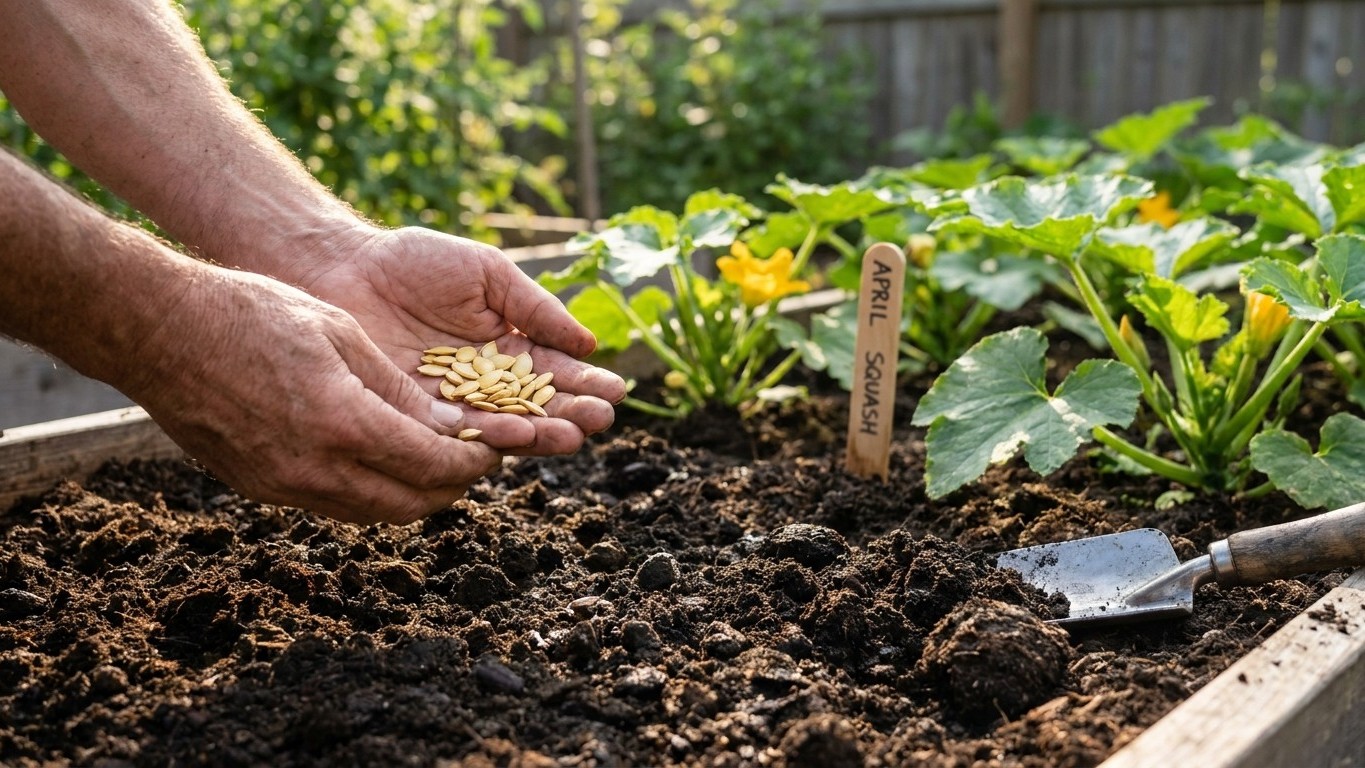

Summer squash goes into the ground in Indiana once the soil has warmed past the last spring frost window, which at the Indianapolis reference station runs from April 9 to April 21. Direct-seed after that date, or start transplants two to three weeks earlier indoors. The growing season that follows gives summer squash more time than it actually needs.
The short answer for Indiana
Plant Summer Squash outdoors after the last spring frost date for your part of Indiana, which the National Centers for Environmental Information puts at April 9 to April 21 for the Indianapolis station (1991-2020 normals, 32°F freeze probability). That range is not a guarantee. It marks the window where the chance of a freezing morning drops from 70% to 30%. Purdue Extension flags a residual risk worth remembering: about a 10% chance of a 32°F reading even after the later end of that window. Anyone setting transplants out on April 9 rather than April 21 should have row cover within reach for a week or two afterward.
Summer squash is frost-tender at every stage, and its seed germinates poorly in cold soil. Waiting until the ground has actually warmed, rather than counting days on a calendar, matters more here than for a hardier crop. Once past that frost date, the calculation gets easy. Summer squash varieties typically mature in 50 to 65 days from seed. The first fall frost at the same reference station lands between October 21 and October 30. That leaves a working season of roughly six months between the two frost windows, far more than the eight or nine weeks the crop needs to produce.
That surplus of season length is the single most useful fact on this page. It means an Indiana gardener has room to stagger plantings, replant after a failed first attempt, or push a second sowing in June or July for a fall harvest, and still finish well before the October frost arrives. It also means there is no reason to rush a planting into cold soil to “get ahead,” since the season was never the limiting factor to begin with. The limiting factor, as the next section lays out, is heat and moisture management once the plants are up and growing.
What will not work here
A short growing season is not the threat in Indiana, so gardeners here should stop planning around frost dates once the crop is up and start planning around July and August heat instead. The reference station averages 14.6 days a year at or above 90°F, most of them clustered in mid-to-late summer. That heat load does two things to summer squash: it pushes blossom drop, where flowers open and fall without setting fruit, and it accelerates water loss from leaves and soil at exactly the moment rainfall tapers off.
Rainfall does taper off. June averages 4.95 inches, July 4.42 inches, and August, the driest of the three, only 3.2 inches. A gardener who waters on a fixed weekly schedule, the habit that works fine in a cooler, wetter month, will find that schedule failing in August: the combination of a 90°F afternoon and three inches of rain spread across four weeks leaves the top few inches of soil dry well before the next scheduled watering. This is exactly the situation the summer rainfall figures warn about: rain that arrives as a single thunderstorm mostly runs off rather than soaking in, so a monthly total that looks adequate on paper doesn’t mean the soil stayed moist. Squash plants that dry out repeatedly during fruit set produce misshapen or bitter fruit, and the plants themselves become more vulnerable to disease.
Humidity is the other trap. Indiana summers combine that heat load with enough atmospheric moisture to favor powdery mildew, and close spacing intended to save garden bed space works against the gardener here. Squash planted tighter than the seed packet recommends traps moisture around the leaves, slows airflow, and speeds up mildew spread once it appears, usually by mid-to-late summer. The Midwest is also home to the squash vine borer, a pest that thrives in exactly this climate; dense plantings make early detection of its telltale sawdust-like frass at the stem base harder to catch before the damage is done.
What changes across Indiana
Indiana is not one growing zone, and a planting calendar built for its capital doesn’t automatically apply statewide. The USDA Plant Hardiness Zone Map places the state across a range from 5b in the north to 7a in the south, a two-zone spread built on average annual extreme minimum winter temperatures. That’s a winter-cold measurement, not a spring-planting one directly, but it tracks closely with how much earlier or later the growing season starts and ends across the state.
The frost dates cited above come from the Indianapolis station, roughly the middle of that range. Purdue’s own guidance notes that southern Indiana, closer to the Ohio River and the warmer end of the hardiness range, typically sees its last spring frost earlier and its first fall frost later than the Indianapolis normals by two weeks or more. Northern Indiana, closer to the Great Lakes and the cooler end of the range, runs the opposite direction: later spring frosts, earlier fall ones, and a shorter effective window overall.
There is no single planting date that covers Fort Wayne and Evansville equally well. A gardener in the northern tier should treat the April 21 end of the frost window as the safer target rather than the April 9 end, and should watch the fall side of the calendar more closely too, since an early frost there can cut a late planting short. A gardener in the south has more room on both ends and can often push an early planting a week or two ahead of the state-level date without much added risk. Anyone unsure where their own county falls within that 5b-7a spread should check the USDA hardiness zone map directly rather than guess from a state average.
Where to check this for your own county
This page gives a state-level answer, built from a single reference station in Indianapolis. That’s useful as a baseline, but Indiana’s spread across two-plus hardiness zones means a county-level source will always beat it. Purdue Extension is that source for Indiana, and it’s worth going there before finalizing a planting date, not after.
Two things are worth looking for specifically once there. First, a county or regional planting calendar, since Purdue’s county offices adjust recommended dates to local frost history rather than relying on the statewide average used here. A county in the far north or in a low-lying frost pocket may run a week or two later than even the cautious end of the state range; a county along the southern border may safely run earlier. Second, look for summer squash varieties that have actually been trialled in that county or region. Local trial data reflects how a variety performs against the specific combination of heat, humidity and pest pressure found in that part of the state, which a generic seed catalog description can’t capture.
A state-level planting calendar, this one included, is meant to frame the general shape of the season: when frost risk drops, how long the growing window runs, what stresses to expect in mid-summer. A county extension recommendation exists to sharpen that frame down to a specific place. Where the two disagree, the county figure should win, since it’s built on more localized data than the single Indianapolis station cited throughout this page.
Checking this against your own garden
No frost date, state or county, replaces what the garden itself is showing on a given morning. Three signs are worth checking by hand before committing seed or transplants to the ground.
- Soil warmth by feel. Push a finger a couple inches into the planting bed in the morning. Summer squash seed wants soil that feels warm to the touch, not just frost-free air above it. A bed that still feels cold or damp-cold well into the stated planting window usually sits in shade longer, drains poorly, or holds a cold pocket that the regional frost dates don’t account for.
- The first flush of male flowers. Summer squash typically opens male flowers before female ones, sometimes by a week or two. Seeing that first flush confirms the plant has moved past establishment and into reproductive growth, and it’s a useful marker for when to start watching for the female flowers, the small swelling behind the bloom, that actually become fruit.
- The first true leaves. The rounded seed leaves that emerge first aren’t the plant settling in; the jagged true leaves that follow are. Their appearance, and how quickly they show up after germination, is a fair read on whether the local microclimate, a warm south-facing bed versus a shaded, slow-to-warm corner, is running ahead of or behind the general dates cited for the region.