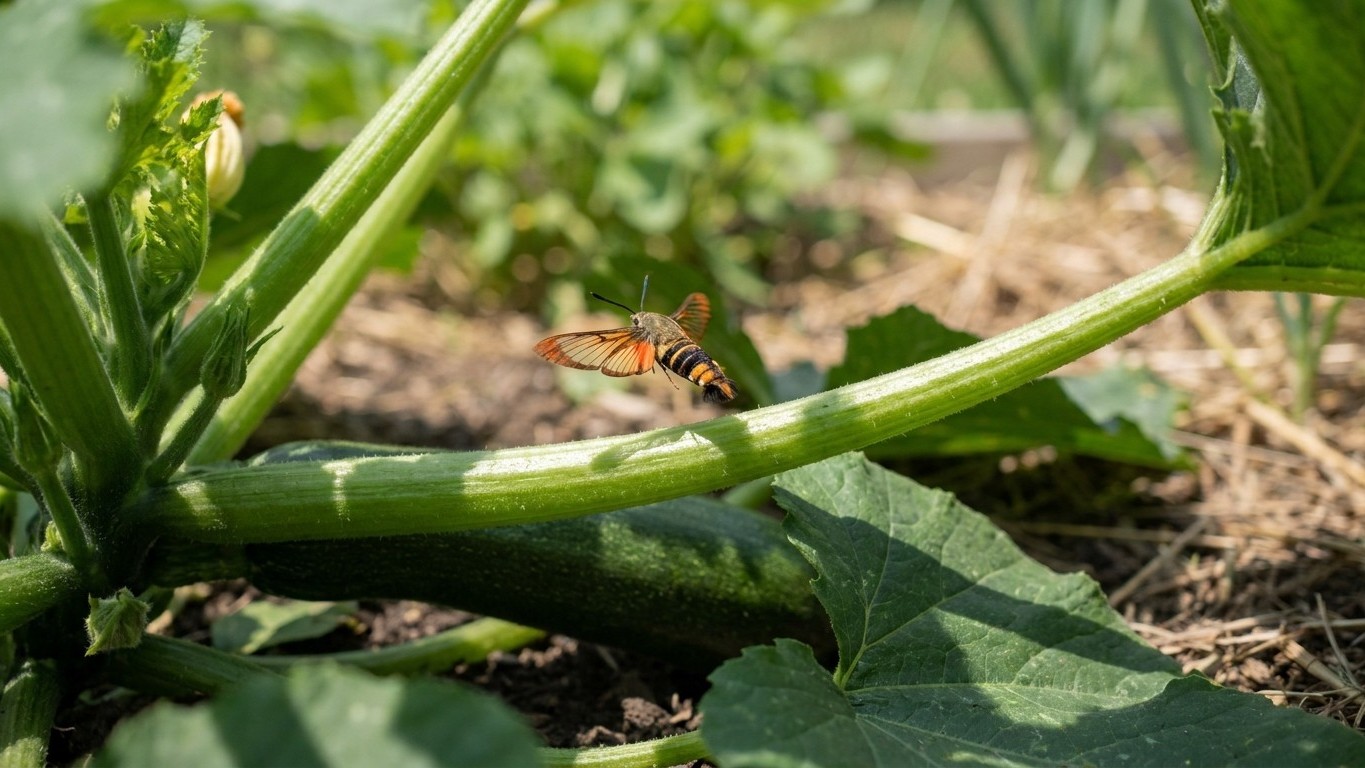

Squash vine borer moths start flying in Indiana anywhere from mid-June in the southern part of the state to mid-July farther north, and once the eggs hatch, gardeners have roughly a one-week window before the larvae tunnel into the stem and become nearly impossible to reach. That timing gap, not the pest itself, is the whole battle. Miss it, and a healthy zucchini plant can collapse within days even though the leaves looked fine the morning before.
When squash vine borer moths are active in Indiana

Indiana spans USDA hardiness zones 5b through 6b, and that north-south spread matters more than most gardeners realize. In the Ohio River counties near Evansville and New Albany, soil warms up earlier, and the first generation of adult moths often emerges by the second or third week of June. Up around South Bend and Fort Wayne, that same emergence typically lags by two to three weeks, pushing peak activity into mid-July.
The moth itself throws people off because it doesn’t look like a moth at all. It flies during the day, has clear-orange hind wings and a black-and-orange abdomen banded like a wasp, and moves in quick, darting flights close to the ground. Most people who spot one assume they’re looking at a strange wasp and swat it away rather than treating it as the threat it is.
Indiana gardens usually deal with a single generation per year. But in warmer summers, especially in the southern third of the state, a partial second generation can show up in August, laying eggs on any squash that’s still producing. That second wave catches gardeners off guard because they’ve already mentally moved past the borer threat once July ends.
How to spot an infestation before it kills the plant
The female moth lays small, flat, reddish-brown eggs at the base of the stem, usually within a few inches of the soil line, though she’ll sometimes scatter a few along leaf stalks too. Each female can lay upward of 150 to 200 eggs over her lifetime, spreading them across multiple plants rather than dumping them all in one spot.
Eggs hatch in about a week, and the newly emerged larvae go straight for the stem. Within hours they’ve bored inside, and from that point on they’re feeding in a protected tunnel where sprays can’t reach them. The telltale sign is a small hole near the base of the plant with a pile of moist, greenish, sawdust-like frass pushed out around it. That frass turns dry and brownish as it ages, which is how you can roughly guess how long the larva has been feeding.
Above ground, the plant usually looks completely normal for the first week or two of feeding. Then, often overnight, a single vine or the whole plant wilts even though the soil is moist. That sudden collapse is the larva having chewed through enough of the stem’s water-conducting tissue that the plant simply can’t move moisture anymore. By the time wilting shows up, the larva inside can already be a half-inch long or more.
Squash and zucchini (Cucurbita pepo) take the worst of it in Indiana gardens, along with most pumpkin varieties. Butternut squash and other Cucurbita moschata types have thicker, more solid stems and tend to shrug off borer damage far better, which is worth knowing if last year’s zucchini patch was wiped out and you’re deciding what to plant this season.
Prevention tactics that actually work in Indiana gardens
Row covers are the single most reliable defense, but timing is everything. Cover young plants as soon as they’re transplanted or germinate, and keep the cover on until flowering begins. Once flowers open, the covers have to come off so bees can pollinate, and that removal date should line up with local moth emergence, meaning southern Indiana growers need to pull covers and start monitoring earlier than northern growers.
Wrapping the base of each stem is a low-tech trick that works surprisingly well. Aluminum foil, a strip cut from an old pair of pantyhose, or even a few inches of paper towel wrapped snugly around the lower stem and buried slightly into the soil blocks the female moth from reaching a spot to lay eggs. It’s tedious with a big planting, but for a backyard garden with a dozen plants, it takes maybe twenty minutes total.
Burying a few stem nodes along the vine encourages secondary rooting, so even if the main crown gets bored through, the plant has a backup root system keeping it alive. This works especially well with vining varieties that sprawl rather than bush types that stay compact.
Staggering planting dates spreads out risk. A second planting three to four weeks after the first often escapes the worst of the first-generation moth flight entirely, since by the time those seedlings are producing stems worth laying eggs on, peak moth activity has passed. Some Indiana gardeners plant a fast-maturing summer squash in early June specifically as bait, sacrificing it to draw moths away from a main planting.
Yellow pan traps, essentially a shallow yellow bowl of soapy water set near the plants, can give an early warning. Squash vine borer moths are strongly attracted to yellow, and catching even one or two in a trap is a signal to start checking stems closely and consider covering plants that haven’t flowered yet.
What to do if borers are already inside the stem
Once frass appears at the base of a plant, the larva is already inside, and no spray applied to the leaves or soil surface will touch it. The only direct fix at that point is surgical. Take a sharp knife or box cutter and slit the stem lengthwise, starting just above the entry hole and working upward until you find the larva, then remove it by hand. It sounds brutal, but squash stems are surprisingly forgiving. After removing the larva, mound moist soil over the wounded section to encourage it to root and heal.
Some gardeners inject the stem instead, using a syringe to push a solution of Bacillus thuringiensis (Bt) directly into the tunnel near the entry hole. Bt is a naturally occurring bacterium that’s toxic to caterpillar-stage insects but harmless to bees, pets, and people, and it’s sold at most garden centers under various trade names. This method works best when caught early, while the larva is still small and close to the entry point.
For plants that haven’t shown symptoms yet but are in a garden with known borer pressure, a preventive approach makes more sense than waiting to operate. Spraying the base of stems with spinosad or a pyrethroid insecticide every five to seven days during the local egg-laying window can kill larvae before they tunnel in. That window in Indiana generally runs from first moth emergence through about three weeks later, covering the bulk of egg-laying activity for that generation.
A plant that’s already wilted badly with multiple entry points is usually a lost cause. Rather than spending an afternoon performing surgery on a stem that’s more tunnel than tissue, it’s often more productive to pull it, destroy it, and put that energy into protecting the rest of the row or starting a late-season backup planting.
Breaking the cycle for next year
Squash vine borers overwinter as full-grown larvae or pupae in cocoons buried one to two inches deep in the soil, usually right where the previous year’s infested plants stood. That’s why fall cleanup does more long-term good than almost any spray. Pulling and destroying infested vines as soon as the season ends, rather than tilling them into the soil or leaving them to compost in place, removes a chunk of next year’s population before it ever gets the chance to overwinter.
Tilling the soil in fall, after vines are removed, exposes overwintering cocoons to freezing temperatures and to birds looking for an easy meal. Indiana winters are cold enough that exposed cocoons have a real shot at not surviving, but that only works if the soil disturbance happens before a deep, insulating snow cover sets in.
Rotating cucurbits to a different part of the yard each year, ideally at least 100 feet from where squash grew the previous season, cuts down on the odds that emerging moths simply crawl or fly a few feet to find a new host. It’s not foolproof since adults can fly considerable distances, but combined with resistant varieties and row covers, crop rotation closes one more gap in the defense.
One detail that surprises a lot of Indiana gardeners: winter squash varieties like Waltham Butternut can still get a few eggs laid on them, but the larvae that hatch often die before doing serious damage because the stem tissue is too tough and fibrous for them to tunnel through effectively. That’s a real, measurable difference in plant anatomy, not just folklore passed around at the farmers market, and it’s the main reason extension agents across the Midwest keep pointing home gardeners toward moschata varieties whenever borer pressure has been bad two years running.
Related guides
- Squash vine borer in Michigan: When It Shows Up and What Stops It
- Squash vine borer in Ohio: When It Shows Up and What Stops It
- Squash vine borer in Iowa: When It Shows Up and What Stops It
- Squash vine borer in Kansas: When It Shows Up and What Stops It
- Squash vine borer in Delaware: When It Shows Up and What Stops It
- Squash vine borer in Nova Scotia: When It Shows Up and What Stops It