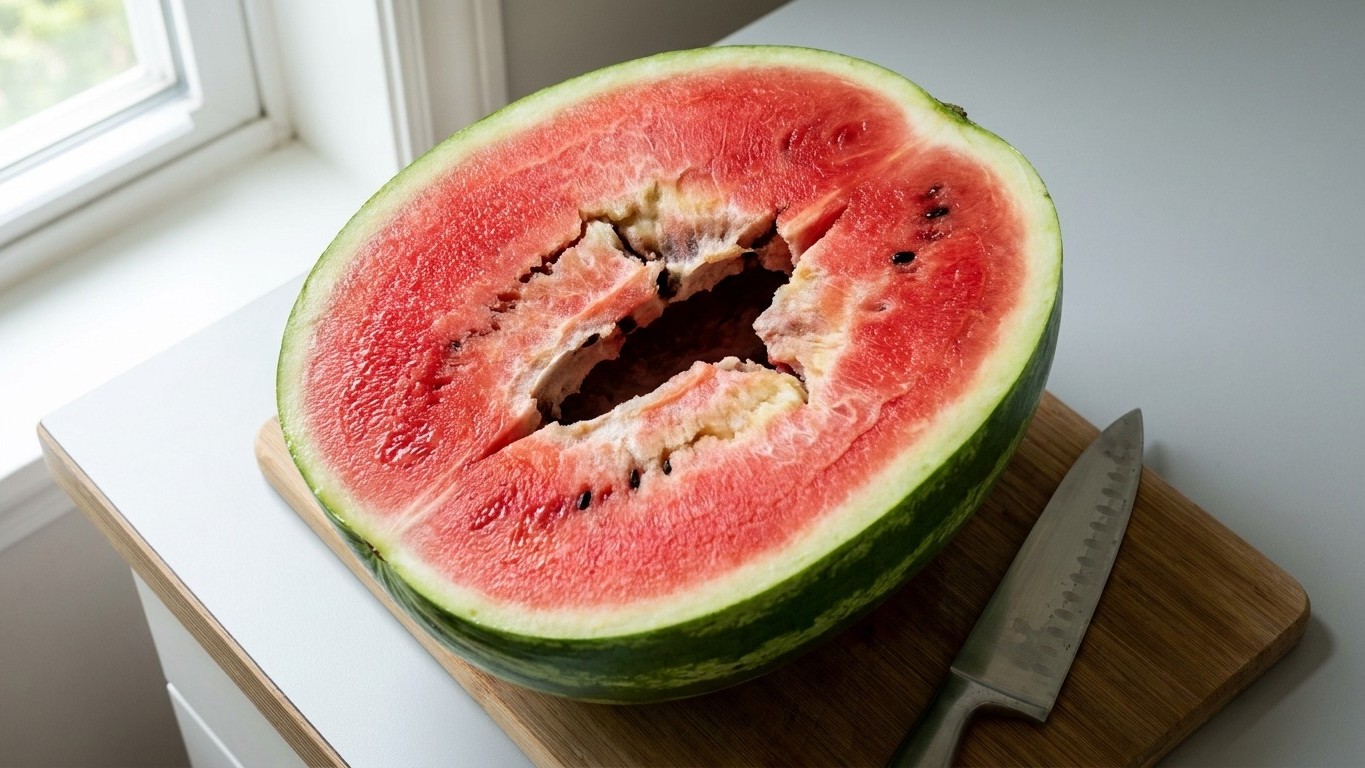

A hollow or cracked center inside an otherwise perfect watermelon is called hollow heart. It’s a physiological disorder tied to how the fruit grew, not a sign of rot, disease, or pests. The flesh around the crack is still safe to eat, though it can taste less sweet and feel a bit mealy near the gap. Nothing on the rind warns you before the knife goes in.
What is actually going on

The thing to understand here is uneven growth: the flesh grows in bursts when conditions swing, and the center tears where it cannot keep up. A watermelon fills out from the inside, and the tissue at the core, where the three seed cavities meet, is the last part to catch up when growth accelerates suddenly. If the outer flesh and rind expand faster than that central tissue can fill in, a gap opens right where the core would normally be solid.
Seed development plays a bigger role in this than most gardeners expect. Flesh growth around a developing seed tends to be more even and complete, because the seed itself signals the surrounding tissue to keep pace. Where pollination was weak or patchy, fewer seeds form, and the flesh in those thin-seed zones grows in fits and starts instead of steadily. That’s part of why seedless (triploid) types, which rely on a nearby pollenizer plant for even a partial seed set, tend to show hollow heart more often than standard seeded types. This isn’t a reason to avoid seedless melons, just a reason to know the risk is baked into how that type reproduces.
Shape matters too, though less predictably. Long, oblong melons seem to develop the disorder somewhat more than round ones, likely because the growth wave has farther to travel from stem end to blossom end. None of this is a reason to chase a specific variety name promising immunity. Trial results shift by region and by season, and the type best suited to your soil and your summer is something your state’s cooperative extension service tracks far better than any general guide can.
One thing hollow heart is not: a sign the melon was picked too early or too late. It’s set in motion during the fruit’s growth weeks before harvest, and it has nothing to do with ripeness at the time you cut the stem. A watermelon doesn’t ripen after picking, it only softens, because sugar stops arriving in the flesh the moment the vine connection is severed. So leaving a melon on the vine longer, or pulling it earlier, does nothing to prevent or fix a hollow center. It only changes how sweet the flesh was allowed to become before you cut it loose.
In the garden
Three things drive the growth swings behind hollow heart: pollination, temperature, and water. Each one can push flesh development out of sync in a different way, and each shows up differently depending on what goes wrong.
| Factor | What goes wrong | What happens instead |
|---|---|---|
| Pollination | Too few pollinator visits, cool mornings when bees stay in the hive, or a seedless block planted without enough pollenizer vines nearby | Seed set is thin or uneven, and the flesh around those seed-poor zones grows irregularly, leaving gaps at the core |
| Temperature | A hot stretch right as fruit sets, followed by a cold snap, or the reverse | Growth surges then stalls, and the outer flesh outpaces the slower-growing center |
| Water | A dry spell followed by heavy irrigation or a big rain | Cells expand rapidly all at once, faster than the internal structure can fill in evenly |
| Fertility balance | A heavy dose of nitrogen close to fruit set, pushing fast vegetative and fruit sizing | Fruit sizes up quickly while internal tissue lags behind, widening the risk of a hollow core |
Notice that none of these are things a gardener fully controls. You can interplant pollenizer rows for seedless types and keep an eye on bee activity during bloom, and you can aim for steady soil moisture instead of feast-or-famine watering. But a heat wave followed by a cool night is weather, not a mistake, and no amount of good practice cancels it out completely. Extension trials in several states have found hollow heart rates swinging year to year in the same field with the same variety, which tells you plainly how much of this is weather-driven rather than something a gardener did wrong.
The good news sits right there in the disorder’s name: it’s a heart problem, not a whole-fruit problem. The flesh surrounding the cavity is almost always fine to eat, sometimes a touch less sweet right at the edge of the crack, but not spoiled. Cut around the hollow section and serve the rest as you normally would. There’s no food-safety reason to discard a melon over hollow heart alone, only a texture and appearance issue at the center.
What it depends on where you are
How often hollow heart shows up, and how bad it gets, depends heavily on where you garden. Season length shapes how much of the fruit’s growth happens during the hottest, most volatile stretch of summer. Regions with long, humid growing seasons give melons more time to develop steadily, while regions where the whole crop rushes through a short warm window compress that growth into a period more prone to sudden swings.
Summer heat patterns matter just as much. A region that runs consistently warm through fruit development tends to see steadier flesh growth than one where heat waves alternate with cool fronts, because it’s the swing, not the heat itself, that opens the cavity. Rainfall follows the same logic: a place with steady, evenly spread summer rain gives roots a predictable water supply, while a place that alternates drought with downpours (a pattern more common in parts of the central and southern Plains, for instance) tends to see more of the rapid, uneven cell expansion that drives hollow heart.
Which pattern describes your yard changes state by state and even county by county. What it can tell you is where to look. Your state’s cooperative extension service runs local variety trials and tracks hollow heart incidence by type and by season, and that data reflects your actual soil and climate in a way no national guide can match.
The mistake that costs the most
The costliest mistake gardeners make with hollow heart isn’t in how they water or fertilize. It’s picking the melon early “just in case,” on the mistaken belief that leaving it on the vine longer is what causes the hollow center. It isn’t. The disorder is set in motion during the fruit’s growth weeks before harvest, driven by pollination, temperature swings, and water inconsistency, not by how many extra days the melon spends on the vine at the end.
Picking early does nothing to prevent hollow heart. What it does guarantee is a less sweet melon, because sugar accumulation stops the instant the stem is cut. A watermelon doesn’t finish ripening on the counter or the windowsill, it only softens as its cells break down, while sugar content stays frozen at whatever level it reached on the vine. So a gardener who harvests early to “play it safe” trades away real sweetness for a problem that early picking never actually solves.
The better move is to judge harvest timing the normal way (checking the ground spot color, the dried tendril nearest the stem, and a dull rather than shiny rind sheen, ideally cross-checked against guidance for the type you’re growing) and accept that hollow heart, if it’s going to happen, was already decided by the growing conditions weeks earlier. If it turns up when you finally cut the melon, that’s frustrating, but it’s not a reason to change your harvest timing next season. It’s a reason to look at pollination coverage and watering consistency instead, and to bring the question to your local extension service, which can tell you how common the disorder has been in your area’s trials this year compared with a typical one.