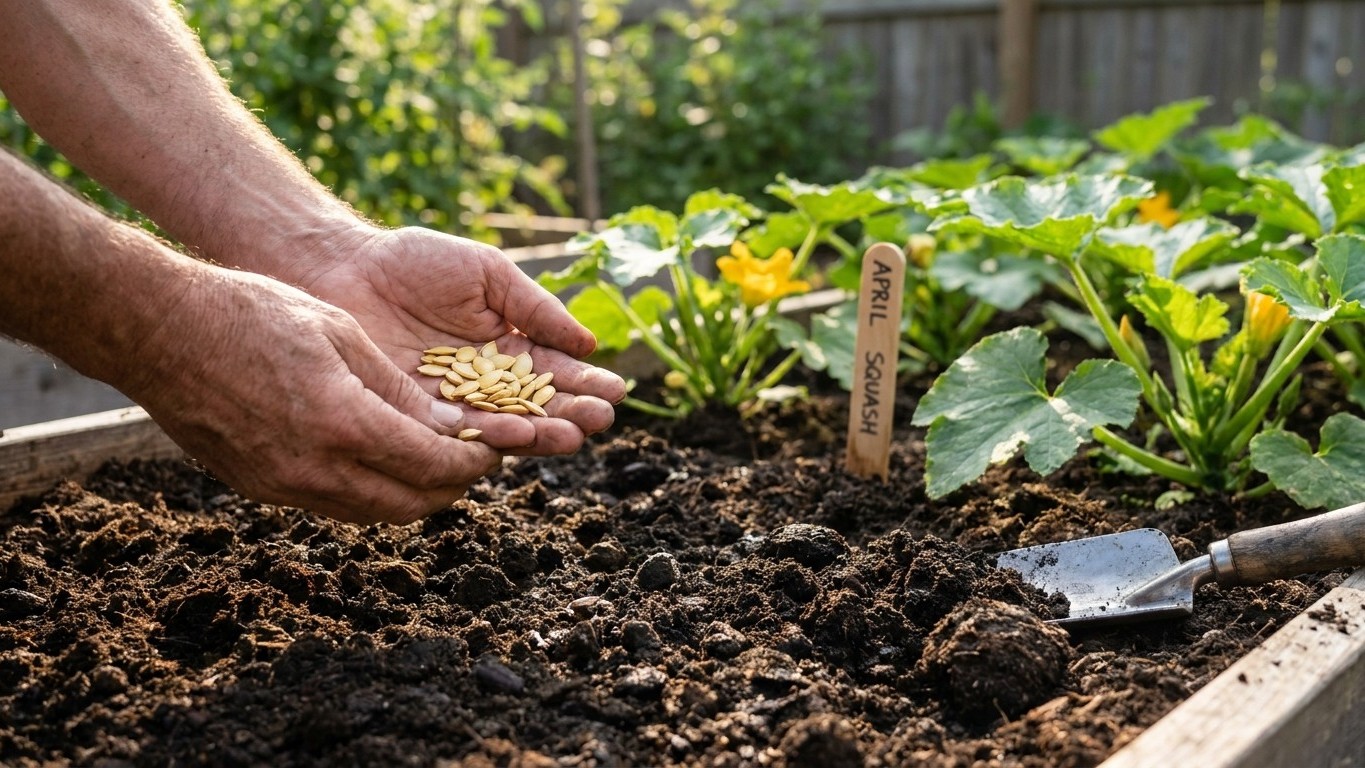

Direct-seed Summer Squash in Kentucky once the soil has shaken off its spring chill, generally from late April through May, and keep sowing every few weeks into July. That window sits between the state’s last spring frost and its first fall frost, but those two dates only tell part of the story.
The short answer for Kentucky
Kentucky’s last spring frost falls between March 24 and April 4, and the first fall frost arrives between November 2 and November 12, according to NOAA’s 1991-2020 Climate Normals for the reference station. Those dates are not guarantees. They mark the window where a 32°F freeze has a 30 to 70 percent chance of occurring, meaning even after April 4 there’s still a real chance of a cold snap, and before November 2 there’s already a real chance of one arriving early.
Summer squash seed itself doesn’t care much about air frost. It cares about soil temperature, and cold soil rots seed before it ever sprouts. Because the spring frost window only closes (in the 70 percent sense) by early April, most Kentucky gardeners wait two to four more weeks past that date before direct-seeding, landing the safe start in late April to mid-May. That gives the soil time to climb well above the 32°F freeze risk and into the 60s, where squash germinates reliably.
From there, the calendar opens wide. Summer squash matures in roughly 50 to 65 days, so a mid-May sowing is harvesting by early July, and there’s room to plant a second and third round through June into early July for a rolling harvest. Counting backward from the November 2 to 12 fall frost window, the last realistic sowing date lands in early August, leaving enough days for the plant to mature and produce before cold weather shuts it down.
One caution matters here. The reference station behind these frost dates sits in an urban setting, and the National Weather Service office covering it has flagged that this kind of station tends to record later spring frosts and earlier fall frosts than the rural county around it. A garden outside the city limits should treat the window as tighter than the dates suggest, not wider. That means rural growers may want to lean toward the later end of the spring range and the earlier end of the fall range when deciding when to plant and when to expect the season’s last squash.
What will not work here
Short season isn’t the threat in Kentucky. With roughly 210-plus days between the latest spring frost and the earliest fall frost, there’s more than enough room for summer squash’s 50 to 65 day cycle, even with a cautious start. The failures here come from a different direction: heat load and watering habits.
Kentucky racks up an average of 37.2 days a year at or above 90°F. That’s more than a month of the growing season spent in genuine heat stress territory, and it’s concentrated right when squash plants are flowering and setting fruit. A watering schedule that works fine in a mild June starts failing in a 90°F July, when a shallow, once-a-week soak simply can’t keep pace with what the plant loses through its leaves in a single afternoon.
Rainfall doesn’t rescue the situation as much as the seasonal total suggests. Summer brings about 12 inches of rain across June, July and August, but it isn’t spread evenly.
| Month | Average rainfall |
|---|---|
| June | 4.27 inches |
| July | 4.05 inches |
| August | 3.71 inches |
August is both the driest summer month and, typically, one of the hottest stretches of the season. A gardener relying on rainfall alone to carry squash through August is setting up exactly the kind of gap that causes blossom drop and stunted fruit. And because Kentucky summer rain often arrives as thunderstorms rather than steady soaking rain, a chunk of that 3.71 inches can run off a hard, dry surface instead of reaching the root zone, especially on compacted or clay-heavy ground.
Humidity compounds the problem in the other direction. Ohio Valley summers stay muggy, and summer squash planted too close together in that kind of air holds moisture on its leaves longer after rain or dew, which is exactly the condition powdery mildew and other fungal issues need to take hold. Tight spacing that might be forgivable in a drier climate becomes a liability here.
What changes across Kentucky
Kentucky isn’t one climate wearing a single planting date. The state spans USDA Hardiness Zones 6a to 7a, a range built entirely on average annual extreme minimum winter temperature. That’s a measure of winter cold, not a direct measure of spring warm-up speed or summer heat, but it’s a useful marker of just how much the state varies from one end to the other.
A full zone of difference, 6a versus 7a, generally works out to a 5 to 10 degree gap in typical winter lows, and in practice it tracks with real differences in how early the ground warms in spring. Higher-elevation and northern parts of the state tend to sit on the cooler 6a end, while western and southern lowland areas, closer to the Ohio and Mississippi river systems, tend to run warmer, closer to 7a. There is no single safe planting date that fits both ends evenly.
A gardener in a cooler, higher-elevation part of the state should treat the state’s late April to mid-May window as an outside floor, not a target, and lean toward the later weeks of that range before trusting the soil. Someone in a warmer, lower-elevation county may be able to start slightly earlier than the state-wide window suggests, and can likely push a final summer sowing a bit later into August than the general cutoff implies.
None of this replaces knowing your own location on the map. The USDA Plant Hardiness Zone Map lets you check exactly where your specific address falls within that 6a to 7a spread, rather than guessing from a state-wide range that, by definition, doesn’t describe any single garden precisely.
Where to check this for your own county
Everything above describes Kentucky as a whole, built from a single reference station and a statewide hardiness range. That’s useful for understanding the pattern, but it’s not a substitute for what your county’s extension office already knows about your specific soil, elevation and microclimate.
The University of Kentucky Cooperative Extension Service is the right next stop. Look specifically for two things once you’re there: a county-level planting calendar that adjusts the general spring and fall windows for your local conditions, and any list of summer squash varieties that extension agents have actually trialled in gardens near you. Varieties that perform well in a humid, mildew-prone eastern county aren’t always the same ones recommended for a drier, hotter western county.
A county-level recommendation will always beat a state-level one, because it accounts for local elevation, local frost pockets and local pest pressure in a way a statewide average simply can’t. This page describes Kentucky broadly, using data from one reference station and a statewide hardiness range. Your county extension office describes your patch of ground specifically, and that’s the version worth following when the two disagree.
Checking this against your own garden
Every date on this page is a normal, built from decades of past weather. Your garden this year is not a normal, it’s a specific place experiencing a specific spring, and it will tell you things no calendar can.
Start with the soil itself. Push a finger a few inches down in the bed where you plan to plant. If it still feels cold and heavy, wet in a way that clings rather than crumbles, the ground hasn’t caught up to the calendar yet, regardless of what the date says. Squash seed sitting in soil like that is more likely to rot than sprout.
Watch for the first male flowers once plants are up and growing. Summer squash typically produces a flush of male blooms before the female flowers that actually set fruit appear, and a strong early flush is a decent sign the plant considers conditions favorable. A long delay, or male flowers dropping without any females following, often points to heat or water stress rather than a timing mistake.
Watch the first true leaves as well, the ones that appear after the initial seed leaves. Slow, pale, or stunted true-leaf growth in what should be warm soil usually means the microclimate in that particular bed, shaded by a fence, sitting in low ground, exposed to wind, is running cooler or harsher than the general county pattern suggests. That’s information your own eyes gather faster than any frost date ever will.