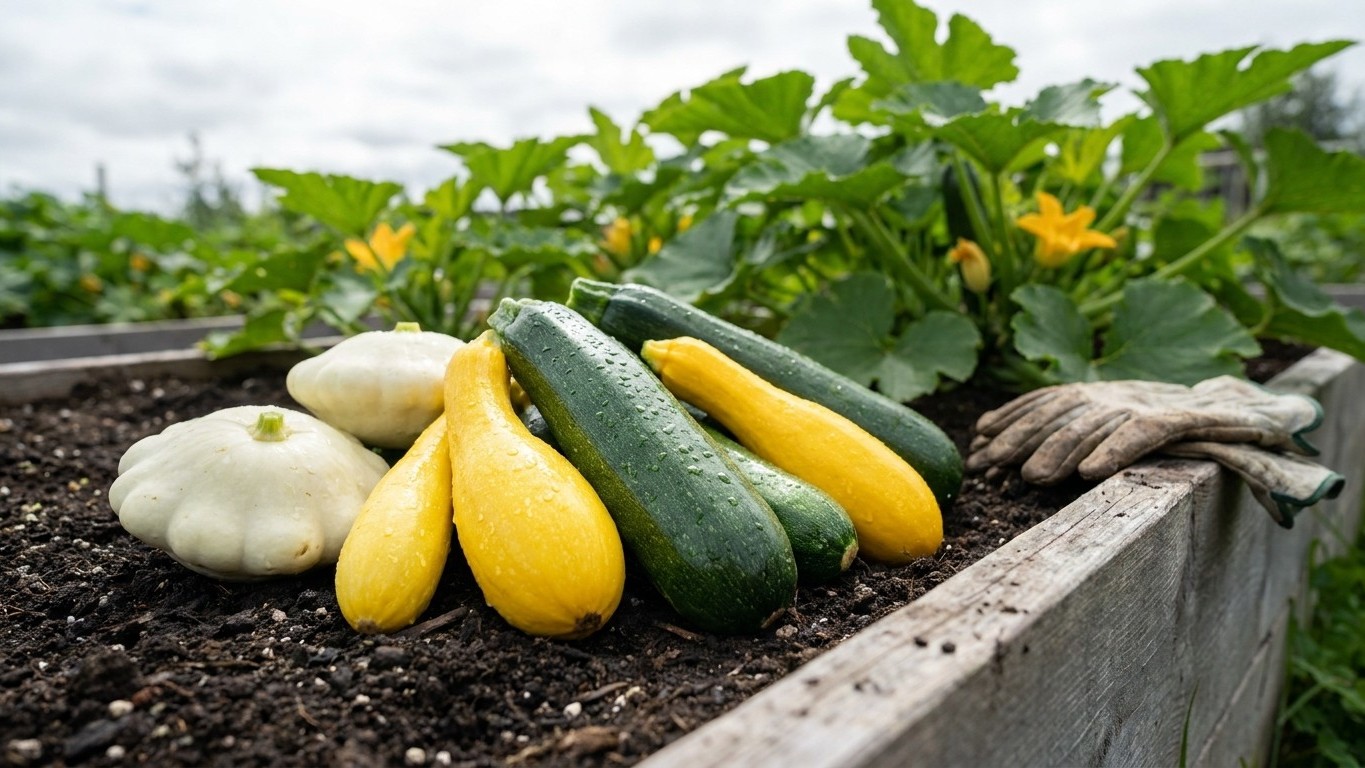

Missouri’s long frost-free window (April 6-20 to October 18-29) means summer squash isn’t racing the calendar here the way it might further north. The real decision is by type: bush zucchini and yellow crookneck for steady, succession-planted harvests, with vining types like tromboncino reserved for gardeners who can keep up with irrigation through the driest weeks of August.
The short answer for Missouri
Start with the math. Last spring frost lands somewhere between April 6 and April 20, and first fall frost arrives between October 18 and October 29. Stack the earliest and latest ends of those two windows and you get a frost-free season running roughly 180 to 205 days, depending on where in that spread your garden actually sits. That’s a long runway. Almost every summer squash type, whether it needs 45 days or 65, fits inside it with room to spare.
Which means maturity length isn’t the filter that matters most in Missouri. Heat is. The reference station averages 32.7 days a year at or above 90°F, and most of those days cluster in July and August, right when a spring-planted squash patch is trying to hold its fruit set. Rainfall doesn’t help much during that stretch either: June brings 5.25 inches, July drops to 4.58, and August, the driest of the three, averages just 4.24 inches. A long season with a hot, dry middle rewards bush types you can plant more than once.
What actually does well
Bush zucchini and bush yellow crookneck or straightneck squash are the safest bet for most Missouri gardens. They mature fast enough to squeeze in two or even three sowings across that 180-to-205-day window, so if squash bugs or powdery mildew take out the first planting by mid-July, a second one started in early July is already fruiting by September. Pattypan and scallop types, bred compact, work well in raised beds and small plots where airflow around the plant matters more than usual given the summer humidity.
Vining summer squash, tromboncino being the best-known example, needs more square footage and a lot more attention to soil moisture during those low-rainfall August weeks. It’s not a bad choice. It’s a choice that assumes you’re watering on a schedule, not hoping the sky does it for you.
What will not work here
The biggest mistake isn’t picking a variety that matures too slowly. Almost everything fits Missouri’s season length. The failures here are management failures dressed up as variety problems.
Weekly watering is the first one. With August averaging only 4.24 inches spread across an entire month, and 32.7 days a year pushing past 90°F driving off soil moisture fast, a once-a-week soak leaves the root zone dry for days at a stretch. Squash responds to that stress with blossom drop and misshapen, bitter fruit, and the gardener usually blames the seed packet instead of the watering can.
Tight spacing is the second failure, and it’s specific to Missouri’s rainfall pattern. That 14.1 inches of summer rain rarely falls as a gentle, even drizzle. It tends to arrive as thunderstorms, dumping moisture fast and leaving humid air behind. Bush varieties planted close together trap that humidity around the leaves, and powdery mildew and bacterial wilt move through a crowded row far faster than through one with airflow. A variety marketed as disease-resistant still struggles if it’s shoulder to shoulder with its neighbors.
A single spring planting is the third failure. Because the season here runs long and hot, squash vine borer and squash bug populations build steadily through June and July. A patch sown only in April is often collapsing by the time those pests peak in midsummer, precisely when a second sowing could be coming into its prime. Treating the long Missouri season as an excuse to plant once and walk away wastes the extra weeks the calendar is actually offering.
Finally, planting by a single fixed date rather than the frost range itself is its own kind of failure. The last spring frost data covers a full two-week spread, April 6 to April 20. Treating one specific day as gospel ignores the built-in uncertainty in that number, and a late cold snap inside that window can still take out tender seedlings set out too early.
What changes across Missouri
Missouri isn’t one growing zone, it’s several stacked on top of each other. The USDA Plant Hardiness Zone Map (2023, built on 1991-2020 normals) places the state anywhere from 5b to 7b, and that’s built on a single measure, the average annual extreme minimum temperature. It’s not a planting calendar on its own, but the spread it represents tells you how differently spring and fall behave from the northern border to the Bootheel.
The frost and heat figures cited here come from a reference station north of Kansas City, and even within that immediate area there’s variation: downtown Kansas City runs about five days earlier in spring than the reference station. Southern Missouri, sitting in the warmer end of that 5b-7b range, tends milder still, with an earlier last frost and a later first fall frost than the numbers on this page describe.
What that means in practice: a gardener near the state’s northern edge, closer to the cooler end of the hardiness range, should expect to plant later and finish earlier than the statewide dates suggest, effectively working with the shorter end of that 180-to-205-day window. Someone farther south, in the warmer end of the range, often has room to start earlier in spring and push a second succession sowing later into fall than the reference-station dates would indicate. Neither is wrong. They’re different gardens inside the same state, which is exactly why a single sowing date for all of Missouri doesn’t hold up. Figuring out which end of that range applies to a specific address means checking the hardiness zone map directly rather than guessing from a regional average.
Where to check this for your own county
Everything above describes Missouri as a whole, built from one reference station and a statewide hardiness range. That’s useful for spotting the pattern, but it’s not a substitute for what your own county’s extension office has already worked out. The University of Missouri Extension runs that program, and its site is the place to go next.
Two things are worth pulling up there specifically. First, the local planting calendar for your county or region, which accounts for the microclimate differences this page can only gesture at, the five-day spring gap between a reference station and downtown, or the milder pattern further south. Second, look for variety trial results from your part of the state. County extension offices and university trial gardens test summer squash types against local disease pressure, local soil, and local pest timing, which a statewide article can’t replicate.
The plain truth is a county recommendation beats a state one every time. This page works at the state level, useful for understanding why Missouri behaves the way it does and which broad type of summer squash fits that pattern. But the specific variety that shrugs off powdery mildew in a humid river-bottom county might not be the same one that performs best on a well-drained ridge two counties over. That level of detail lives with your local extension office, not on a page written for the whole state.
Checking this against your own garden
Every date and average on this page describes a normal, not a promise. The garden in front of you settles the actual question, and it does that through a few signs anyone can read without a single tool.
Soil warmth by feel is the first one. Summer squash seed germinates poorly in cold soil no matter what the calendar says. Push a finger a couple of inches into the bed in spring; if it feels cool and damp rather than merely cold, that’s usually a better cue than a fixed date pulled from a regional average.
The first flush of male flowers is the second sign worth tracking. Squash plants typically send out male blossoms before the female flowers that actually set fruit appear. A garden producing male flowers early and heavily, but no fruit, isn’t failing, it’s just running slightly ahead of its own pollinator population or its own timing, and that gap tends to close within a week or two.
The first true leaves, the ones that appear after the initial rounded seed leaves, are the third thing to watch. Slow, pale true-leaf growth in a bed that’s supposedly warm enough usually points to a soil or drainage issue specific to that spot, something no statewide frost date or rainfall average can flag. A patch of ground that lags behind the rest of the garden year after year is telling you something about its own microclimate that’s worth listening to more than any number on this page.