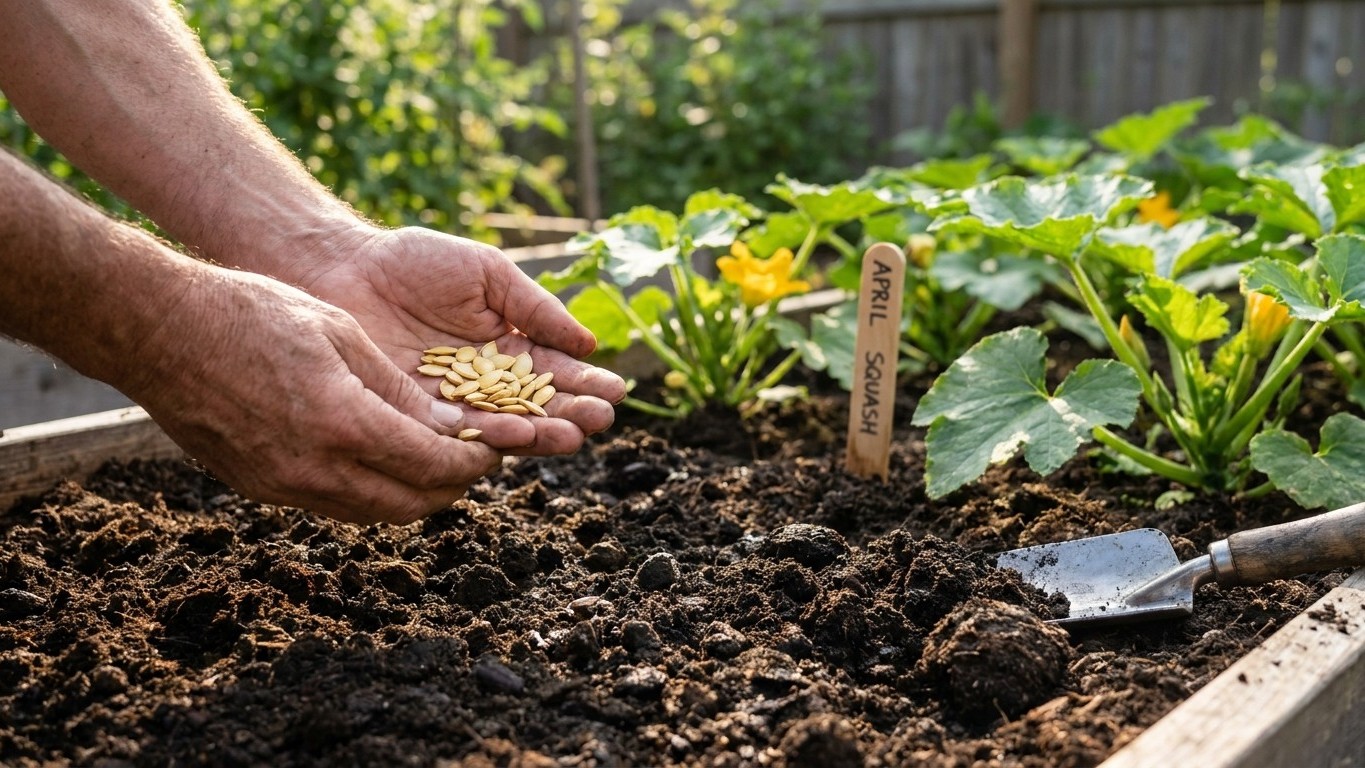

New Jersey gardeners can direct-seed summer squash outdoors once the soil has warmed past the reference frost window of March 29 to April 6, which puts most safe sowing dates from late April into May, with succession plantings running into early July. That window comes from one weather station, not your backyard, so treat it as a starting point, not a rule.
The short answer for New Jersey
Summer squash is a warm-season, frost-tender crop. It does not go in the ground at the last frost date itself, it goes in after that date, once the soil has had time to warm. For the reference Newark airport station (NOAA NCEI U.S. Climate Normals 1991-2020), the last spring freeze at 32F falls in the 30-70% probability band between March 29 and April 6. That band is the range where a freeze is neither a sure thing nor a rare event, so it marks the point after which cold snaps become progressively less likely, not the day squash seed should hit the ground.
In practice, that means waiting a few extra weeks past early April, until the soil itself has caught up with the calendar. Most New Jersey gardeners land somewhere in the second half of April through May for a first sowing, with the caution built in: this is the airport figure, and suburban and rural gardens typically see their own last frost land one to two weeks later, more at elevation. If your yard sits in a low spot or a valley that collects cold air, push the date back further rather than trust the station number.
The other end of the season comes from the first fall frost, which the same station puts between November 4 and November 16. Summer squash usually matures in roughly 50 to 60 days from seed, so even a cautious May planting leaves a wide cushion before that fall date arrives. That cushion is exactly what makes succession sowing worthwhile here: a second or third round of seed dropped in through late June or the first days of July still has time to mature before frost risk climbs, and it keeps a harvest coming after the first flush of plants slows down or succumbs to pests.
Heat matters too. The reference station averages 20.8 days a year at or above 90F, a heat load that speeds up both growth and water loss once plants are established. That number does not change when to plant, but it shapes how the plants behave once they are in the ground, which the next section covers in more detail.
What will not work here
The single most common failure is not a season-length problem, it is a timing problem at the front end. Summer squash seed dropped into cold, wet soil before the frost window has passed tends to rot before it germinates rather than wait patiently for warmth. New Jersey’s spring frost band running into early April means an eager gardener sowing in March, thinking they are getting a jump on the season, is usually just feeding seed to the soil. Squash does not reward an early start the way a cold-tolerant crop does; it punishes it.
At the other end of summer, the failure mode flips. With 4.15 inches of rain typically falling in August, the driest of the three summer months, against June’s 4.34 inches and July’s 4.66 inches, a garden that gets by on rainfall alone in June and July can suddenly run short exactly when the days above 90F are stacking up. Squash plants under that combination, heat plus a drying month, drop blossoms, produce misshapen fruit, or simply stall. A once-a-week watering habit that worked fine in a cooler, wetter June often is not enough by August, particularly on sandy soil that drains fast; the same inch of rain that lingers in clay for a week can be gone from sand within a day.
Humid New Jersey summers also punish tight spacing. Powdery mildew thrives when air cannot move freely between plants, and a garden that crowds squash hills close together to save space is inviting the white, dusty coating that eventually shuts down photosynthesis and fruit production. This is not a soil or a frost issue, it is a spacing-meets-humidity issue, and it shows up reliably in gardens that treat squash like a compact crop instead of the sprawling, air-hungry plant it actually is.
None of these are exotic risks. They are the predictable result of the state’s own numbers: a spring cold window that punishes early seed, a dry August riding on top of a heat load near 21 days over 90F, and summer humidity that turns close spacing into a mildew incubator.
What changes across New Jersey
New Jersey is not one climate. The USDA Plant Hardiness Zone Map (2023 edition, built on 1991-2020 normals) places the state across a 6a to 7b range, and that spread by itself tells you there is no single planting date that fits Cape May and the Skylands equally well. Zone 6a areas, generally the higher, more inland and northwestern parts of the state, run colder on average than the 7b areas closer to the coast and in the southern counties.
That two-zone difference translates into real weeks on the calendar. A garden sitting toward the colder end of that range should expect its own last frost later than the Newark reference date, its own first fall frost earlier, and therefore a shorter practical window for squash than a garden near the milder end. Elevation compounds this: a property in the northwestern highlands can run noticeably cooler than a similarly-latitude spot at low elevation closer to the shore, simply because cold air settles and lingers longer at height.
The USDA zone system itself is worth naming plainly here, because it is built on exactly one variable, the average annual extreme minimum temperature. It says nothing about summer rainfall, humidity, or how many days a location spends above 90F, all of which also vary across the state and all of which matter more to a summer squash planting than the winter minimum ever will. Two gardens in the same hardiness zone can still see different rainfall patterns and different mildew pressure.
None of this points to a single fix a reader can apply from this page. The honest answer is that a 6a garden and a 7b garden in the same state are working with different calendars, and figuring out which end of that range applies to a specific property means checking the map rather than guessing from a town name or a general sense of “North Jersey” versus “South Jersey.”
Where to check this for your own county
This page describes New Jersey as a whole, which by definition smooths over the county-to-county differences that actually decide when squash goes in the ground on any one property. The place to narrow that down is Rutgers Cooperative Extension (NJAES), the state’s land-grant university extension service.
Once there, look for two specific things rather than browsing generally. First, a county-level or regional planting calendar, which will reflect local frost data and growing conditions more closely than a single statewide airport station ever can. Second, any list of summer squash varieties that Rutgers or a county extension office has actually trialled in New Jersey conditions, since variety performance against local disease pressure and humidity is exactly the kind of detail a state-level page cannot responsibly provide.
A county recommendation beats a state one every time, because it is built closer to the soil a reader is actually planting into. This page works at the state level on purpose. It uses one reference station’s frost and rainfall normals to describe patterns that hold reasonably well across New Jersey, but it cannot account for a specific county’s microclimate, soil type, or the particular pest pressure a local extension office tracks year to year. Treat what is written here as the broad outline and treat the county extension office as the fine print that actually applies to a specific yard.
Checking this against your own garden
Every date on this page is a probability drawn from one weather station’s history. A reader’s own soil and plants outrank all of it, and three simple observations settle the question better than any calendar.
The first is soil warmth, checked by hand rather than by thermometer. Squash seed sitting in soil that still feels cold and heavy to the touch, even weeks after a calendar date says it should be fine, is soil that has not caught up with spring yet, often because of shade, heavy clay, or a low, damp spot that holds cold longer than the surrounding yard.
The second is the first flush of male flowers. Squash plants typically produce male blossoms before female ones, and a strong early show of male flowers with few or no females forming behind them usually means the plant is still adjusting to its conditions, whether that is heat stress, inconsistent watering, or simply youth. Female flowers, recognizable by the small swelling at their base that becomes the fruit, are the sign that pollination and fruit set are actually underway.
The third is the appearance of the first true leaves, the second set that emerges after the rounder seed leaves. Slow, stunted, or oddly colored true leaves after a normal germination point to a mismatch between the plant and its spot, whether that is soil temperature, drainage, or light, and it is a far more reliable signal of local conditions than counting days since a frost date on a page written for the whole state.