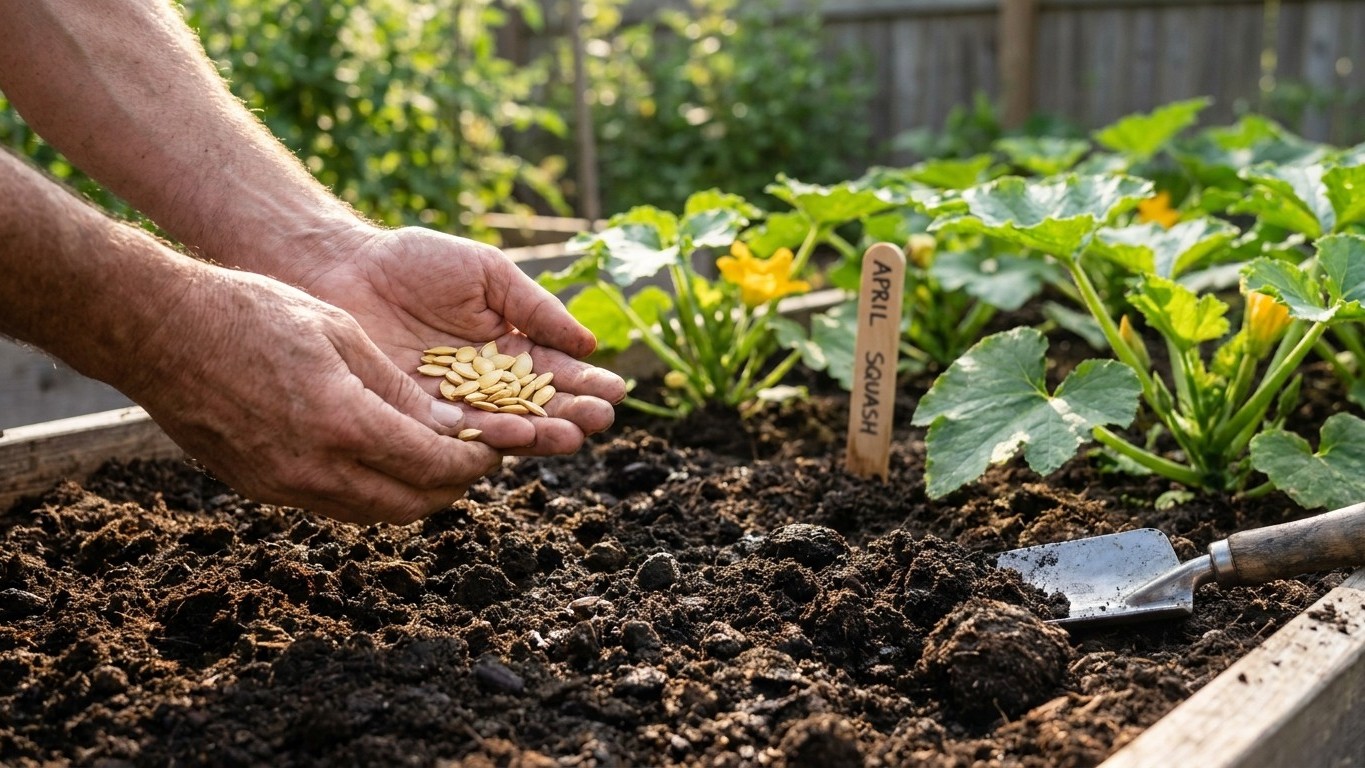

Summer squash needs warm soil, not just a frost-free calendar date, so in the New York City area the safe direct-sow window runs from mid-May through early June, with upstate and higher-elevation gardens waiting until late May or even mid-June. The frost dates below tell you when the air stops threatening the plant. Soil temperature and season length tell you when it will actually grow.
The short answer for New York
NOAA’s Climate Normals for the New York City reference station put the last spring frost between March 23 and April 3, and the first fall frost between November 14 and November 27. Those aren’t single dates. They mark a 30 to 70 percent probability band for a 32°F freeze, meaning even by the later date there’s still a real chance of frost, and by the earlier one the odds have only dropped to about even. Treat the window as a fade-out, not a switch.
That matters for summer squash because the seed itself is the limiting factor, not the plant. Squash seed barely germinates in soil under 60°F, and it rots outright in cold, wet ground. Waiting for the calendar date of last frost still often means sowing into soil in the low 50s, which stalls germination for a week or two and invites the exact seedling diseases growers blame on “bad seed.” The practical fix used across the region is to let three to four weeks pass after the last-frost window closes before direct-sowing, which for the NYC area lands sowing in mid-May to early June.
Run the other end of the calendar and the picture gets more forgiving. Even using the earlier fall-frost estimate of November 14, a New York City garden that sows in late May has roughly 170 days of frost-free growing season ahead of it. Summer squash reaches first harvest in about 45 to 55 days from direct sowing, so the crop has enormous slack at the back end. The real risk in New York isn’t running out of season. It’s starting too early and losing two or three weeks to a stand that never really took off.
This page can only speak from the New York City reference station’s numbers. Anyone gardening upstate, in the Southern Tier, or at elevation in the Adirondacks is working with a materially shorter, later, colder frost-free stretch than what’s cited here, a point the next two sections deal with directly.
What will not work here
Sowing on the calendar date of last frost, rather than three to four weeks after it, is the single most common failure in this region. The March 23 to April 3 window is a probability, not a guarantee, and soil at that point is still cold from winter. Seed put in the ground during that window either rots or sits dormant while later-sown seed, planted into warmer soil, catches up and passes it within days. There’s no yield advantage to an early sowing here. There’s only added risk.
Watering on a fixed weekly schedule is the second failure, and the summer rainfall numbers explain why. The New York City area averages about 13.7 inches of rain across June, July, and August, with June the driest month at 4.54 inches. That sounds like plenty, but the region also averages 12.2 days a year at or above 90°F, and that heat drives evaporation fast. The rain rarely arrives as a gentle, soaking inch spread evenly across the week. It tends to come as a single thunderstorm that dumps its total and runs off a still-dry root zone rather than soaking in. A garden on a fixed once-a-week watering habit, especially on sandy or compacted soil, can go through a stretch of 90°F days between storms with the root zone bone dry the whole time. Summer squash under that kind of stress drops blossoms and produces bitter, misshapen fruit even when the vine itself looks fine.
Crowding is a humidity problem, not just a space problem
Tight spacing is the third failure, and it’s specific to how New York summers combine heat and rainfall. Powdery and downy mildew both spread fastest where foliage stays damp and airflow is poor, and a summer with regular thunderstorm rainfall plus stretches of 90°F humidity gives both diseases exactly the conditions they need. Squash planted at the spacing recommended for a drier, less humid state will mildew out here weeks before it would somewhere with less summer moisture. Wider spacing than the seed packet suggests, and morning watering that lets foliage dry by afternoon, do more for a New York summer squash stand than any fungicide schedule.
What changes across New York
New York spans USDA hardiness zones 3b to 7b, one of the widest ranges of any state in the Northeast, and that spread comes from just one measurement: the average annual extreme minimum winter temperature. A zone 3b winter regularly bottoms out near -35°F. A zone 7b winter on Long Island rarely sees single digits. That’s not a difference of degree. It’s a different growing world, and it means there is no single New York planting date for summer squash, only a state-wide range framed by the frost data cited above for the New York City reference station.
The practical effect for summer squash lands on both ends of the season. In the Adirondacks and much of the North Country, sitting in the colder end of that zone range, the frost-free season starts later than the March 23 to April 3 NYC window and ends earlier than the November 14 to 27 NYC window, sometimes by three to five weeks on each side. A grower there working off the New York City dates in this article risks sowing into ground still too cold and racing a fall frost that arrives well before Thanksgiving. Elevation compounds it further. Even within a single county, a garden 800 feet higher than the valley floor can run a week or two behind on both spring warmup and fall frost arrival, independent of hardiness zone.
This page can’t tell an individual reader which of those zones applies to their own yard, and it shouldn’t try. The USDA Plant Hardiness Zone Map lets you check a zone by ZIP code, and that number, combined with your own frost history, is a far better guide than a single statewide date range built from one Manhattan-area station.
Where to check this for your own county
Every fact in this article comes from a single reference station in New York City. That’s useful for setting the outer bounds of a statewide answer, but it is not a substitute for county-level guidance, and Cornell Cooperative Extension exists specifically to fill that gap. Their Cornell Cooperative Extension directory links out to county offices across the state, each of which tracks local frost data, soil conditions, and variety trial results that this statewide page has no way to capture.
Two things are worth pulling from your county’s extension office specifically. First, their own local planting calendar, built from frost records at a station much closer to your actual garden than the New York City airport data cited here, which can shift a recommended sowing date by two weeks or more depending on how far you are from the city and how much elevation separates you from it. Second, their variety trial results, since Cornell’s regional research stations test summer squash cultivars for disease resistance and yield under conditions specific to that part of the state, whether that’s the humid Hudson Valley, the shorter-season North Country, or the sandier soils of eastern Long Island.
A county recommendation will always beat a state one, because it’s built from a station and a set of trial plots much closer to the garden in question. This page is deliberately the state-level version: a starting point for understanding the range New York covers, not the final word on when to sow in a specific county. Treat the numbers here as the outer edges of a range your local extension office can narrow considerably.
Checking this against your own garden
No frost date on this page knows your actual soil, and your own observation will always outrank it. Before trusting a calendar window, three checks tell you more about your specific plot than any regional average.
Push a finger two inches into the soil where you plan to sow. If it feels cold and clammy rather than merely cool, the ground hasn’t caught up to the air temperature yet, whatever the frost date calendar says, and squash seed sown into it will sit and sulk rather than germinate. A garden against a south-facing wall or fence often warms a full week or two ahead of an open bed just a few yards away.
Watch for the first male flowers once the vine is established. Summer squash produces male blossoms in a flush before the female flowers that actually set fruit appear, and a gap of more than a week or two between that first male flush and the first females can signal heat or moisture stress worth addressing before it costs you a harvest window.
Check the true leaves, not just the first seed leaves. The rounded seed leaves that emerge first say only that germination worked. The jagged, more squash-shaped true leaves that follow are the plant’s real signal that it’s established and growing, and how quickly they show up after germination is one of the clearest markers of whether your particular bed is running warm or cool for the season.