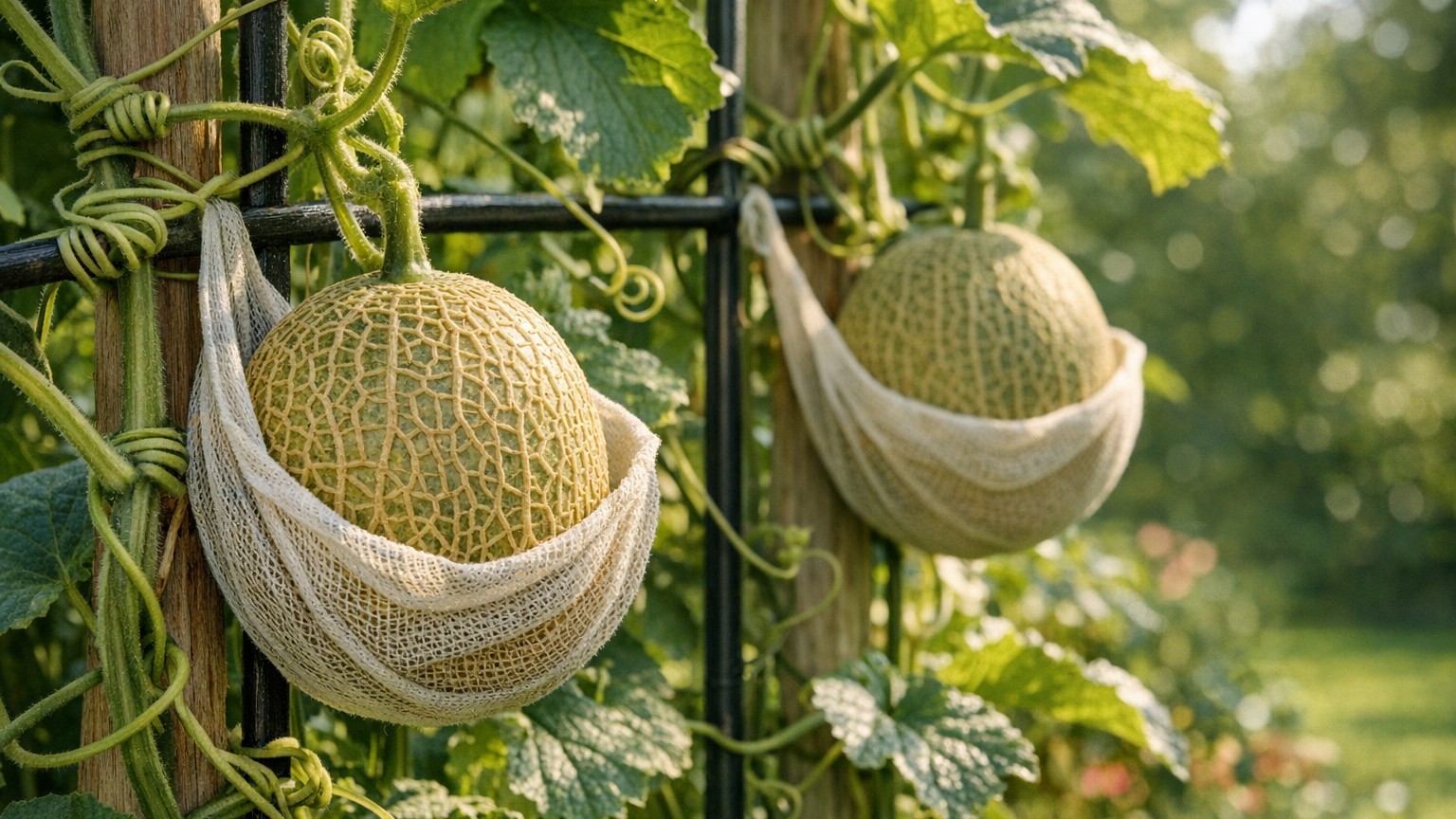

Yes, melons can be trellised, but the answer splits by size. Small and medium melons, the type most home gardeners call cantaloupe or muskmelon, climb a vertical support well when each fruit gets a sling for backup. Large watermelon-type melons are the wrong candidate for a trellis; their weight overwhelms the vine long before the fruit is ready.
What is actually going on

The thing to understand here is weight. A melon vine is strong enough to lift a fruit off the ground and hold it in the air while it grows, right up to a point. Past that point, the peduncle, the short stem connecting fruit to vine, tears under the load. Once it tears, the fruit is done growing and done sweetening. That single mechanical fact is the whole reason trellising works for some melons and fails for others: it isn’t about which type “likes” to climb, it’s about how much stress the stem can take before it gives out.
Small-fruited types, the ones that mature at a size you can comfortably hold in two hands, generally stay under that failure threshold even without help, though a sling still reduces stress on the vine and keeps the fruit from twisting as it swells. Larger types cross the threshold well before they’re anywhere near ready to pick. No amount of extra tying fixes that; the vine itself, and the point where it attaches to the main stem, simply isn’t built for that kind of cantilevered load. This is also why trellising isn’t really about the trellis. The structure just holds the vine up; the sling is what actually carries the fruit.
Ripeness is where a lot of gardeners get tripped up, trellis or no trellis. A melon builds sugar through the vine while it’s attached, drawing on the plant’s own photosynthesis right up until the stem separates. It does not continue sweetening after that. A melon that softens on a windowsill is only losing firmness, not gaining flavor, because the sugar supply stopped the moment it left the plant. That matters more on a trellis than on the ground, because a fruit under tension from its own weight is more likely to drop or tear loose a little early if the sling isn’t doing its job, and an early drop can’t be corrected afterward. There’s no do-over once the stem parts.
Trellising also changes the conditions the fruit sits in, and that has real consequences. Off the soil, a melon isn’t sitting in standing moisture, isn’t shaded by its own leaves in the same way, and gets more consistent airflow around the skin. That reduces some of the rot and pest pressure that soil-level fruit deals with, but it doesn’t change the ripening chemistry at all. Vertical growing solves a moisture and space problem; it does not solve, or even touch, the sugar problem.
In the garden
Not every melon on the seed rack is a trellis candidate, and the practical differences come down to fruit size and skin texture. The table below breaks down how the main types tend to behave vertically, and, more usefully, what goes wrong when a gardener tries to force the wrong type onto a support.
| Melon type | Trellis fit | Sling approach | What goes wrong without one |
|---|---|---|---|
| Small round, netted (cantaloupe/muskmelon-type) | Good; a common vertical crop | A soft fabric sling or repurposed mesh, tied loosely to the trellis under each fruit | Vine can usually hold the fruit alone, but stem stress and skin abrasion increase, and fruit sits crooked against the netting |
| Small to medium oval or elongated dessert types | Good, often better than round types because the shape sits into a sling neatly | Sling positioned early, before the fruit gains most of its weight | Fruit rotates and rubs against the support, developing flat, scarred patches |
| Smooth-skinned honeydew-type | Workable but skin bruises more easily, so padding matters | A wider, softer sling than for netted types, checked often for chafing | Pressure points show as soft, discolored patches that spread quickly once the fruit softens |
| Large round watermelon-type | Poor; generally not a trellis crop | Not recommended; ground growing with a barrier under the fruit instead | Peduncle tears well before maturity, dropping an unripe fruit that will only soften from here, never sweeten |
The mechanics of slinging are the same across the types that do work vertically. Wait until a fruit is set and visibly swelling, then cradle it in the sling material rather than the stem, and tie the sling to the trellis frame itself, not to the vine. The sling should support the fruit’s full weight independent of the vine, taking the load off the peduncle rather than adding another point of stress. Check the tie every week or so; melons put on weight quickly in the final stretch, and a sling that fit two weeks ago can be too tight or too loose by picking time.
Space and airflow are the other half of the trade. A vertical melon planting takes a fraction of the ground footprint of a sprawling patch, which matters most for gardeners working raised beds or small backyard plots. The airflow gain is real too: fruit and foliage lifted off the soil surface dry faster after rain or irrigation, and that alone cuts down on some of the fungal pressure that thrives in a dense, ground-level canopy. None of that changes how the fruit ripens, but it does change how much of the crop survives to ripen at all.
What it depends on where you are
The mechanics above are universal: a stem’s limits don’t change from one zip code to the next, and a sling works the same way in every climate. What changes by region is everything upstream of that, mainly how long and how reliably a season delivers the heat a melon vine needs to carry fruit from bloom to full ripeness. A short or unpredictable warm season doesn’t just mean fewer melons, it can mean fruit still bulking up when the vine’s growing window closes, and a trellised planting doesn’t buy back lost heat units any more than a ground planting does.
Humidity and rainfall patterns are the other regional variable, and they interact directly with the airflow benefit trellising provides. In a naturally dry season, the gap between trellised and ground-grown fruit in disease pressure is smaller, because ground fruit isn’t sitting in much moisture to begin with. In a humid or rain-heavy stretch, that same gap widens considerably, and lifting the fruit off the soil surface can be the difference between a clean skin and a rotted one. Wind exposure matters too: a trellis in an open, breezy spot needs sturdier anchoring and tighter sling checks than the same structure tucked against a wall or fence line.
None of this is something a general guide can settle for a specific reader, because it depends on a specific piece of ground and a specific summer. The mechanism is settled; your local season length, your typical July rainfall, and which specific varieties have performed well in trials near you are not. That’s local knowledge, and it lives with your state’s cooperative extension service and with the growing conditions covered in this site’s melon growing guides, which break the regional differences down further. Checking those sources before choosing a variety saves more disappointment than any trellis technique ever will.
The mistake that costs the most
The single costliest error is skipping the sling because the vine looks like it’s handling the fruit fine on its own. It usually does, for a while. Melon vines are surprisingly strong early on, and a small, light fruit riding a trellis without support can go weeks without any visible strain. The trouble shows up later, in the final stretch before ripeness, when the fruit has put on most of its weight and the plant’s own stem is now carrying a load it was never built to hold indefinitely. That’s exactly the point where a gardener is closest to a full-sized, nearly finished melon, and exactly the point where an unsupported peduncle is most likely to tear.
When it tears early, the fruit doesn’t just fall, it stops developing at whatever sugar level it had reached that day. Because a melon draws its sweetness from the vine right up until separation and only softens afterward, a fruit that drops a week or two ahead of schedule is not a slightly early harvest, it’s a permanently unfinished one. There’s no bringing it back on a counter or a windowsill. The plant did most of the work over many weeks, and an unsupported stem can undo all of it in a single afternoon of wind or an ordinary weight increase overnight.
The fix costs almost nothing: sling every fruit on a trellised vine as soon as it’s clearly set, not just the ones that look heavy, and check each tie roughly weekly as the fruit fills out. It takes a few minutes per plant. Skip that step, treat the sling as optional insurance rather than a basic part of the setup, and the plant will eventually collect on the debt, usually on the exact melon that was closest to being worth eating.