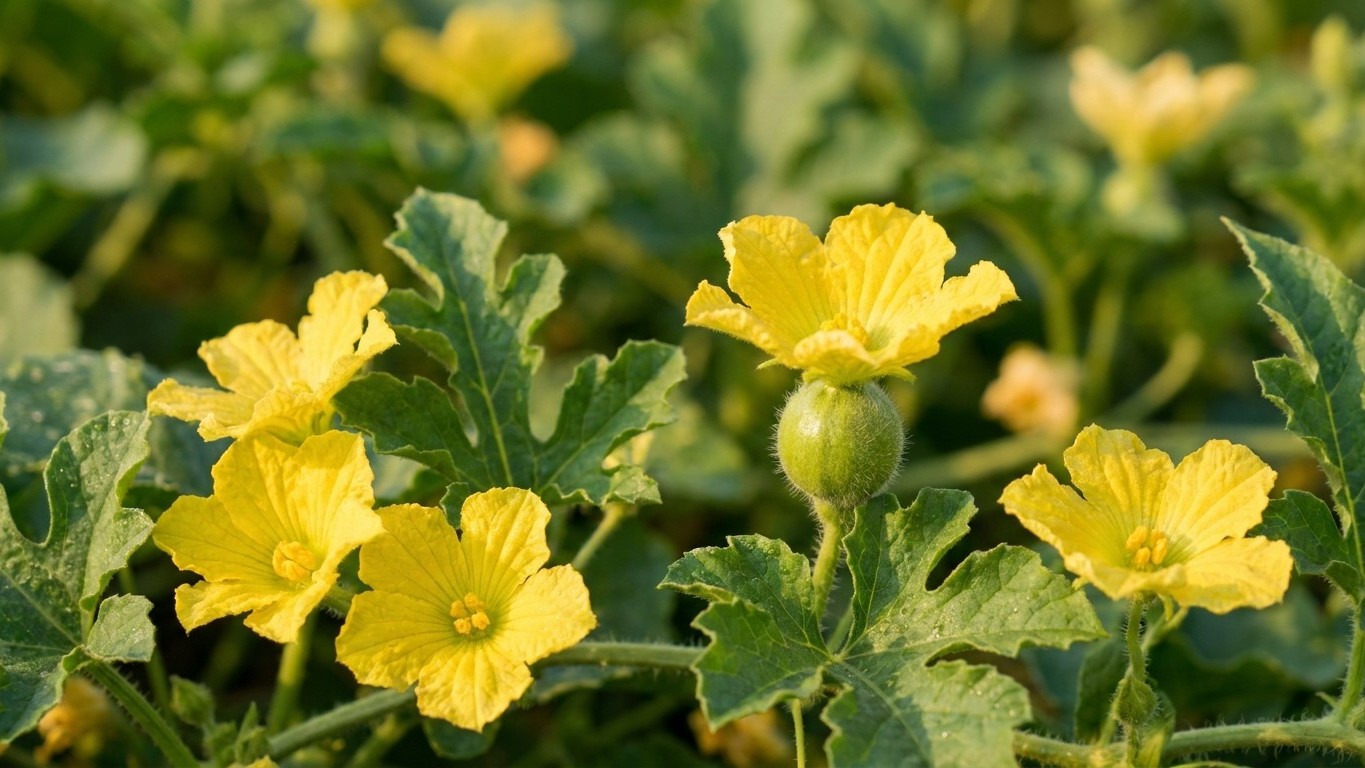

A melon vine loaded with yellow flowers and not a single fruit forming is rarely a disease or a soil problem. It’s timing. The first two or three weeks of bloom on any melon plant produce almost nothing but male flowers, which carry pollen but no ovary behind them. Female flowers, the ones that actually turn into melons, show up later and need a pollinator to visit them within hours of opening. No visit, no fruit.
What is actually going on
Every melon variety, whether it’s a cantaloupe type, a honeydew type, or a specialty netted melon, follows the same flowering pattern. The plant puts out male flowers first, sometimes dozens of them, as a kind of advertisement to pollinators before it has anything worth pollinating. This isn’t a flaw in the plant. It’s a strategy: attract bees early, train them to visit this patch of vine, so that when the female flowers finally open, the workforce is already there.
A female flower is easy to spot once you know what to look for. Behind the petals sits a small swollen bulge, roughly the shape of a tiny melon, that isn’t present on male flowers. That bulge is the ovary, and it only develops into fruit if enough pollen grains land on the stigma inside. Each flower opens for a single morning. By early afternoon on a hot day, it has already closed for good, pollinated or not. That narrow window is why weather and bee traffic matter so much more with melons than with, say, tomatoes, which can pollinate themselves with a puff of wind.
Fertilization has to be thorough, not just present. A melon flower has multiple ovules inside, and each one needs its own grain of pollen to develop into a seed. Partial pollination doesn’t just mean a smaller melon. It means a lopsided one, often with a shrunken end where the ovules never fertilized, and it means a fruit that struggles to size up because it doesn’t have a full seed cavity signaling the plant to keep sending it sugar. This is worth sitting with, because it explains a fruit that starts, then stalls, then yellows and drops instead of growing to size.
Sugar only accumulates while the fruit stays attached and the pollination behind it was complete. A melon does not sweeten after picking. It softens, and the flesh may feel less firm, but the sugar content it has at the stem is the sugar content it will ever have. Everything that happens in the flower, weeks earlier, sets a ceiling that no amount of counter-ripening can raise.
In the garden
Most of what goes wrong with melon pollination happens for one of a handful of predictable reasons, and each one has a visible sign in the garden if you know to look for it.
| What you see | What it means | What happens if you get it wrong |
|---|---|---|
| Only male flowers, week after week | Normal early bloom stage, or excess nitrogen pushing vegetative growth over flowering | Gardeners assume the plant is failing and pull it or dose it with more fertilizer, delaying female flowers further |
| Female flowers open but wilt unopened or unvisited | Low bee activity, often from cold mornings, heavy rain, or insecticide use nearby | The flower closes by afternoon with no pollen delivered and drops within a day or two, and the gardener blames the variety instead of the pollination window |
| Row covers still on at bloom | Covers meant to block early-season pests are also blocking every pollinator | Flowers open and close under fabric with zero pollen transfer; the whole first flush of female flowers is lost before anyone notices |
| Small yellow fruit that swells, then stops and drops | Incomplete pollination, not enough pollen grains reaching enough ovules | Gardeners keep watering and feeding, assuming a nutrient problem, when the fruit was never going to finish |
| Fruit that sizes on one end and stays pinched on the other | Partial fertilization inside that single flower | Left on the vine hoping it will even out, which it won’t, and the plant wastes energy holding onto a fruit that will never be worth eating |
Row covers deserve their own note because they’re the single most common self-inflicted cause of poor melon set. They’re genuinely useful early on, keeping cucumber beetles and aphids off young seedlings while the plant builds leaf area. But covers have to come off the moment flower buds appear, not after the first bloom, and definitely not “when I get around to it.” A cover left on through flowering does its job too well: it keeps out the bees along with the pests.
Hand pollination is worth doing in a garden with few bees, cool mornings, or only one or two plants where natural visitation is unreliable. It’s simple: pick a freshly opened male flower, strip back the petals, and dab the pollen-covered center directly onto the center of an open female flower, ideally before mid-morning while both are still fully open. It won’t hurt an already well-pollinated plant, and for gardeners in short-season areas relying on their state extension service’s variety trials to pick a fast-maturing type, it can be the difference between a full harvest and a handful of stalled fruit.
What it depends on where you are
The mechanism described above (male flowers first, a narrow window for female flowers, pollen needing a live insect to move it) is the same for every melon plant grown in the United States. What varies enormously is how much margin for error a given garden actually has, and that comes down to three regional factors: how long the growing season runs, how hot the summer gets, and how much rain falls during bloom.
A shorter growing season leaves less room to recover from a lost first flush of female flowers. If covers come off late or a cold, wet stretch keeps bees grounded during the first two weeks of bloom, a gardener in a long, hot growing region can often coast on a second or third flush later in the summer. A gardener working with a compressed season has far less slack, which is exactly why choosing a melon type suited to the local season length, something a state extension service tests directly, matters more there than almost anywhere else in vegetable growing.
Heat changes pollen viability and how long a flower stays receptive in the morning before closing. Regions with intense, dry summer heat tend to see flowers close earlier in the day, shortening the pollination window further, while cooler, cloudier regions may keep flowers open a bit longer but also tend to have lower bee activity on any given morning. Rainfall during bloom is its own variable: heavy or frequent rain keeps pollinators inactive and can wash pollen off flowers before a bee ever arrives, which is a bigger risk in humid eastern growing regions than in arid ones.
None of this can be answered in general terms with any honesty, because “hot,” “short,” and “wet” mean very different things in a mountain valley than they do along the Gulf Coast. This site’s state-level melon pages walk through what those local conditions typically look like and when bloom usually falls in that region. For anything more specific, a state extension service is the source built for exactly this question, since their trial data reflects real local seasons rather than a national average.
The mistake that costs the most
Spraying for pests during bloom is the single costliest mistake a melon grower makes, and it’s costly precisely because it looks responsible. Cucumber beetles and aphids show up right around flowering time, and the instinct to treat them the moment they’re spotted is reasonable on its face. The problem is that most broad insecticide applications don’t distinguish between the pest and the bee that’s supposed to visit that same flower an hour later. Spray a blooming melon patch in the morning, when both pests and pollinators are active, and the fix for one problem creates a much bigger one: a plant with clean leaves and no fruit.
The damage isn’t always obvious right away. Flowers keep opening for another week or two, looking completely normal, and it’s only when nothing is swelling behind any of them that the connection to a spray applied ten days earlier gets made, if it gets made at all. By then the plant has usually moved past its heaviest bloom, and whatever fruit should have set from that window is simply gone for the season.
The fix isn’t to leave pests unmanaged. It’s to change when and how the plant gets treated. Target the base of the plant and the underside of leaves rather than open flowers, and do any necessary treatment in the evening after flowers have closed for the day, when bees aren’t foraging and pollen has already been delivered or lost for that flower’s one window. Spot-treating individual pest hot spots, rather than covering the whole plant, also limits how much pollinator activity gets disrupted. It takes a little more attention than a single blanket application, but it’s the difference between a vine that sets fruit through its whole bloom period and one that flowers beautifully all summer while producing almost nothing to show for it.