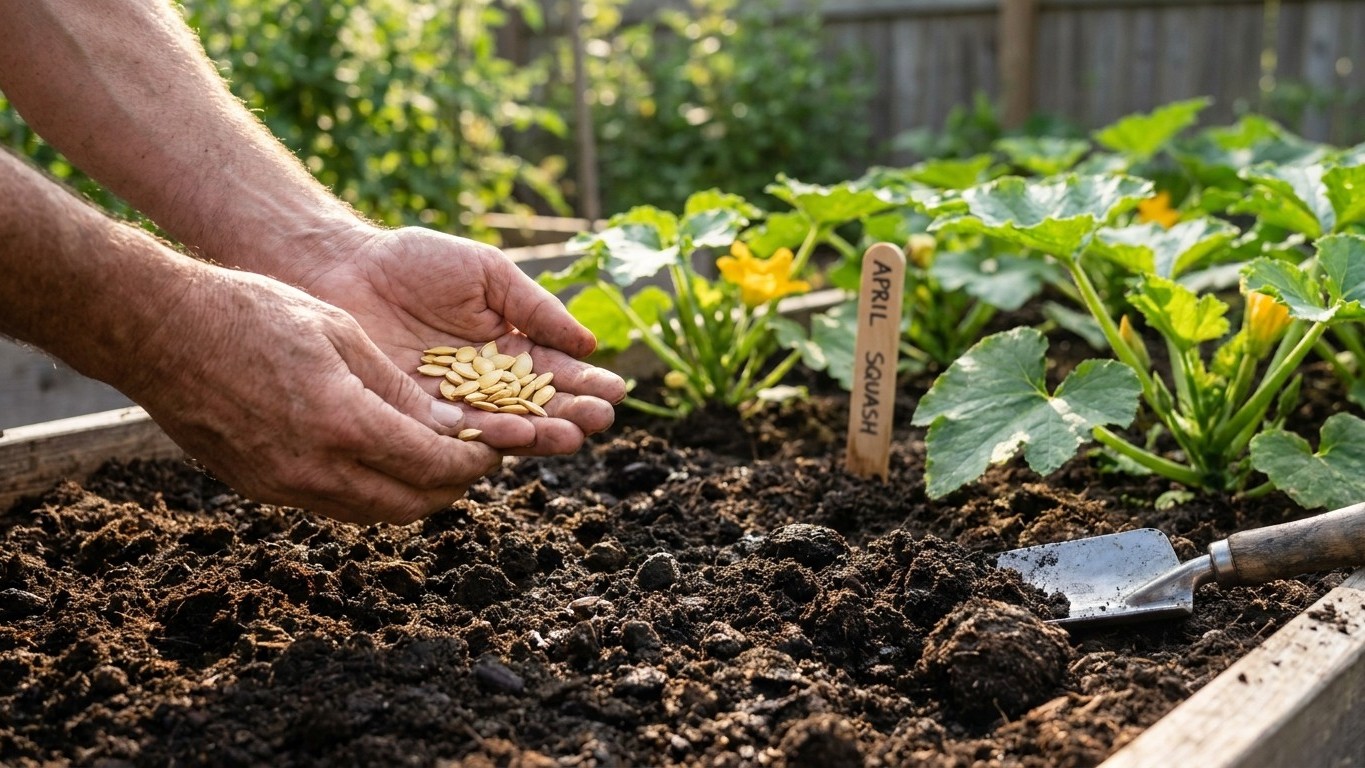

Summer squash goes into Ohio ground after the last spring frost clears, typically May 5 to May 15 in zone 6a, and keeps producing until the first fall frost arrives, October 5 to October 15. That gives a working window of roughly five months, wide enough for more than one planting if a gardener wants it.
The short answer for Ohio
Summer squash has zero frost tolerance. A seedling touched by 32°F overnight is done, and seed sitting in soil below the mid-50s just rots instead of germinating. That’s why the sowing window in Ohio starts at the last spring frost date, May 5 to May 15 depending on where in zone 6a a garden sits, and not a week before. Direct-seeding right at that date is the standard approach; starting seed indoors three to four weeks earlier and transplanting out only after the frost date has passed works too, and buys a slightly earlier first harvest.
The other end of the calendar matters just as much. First fall frost in this zone lands October 5 to October 15. Summer squash needs somewhere between 45 and 65 days from seed to first harvest depending on the variety, so a planting made even in late May is done producing well before frost shuts it down. That leaves a gap of four months or more between “first safe sowing date” and “season-ending frost,” which is more time than a single planting actually needs.
Why the window is wider than one sowing date
Because the frost-to-frost span in Ohio runs so long relative to how fast summer squash matures, a second sowing in late June or even early July is realistic and often recommended by growers who deal with squash vine borer or powdery mildew wiping out a first planting midsummer. A second round sown by early July still has close to 90 days to mature and produce before the first fall frost risk begins. Treating “When to Plant Summer Squash in Ohio” as a single date on the calendar undersells what the season actually allows.
The frost dates themselves are worth reading correctly. May 5 to May 15 is not a guarantee, it’s a probability band built from Ohio State University Extension’s Ohio Gardening Calendar, meaning frost after that window still happens some years. A gardener planting on May 6 in a low-lying yard is taking on more risk than one planting on May 14 in the same county.
What will not work here
Sowing before the local last-frost date is the most common failure, and it fails two ways at once. Either a late cold snap kills the seedlings outright, or the soil simply hasn’t warmed enough for germination and the seed sits and rots before it ever sprouts. Ohio’s frost date band already carries some year-to-year swing, so treating May 5 as a safe green light statewide is optimistic; in a cooler pocket or a low spot where cold air pools, that date can still see frost.
Heat load is the failure mode gardeners underestimate. Columbus averages 15.3 days a year at or above 90°F, concentrated in July and August, and that heat drives blossom drop and stress on plants that look otherwise healthy. A summer squash plant watered on a fixed weekly schedule through that stretch is often getting watered too little on the hottest weeks and too much on the mild ones. The driest month of summer, August, averages only 3.74 inches of rain against June’s 4.33 and July’s 4.67, so the month with the heaviest heat load is also the one with the thinnest rainfall cushion. That combination, not the summer rainfall total on its own, is what pushes plants into stress in most Ohio gardens by late summer.
Spacing and humidity
Ohio’s summer rainfall, about 12.7 inches across June, July and August, arrives less as steady soaking rain and more as thunderstorm bursts, which means foliage gets wet fast and dries slowly in a crowded planting. Summer squash spaced too tightly holds that humidity around the leaves, and powdery mildew shows up as the pale dusty coating on leaves by midsummer in gardens that skimped on airflow. Wider spacing than the seed packet’s minimum, and morning watering at the soil line rather than overhead, both reduce that risk in a state where summer humidity is a given, not an exception.
Relying on a single planting date is its own kind of failure here, given how long the frost-free season actually runs. A May-sown planting that succumbs to squash vine borer in July, with no backup seed in the ground, means an empty patch for the rest of the season in a state where there was clearly time for a second round.
What changes across Ohio
Ohio spans USDA hardiness zones 5b to 6b, a range built entirely on one measurement: the average annual extreme minimum temperature, per the USDA Plant Hardiness Zone Map. That’s a three-band spread inside a single state, and it means there is no single last-frost date that applies evenly from the Ohio River counties to the Lake Erie shore or the higher ground in the state’s northeast and southeast.
The pattern generally runs warmer in the south, where zone 6b conditions near the Ohio River bring an earlier effective last frost and a longer season, and cooler toward zone 5b pockets in the north and at higher elevation, where frost risk lingers later into spring and returns earlier in fall. A gardener in one of those cooler zone 5b areas is working with a shorter frost-free season than the May-to-October window this page describes for zone 6a, and pushing a May 5 sowing date there carries more risk than the statewide dates suggest.
None of this tells an individual reader which zone applies to their own yard, because zone boundaries don’t follow county lines cleanly and can shift within a few miles near a lake, a valley or a ridge. The USDA’s interactive map is the tool for that, not a guess based on which part of the state a reader lives in generally. Checking the actual zone for a specific address is the only way to know whether the May 5 to May 15 window applies as written or needs to shift later.
Where to check this for your own county
This page gives Ohio’s statewide numbers: frost dates for zone 6a, the Columbus heat and rainfall normals, the statewide hardiness zone range. A county-level recommendation from Ohio State University Extension will beat every one of those figures, because it’s built on data specific to that county rather than averaged across the whole state.
Ohio State University Extension runs county offices throughout the state, reachable through extension.osu.edu. Two things are worth asking for specifically. First, the local planting calendar for that county, which will narrow the statewide May 5 to May 15 frost window down to dates that reflect actual local conditions rather than a zone-wide average. Second, the summer squash varieties that county’s extension office has actually trialed in local demonstration gardens or recommends based on regional pest and disease pressure, since squash vine borer and powdery mildew pressure both vary by region within the state.
A statewide answer is useful for planning purposes and for understanding the mechanics behind the dates, which is what this page is for. It is not a substitute for what a local extension office knows about a specific county’s microclimate, soil, and pest history. Anyone serious about nailing the exact planting week for their own garden should treat the county office as the next and more precise step, not an optional extra.
Checking this against your own garden
Calendar dates are a starting estimate, and a gardener’s own observations in their own soil will always outrank them. Three signs are worth checking before committing seed to the ground, regardless of what the date on the calendar says.
Soil warmth by feel is the first and most direct check. Cupping a handful of soil that feels cool and slightly damp, closer to refrigerator temperature than room temperature, signals the ground still hasn’t caught up to the air, even if the calendar says the frost date has passed. Warm, crumbly soil that feels closer to room temperature is the better cue that germination conditions have actually arrived.
The first flush of male flowers on an already-planted squash tells a different story: it’s normal, and expected, before any fruit sets, since male flowers typically open days ahead of the female flowers that actually produce squash. Seeing only male flowers for a week or two isn’t a failure, it’s the plant’s usual sequence playing out.
The appearance of true leaves, the second set that emerges after the rounder seed leaves, is the marker that a seedling has moved past its most fragile stage and into active growth. A garden where true leaves show up faster than a neighboring plot planted the same week is often sitting in a slightly warmer, better-draining spot, which is exactly the kind of local detail no statewide calendar can capture.