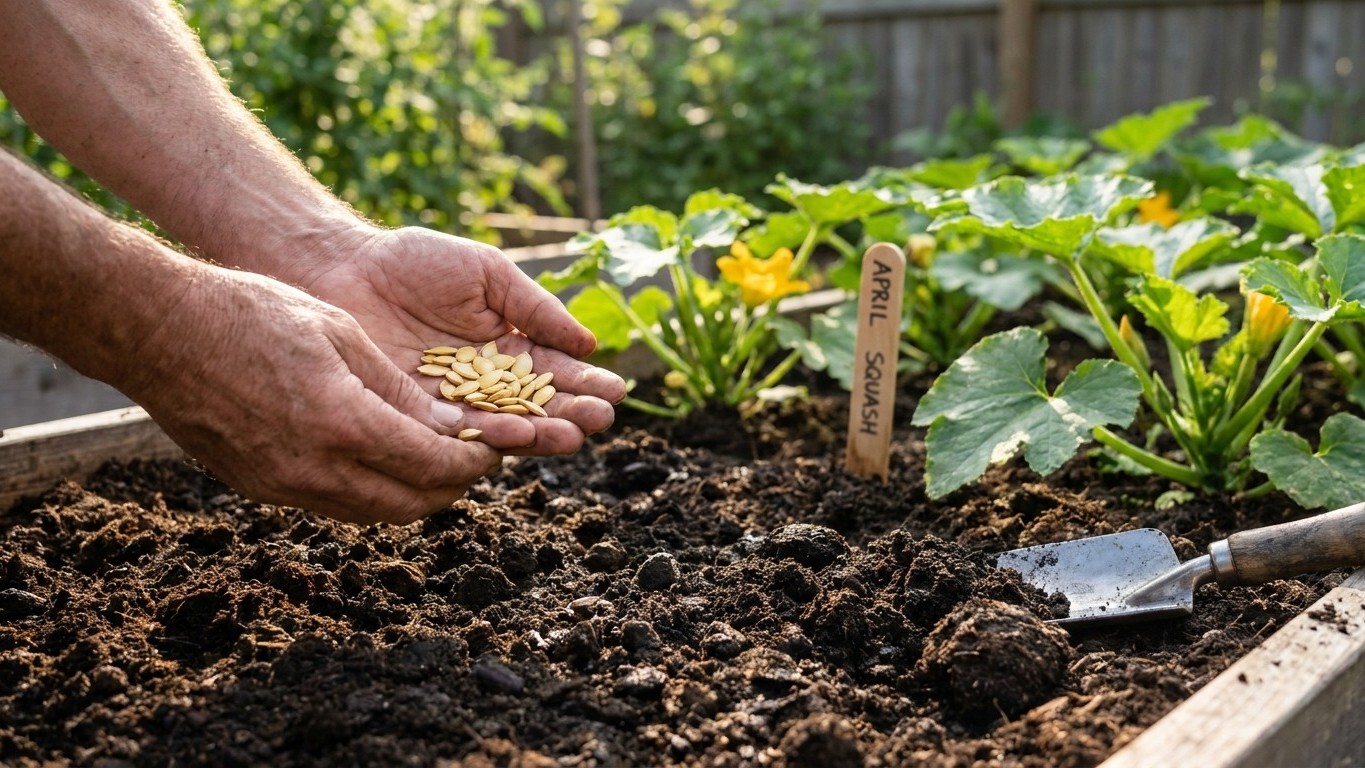

In Oklahoma, direct-sow summer squash seed once the soil has cleared the last spring frost window of March 28 to April 10, then stop counting on spring planting alone: the state’s heat load makes a second, fall-harvest sowing in late July or early August just as reliable, sometimes more so.
The short answer for Oklahoma
The reference frost dates come from NOAA’s 1991-2020 climate normals at the Oklahoma City airport station (USW00013967), and they describe a 30-70% probability band for a 32F freeze, not a hard line. Last spring frost falls somewhere between March 28 and April 10 in most years at that station; first fall frost lands between October 29 and November 8. Summer squash has zero frost tolerance, so the planting decision is built around those two windows, with a safety margin added on the spring side because a squash seedling that gets nipped in early April has to be replanted anyway.
Most Oklahoma gardeners treat mid-to-late April as the practical starting line for direct seeding, giving the soil an extra week or two past the probability band to warm into the 65F-70F range squash germination wants. Seed started in cold, wet April soil sits and rots more often than it sprouts.
The fall side of the calendar matters just as much here, because summer squash matures in roughly 45 to 55 days from seed. Counting back from the October 29 to November 8 first-frost window, the last realistic sowing date lands in the first half of August. That gives a plant just enough runway to flower, set fruit, and produce a harvest before frost shuts it down.
| Planting window | Anchor date | Why |
|---|---|---|
| Spring direct-seed | Mid-to-late April | Past the March 28-April 10 frost probability band, soil warmed |
| Fall direct-seed | Late July to early August | 45-55 day maturity, counted back from Oct 29-Nov 8 first frost |
Both dates are anchored to the Oklahoma City reference station. Gardens outside the metro, especially in suburban and rural settings, typically see the last spring frost run later and the first fall frost arrive earlier than the airport figures, sometimes by one to two weeks. That shrinks the growing window on both ends, which is exactly why the next sections matter as much as the calendar dates themselves.
What will not work here
A weekly watering schedule is the most common way summer squash fails in Oklahoma, and the rainfall numbers explain why. Summer rain across June, July and August averages about 11.7 inches at the reference station, but it is not spread evenly: July, the peak heat month, is the driest of the three at 3.59 inches, compared with 4.49 in June and 3.6 in August. Combine that dry stretch with a summer that averages 70.7 days a year at or above 90F, and a plant watered once a week is running a moisture deficit through exactly the period when it needs the most water to hold blossoms and swell fruit.
Heat stress, not season length, is the real limiter here. Oklahoma’s frost-free stretch, from the spring window in late March or April to the fall window in late October or November, gives summer squash more than enough calendar days to mature. What it does not give a plant is relief from mid-summer heat. Once daytime highs push repeatedly past 90F, squash blossoms drop before they set fruit, pollen viability falls, and plants that looked strong in June stall out by mid-July. Gardeners who plant only once, in spring, and expect a single continuous harvest through September are working against that heat curve, not with it.
Tight spacing is another failure point, though the cause is different from what gardeners in wetter states assume. Oklahoma’s summer rainfall total is not high enough to call the state humid in the way the Southeast is, but the combination of heat, intermittent thunderstorm rain, and poor airflow between crowded plants still creates the damp leaf surfaces powdery mildew needs. Squash planted shoulder to shoulder to save space loses air circulation exactly when disease pressure is building, and a mildew infection in July heat spreads faster than in a mild spring.
Slow-maturing squash varieties are not disqualified by the season length here, but they are disqualified by the heat window. A variety that needs 65 days to first harvest, planted at the safe mid-to-late April start, is trying to set its heaviest fruit load right as July’s 90-plus-degree days peak. Faster-maturing types get a harvest banked before that heat wall hits.
What changes across Oklahoma
Oklahoma spans USDA Plant Hardiness Zones 6a through 8a, under the USDA Plant Hardiness Zone Map built on 1991-2020 normals. That is a wide spread for one state, and it means there is no single planting date that fits the whole map. Zone 6a, built on average annual extreme minimum temperature, sits at the cold end and shows up in the Panhandle and higher-elevation parts of the state; zone 8a, the warm end, runs through the southeast.
A gardener working land closer to the 6a end should expect the last spring frost to arrive later than the Oklahoma City reference dates and the first fall frost to arrive earlier, which compresses both the spring and fall summer squash windows described above. That argues for leaning on the fall planting less, or shifting it earlier into July rather than August, since the frost-free runway on that end of the state is shorter.
A gardener closer to the 8a end typically sees the opposite: an earlier spring warm-up and a later fall frost, stretching the calendar on both sides. But that same warmth means the mid-summer heat wall arrives sooner and lasts longer, which reinforces the earlier point about fast-maturing varieties and the value of a genuine second planting rather than one long spring-to-fall stretch.
None of this tells an individual reader which zone applies to their own address, and this page will not guess. The USDA Plant Hardiness Zone Map is the tool built for that lookup, and it is worth five minutes before finalizing a planting date, especially for anyone gardening near the Panhandle, at higher elevation, or right along the state’s southeastern edge where the 8a pocket sits.
Where to check this for your own county
Oklahoma State University Extension is the source that goes beyond a statewide range and down to what actually works in a specific county. This page has drawn its numbers from NOAA climate normals at one reference station and a statewide hardiness zone range; a county extension office works from local trial data and from the growers who’ve been planting that same soil for years.
Two things are worth pulling up on the extension site specifically. The first is a local or regional vegetable planting calendar, which will translate the frost-date logic used here into dates adjusted for that county’s actual conditions rather than the airport station’s. The second is the list of summer squash varieties that have been trialled in Oklahoma conditions, since variety performance against heat stress and squash vine borer pressure varies enough across the state that a statewide recommendation is a starting point, not a final answer.
A county-level recommendation from OSU Extension will beat anything on this page every time, because it accounts for local soil, local pest pressure, and microclimate details that a statewide climate-normal analysis cannot see. This page exists to explain the mechanism behind the dates, the frost probabilities, the heat load, the rainfall pattern, so that a county-specific calendar makes sense when a reader gets to it, not to replace that county-level source.
Checking this against your own garden
Every date on this page is a probability drawn from thirty years of climate data at one weather station. A reader’s own garden will tell them something more current and more local, and it costs nothing to check.
Soil warmth by feel is the first check. Summer squash seed wants soil in the 65F-70F range to germinate reliably. Pushing a bare hand a few inches into the planting bed in the morning gives a rough read: soil that still feels cool and damp like early spring hasn’t caught up to the calendar yet, no matter what date the calculation above suggests.
The first flush of male flowers is the second signal. Summer squash plants typically produce a run of male blossoms before the first female flowers, recognizable by the thin stem behind the bloom versus the small swollen bulge behind a female flower, appear. A long gap between the two, or male flowers dropping without any females following, often points to heat stress or a pollination gap worth watching rather than a calendar problem.
The third check is the speed of true-leaf emergence after the seedling’s first rounded cotyledon leaves appear. Fast, vigorous true-leaf growth within a week or so signals the plant has found favorable warmth and moisture; slow or stalled growth after cotyledons suggests the soil or air conditions are still working against the plant, whatever the frost-date math says. All three of these observations outrank a printed date, because they come from the specific patch of ground where the seed actually went in.