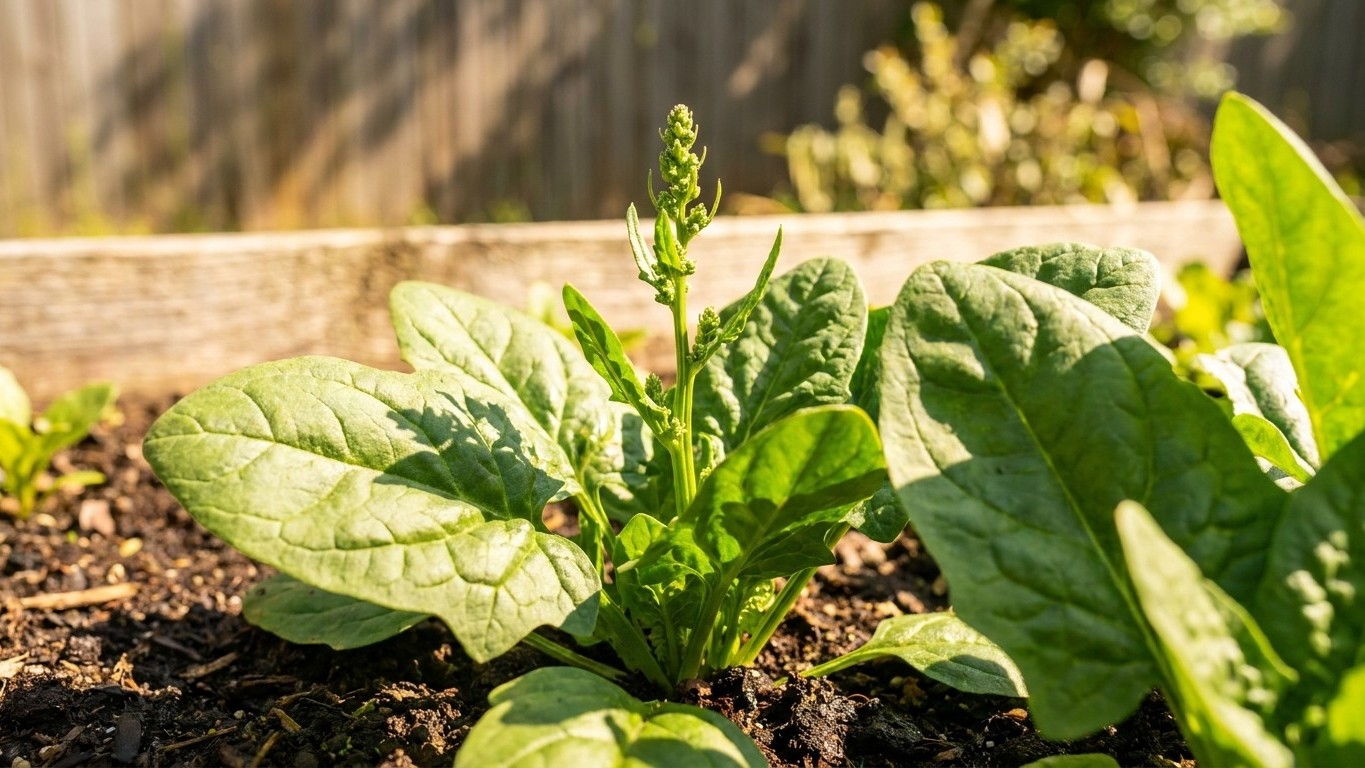

In Hawaii’s lowland gardens, spinach faces aphids, beet armyworm, Chinese rose beetle, leafminers, mites, and whiteflies, the sap-suckers and leaf-chewers that University of Hawaii CTAHR Extension documents on vegetable crops here. They show up as soon as seedlings emerge, and because the islands never see a frost, there’s no cold season to slow them down or reset their numbers between plantings.
Which pests attack spinach in Hawaii
University of Hawaii CTAHR Extension documents these pests for the territory:
- Aphids
- beet armyworm
- cabbage webworm
- Chinese rose beetle
- Leafminers and bean fly
- melon fly
- Southern green stinkbug and mites
- Whiteflies
That’s the full list CTAHR publishes for this territory. It doesn’t run longer, and nothing beyond these entries has a documented track record here.
Not every name on that list belongs on a spinach bed, though. Cabbage webworm targets cole crops, cabbage, broccoli, and the rest of the brassica family, and rarely bothers a leafy green outside that group. Bean fly, listed alongside leafminers, feeds on legume stems and pods, not spinach foliage. Melon fly goes after cucurbits and other fruiting vegetables, and a spinach plant, which never sets that kind of fruit, gives it nothing to work with. Southern green stinkbug follows the same logic, puncturing pods and developing fruit rather than leaf tissue.
That leaves six pests that actually feed on spinach in Hawaii gardens: aphids, beet armyworm, Chinese rose beetle, leafminers, mites, and whiteflies. Aphids and whiteflies are sap-suckers, clustering on the undersides of young leaves and multiplying fast in warm, humid air. Beet armyworm chews on beet-family and related leafy crops, spinach included, and larvae can strip a seedling bed once they hatch in numbers. Chinese rose beetle is a nighttime generalist that feeds on foliage across dozens of plant families, then disappears into soil or mulch by daylight. Leafminers tunnel between leaf surfaces, leaving pale trails that are hard to miss. Mites, paired with stinkbug in CTAHR’s listing but unrelated to it in habit, rasp at leaf tissue and thrive in the hottest, driest stretches of the year.
The number that matters most here is 18.7, the average number of days per year Honolulu reaches 90°F or higher, per NOAA Climate Normals for 1991-2020. That heat load keeps sap-suckers and mites active nearly year-round in lowland Hawaii, unlike mainland gardens where a hard freeze resets pest populations every winter. There’s no such reset here.
When each one shows up, and what it does first
Hawaii’s growing calendar isn’t ruled by a frost date, because none exists in the places people garden. Frost only touches the summits of Mauna Kea, Mauna Loa, and Haleakala, never the lowland beds where spinach actually grows. What governs the calendar instead is soil temperature and rainfall, plus whether a garden sits on the windward or leeward side of the island.
Seed goes in once soil has cooled below the 80°F point that Utah State University Extension identifies as the threshold where spinach germination starts to fall off. In much of lowland Hawaii, that window opens as wetter, slightly cooler conditions settle in, rather than at any fixed calendar date.
Aphids and whiteflies are usually the first sign of trouble, showing up on the undersides of the earliest true leaves before the plant has any size to spare. A cluster of small, soft-bodied insects, or a cloud of tiny white insects lifting off when a leaf is brushed, is the early tell for either.
Leafminers follow close behind, tunneling as soon as leaves are wide enough to mine and leaving pale, winding trails visible from above. Mites tend to show up later, once the crop has been in the ground longer and conditions turn drier, since they favor dusty, moisture-stressed foliage over young, well-watered growth.
Beet armyworm and Chinese rose beetle arrive with less warning. Beet armyworm moths lay eggs in clusters, so damage tends to appear suddenly, as a patch of leaves skeletonized overnight rather than a slow build. Chinese rose beetle feeds after dark, so the first evidence is ragged, rounded holes chewed into leaf margins, with no insect in sight the next morning.
All of this runs against a clock the crop already faces: a fall planting is figured at 50 to 75 days from seed to the date a gardener wants to harvest. Every week lost to an early pest problem eats into that window, and in lowland Hawaii’s warmth, there’s no cool tail end of the season to make up for it.
Telling the damage apart from everything else
A yellowing spinach leaf doesn’t always mean an insect is involved, and jumping straight to a pest diagnosis is one of the more common mistakes in a home garden. Nitrogen deficiency, uneven watering, and fungal disease all produce symptoms that overlap with aphid or mite feeding, and the fix for one does nothing for another.
| What you see | Possible cause | What tells them apart |
|---|---|---|
| Leaves yellowing from the bottom up | Nitrogen deficiency, or aphid/whitefly feeding | Check leaf undersides for clusters of insects first; deficiency shows none |
| Ragged holes at leaf margins | Chinese rose beetle, or wind/mechanical damage | Beetle holes are rounded and concentrated at edges; wind tearing follows leaf veins |
| Pale, winding trails inside the leaf | Leafminer | No other common cause produces this pattern in spinach |
| Wilting despite damp soil | Root disease, or heavy mite/aphid infestation | Pull one plant and check roots for rot before assuming insects |
| Bitter taste, tall central stalk | Bolting from heat and long days, not a pest | No insect causes bolting; it’s a response to temperature and day length |
The 75°F ceiling Utah State University Extension sets for good spinach growth is also the bitterness threshold. Once the crop spends extended time above it, leaves turn bitter and the plant pushes up a seed stalk, and no pest treatment reverses that. Confusing bolting with pest damage leads a lot of gardeners to spray a plant that was never going to recover regardless.
When the cause still isn’t clear after checking leaf undersides, roots, and the pattern of damage, that’s the point to bring a sample, or a clear photo, to the local extension office rather than guessing further.
What actually works here, and what is a waste of time
Physical barriers do more work in Hawaii’s spinach beds than most gardeners expect, partly because the growing window is short and there’s no cold snap to help thin pest numbers the way there is on the mainland. Fine mesh row cover, set over seedlings the day they germinate, keeps aphids, whiteflies, and egg-laying beet armyworm moths off the crop during the weeks when a small plant can least afford damage. It comes off once the leaves are large enough to tolerate some feeding without losing the harvest.
Handpicking works surprisingly well against Chinese rose beetle, precisely because it feeds at night and hides in soil or mulch by day. Checking plants after dark with a flashlight, during the first couple of weeks after germination, catches beetles before they’ve done much damage, and it costs nothing.
Timing the planting to soil temperature, not the calendar, is the single decision that does the most good. Sowing into soil that’s already climbed close to or past 80°F sets up two problems at once: germination drops off on its own, and any seedlings that do come up face a longer stretch of pest pressure before reaching a size that can shrug off feeding. Waiting for cooler, wetter soil solves both.
What’s a poor use of effort is treating a bolted plant. Once the seed stalk starts up under heat and long days, no barrier, no handpicking schedule, and no spray changes that outcome, because the plant has already switched modes and the leaves it produces from that point turn bitter regardless. Effort spent trying to salvage a bolting plant is effort not spent on the next sowing.
Beyond barriers and timing, choosing what to spray isn’t something a general guide can responsibly cover. What’s registered for use on vegetables changes by state and by product, and that call belongs to the local extension office, not a website.
Where to check this for your own county
University of Hawaii CTAHR Extension is the authority behind every pest named on this page, and it’s the right first stop for anything more specific than what’s covered here. CTAHR maintains extension offices across the islands, and pest pressure documented at the state level doesn’t necessarily match what’s happening in one particular garden. A leeward Oahu plot and a windward Hawaii Island plot can see different pest loads in the same season, even under the same statewide list.
The single most useful step before spraying anything is a call or visit to the local extension office, ideally with a sample leaf or a clear photo of the damage in hand. Extension staff can confirm which of the six spinach-feeding pests is actually present, rule out a look-alike problem like nutrient deficiency, and point to what’s currently registered for use in that state, information this page deliberately doesn’t provide, because it changes and because it isn’t a website’s call to make.
Rainfall, elevation, and whether a garden sits on the windward or leeward side of an island all shift which pests show up first and how bad they get, in ways a statewide list can’t capture. A garden at higher elevation with cooler, wetter conditions won’t necessarily follow the same pattern as a hot, dry leeward lot a few miles away, even though CTAHR’s documented pest list covers both.
Anyone unsure which office serves their address can start with CTAHR’s extension directory and work down to the county level from there, a faster path to an accurate answer than comparing symptoms against photos online.
Common questions
Does spinach face frost damage anywhere in Hawaii?
Not in the areas people garden. NOAA Climate Normals for the reference station show no freeze occurring in inhabited areas of the islands; frost is limited to the summits of Mauna Kea, Mauna Loa, and Haleakala. Growing conditions here are shaped by rainfall, elevation, and wind exposure instead of a frost calendar.
Can spinach be grown year-round in Hawaii?
It grows best where temperatures stay below 75°F, and Honolulu averages 18.7 days a year at 90°F or higher, so stretches of the year push well past what spinach tolerates. Long days combined with that heat push the plant toward bolting, which is why a fall sowing timed to cooler, wetter soil tends to outperform a summer attempt.
Which spinach variety does best in Hawaii?
The available guidance names four varieties, Bloomsdale, Melody, Teton, and Olympia, without publishing performance data for any of them for this territory. Choosing among them without that data means relying on the local extension office or direct trial rather than a published recommendation.
How far ahead should I plant spinach before I want to harvest?
For a fall crop, the guidance is to plant 50 to 75 days before the target harvest date. No days-to-maturity figure is published for spinach specifically, so that planting window, tied to when soil temperature drops rather than to a fixed date, is the figure to work from.