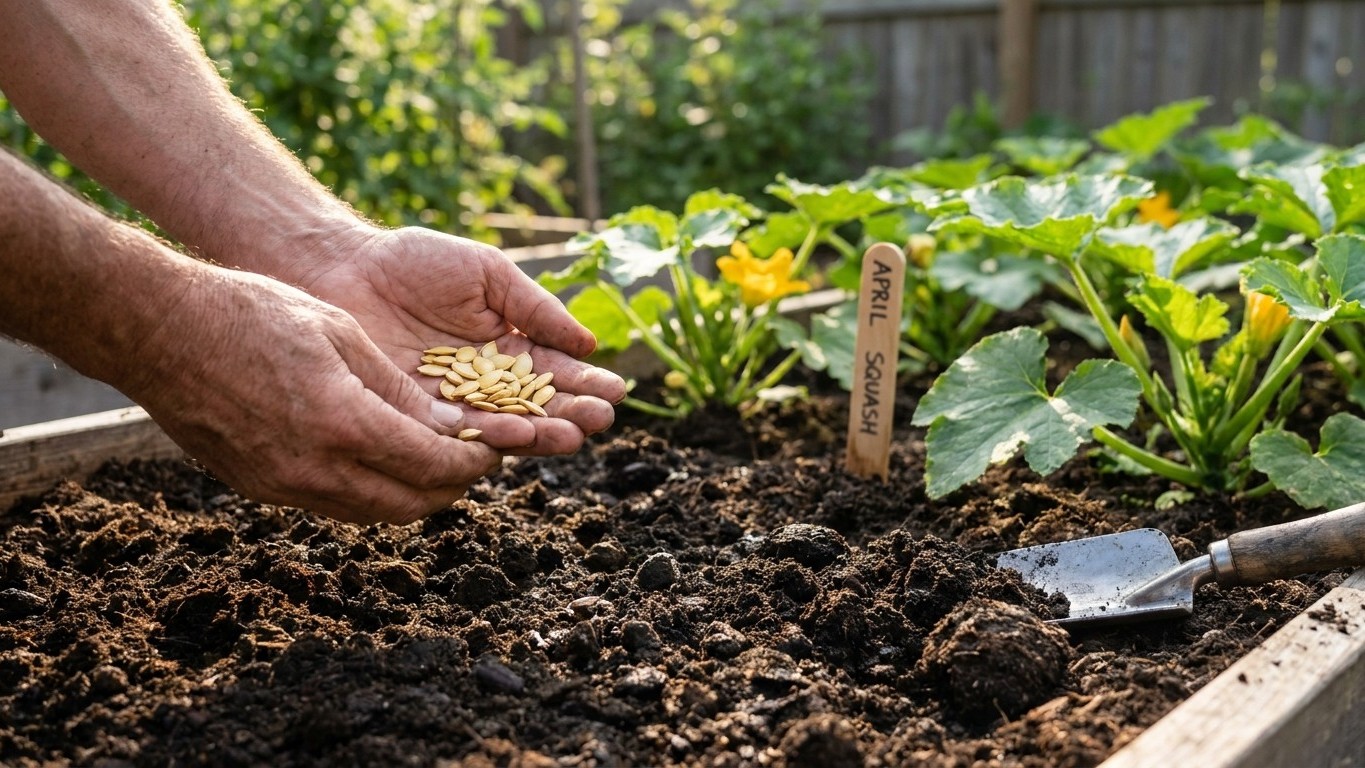

Sow summer squash outdoors in South Carolina from late March along the coast to mid-April upstate, timed to the last spring frost window of February 28 to March 17. A second sowing in July gives a fall crop that can finish before the first fall frost, which arrives between November 20 and December 5 depending on where you garden.
The short answer for South Carolina
Those frost dates aren’t a single day carved in stone. They mark the window during which the reference weather station (Charleston area, station USW00013880) has a 30 to 70 percent chance of a 32F freeze, based on 1991-2020 NOAA climate normals. Early in that window, on February 28, the odds of a freeze are still on the higher side. By March 17, they’ve dropped closer to the low end of that band. Summer squash seedlings don’t tolerate frost at all, so the safer play is to treat March 17 as your target, not February 28, unless you’re prepared to replant if a late cold snap sneaks through.
That gives you a spring sowing window running from roughly mid-March to early April, depending on how far inland or upstate you are. Squash germinates poorly in cold, wet soil anyway, so waiting a week or two past the frost date usually costs you nothing and buys real insurance.
The fall side of the calendar matters just as much and gets ignored more often. The first fall frost lands somewhere between November 20 and December 5. Count backward from that date using your chosen variety’s days-to-maturity (most summer squash runs 45 to 65 days from seed), and you’ll find a July sowing window that produces a second harvest before the season closes. Between the two windows, South Carolina gardeners get roughly eight months of frost-free growing to work with, wide enough for two full squash cycles if you don’t waste the front end waiting too long or the back end pushing your luck against a hard freeze.
Both dates come from one station, and the CAUTION attached to them matters: peninsular Charleston runs milder than that airport reference point, while the Upstate runs several weeks tighter at both ends of the season. The short answer above is a state-level starting point, not a county forecast.
What will not work here
The biggest mistake isn’t planting too late, it’s planting once and assuming that single crop will carry through summer. South Carolina averages 55.1 days a year at or above 90F, concentrated right in the middle of the growing season. Summer squash blossoms drop or fail to set fruit once daytime heat climbs into the mid-90s for stretches, especially combined with humid nights that keep pollen from working properly. A spring-only planting typically peters out in July, exactly when the heat load peaks, which is why the July sowing for a fall crop isn’t optional extra credit, it’s how you avoid a garden that produces for six weeks and then quits.
Weekly watering schedules fail here too, and the rainfall numbers explain why. Summer rain averages about 19.8 inches across June, July and August, which sounds generous until you look at how it arrives. June, the driest of the three months, still averages 6.21 inches, July 6.6 and August 6.97, but that rain mostly falls as short, heavy thunderstorms rather than steady soaking rain. Combined with 55-plus days of 90-degree heat driving evaporation, a lot of that rainfall runs off the surface instead of reaching squash roots. A once-a-week watering habit built for a drier, cooler climate leaves squash roots dry for days at a time here, particularly on sandy Coastal Plain soil that drains within hours of a storm passing.
Tight spacing is the third failure mode, and it’s a humidity problem, not a heat problem. Squash planted shoulder to shoulder in a garden that regularly clears 90F and gets hit with heavy summer rain holds moisture between leaves long after a storm passes. That’s the setup powdery mildew and bacterial wilt need. Wider spacing than a seed packet written for a drier climate would suggest, plus morning watering instead of evening, does more to prevent disease here than any fungicide schedule.
What changes across South Carolina
South Carolina’s hardiness zone range, 7a to 9a under the USDA system, spans a real climate gradient, not a rounding error. That system is built on one number, the average annual extreme minimum temperature, but it’s a useful proxy for how differently the state’s coast and upstate behave. A zone 9a reference point near Charleston and a zone 7a reference point in the northwestern foothills aren’t experiencing the same growing season at all, and treating them as interchangeable is exactly how a planting calendar goes wrong.
The practical shift for a gardener working land toward the upper end of that zone range, further north or at higher elevation, is to push the spring sowing date later and the fall sowing date earlier than the state-level window above suggests. The CAUTION on the frost data backs this up directly: the Upstate runs several weeks tighter at both ends of the season compared to the coastal reference station. That’s not a small adjustment. A three-week compression on each end of the season can mean the difference between fitting in a second squash planting and running out of frost-free days before it matures.
There’s no single date that covers a 7a to 9a range honestly, and any calendar claiming otherwise is quietly picking one end of the state and calling it the whole state. What a reader can’t get from this page, and shouldn’t expect to, is which of those zones their own property falls into. That’s a lookup, not a guess: the USDA Plant Hardiness Zone Map lets you enter a ZIP code and get a specific answer, and it’s worth doing before locking in a sowing date based on state-level normals.
Where to check this for your own county
Clemson Cooperative Extension is South Carolina’s land-grant extension service, and it’s the right next stop after this page, not an optional extra. Find it at clemson.edu/extension. A state-level planting window, built from one reference weather station, is a starting point. A county-level recommendation, built from local trial data and local frost records, beats it every time.
Two things are worth hunting down specifically once you’re there. First, a local vegetable planting calendar for your county or region, which will translate the frost-date logic above into dates that reflect your actual local station rather than the airport-adjacent reference used here. Clemson organizes a lot of its horticulture guidance by crop and species rather than by one blanket state document, the same way its turfgrass program publishes separate maintenance calendars for bermudagrass, zoysiagrass, centipedegrass and St. Augustinegrass rather than one lawn calendar for everybody. Vegetable guidance works the same way: look for the summer squash or cucurbit-specific sheet, not a general garden overview that might be written with a different crop’s schedule in mind.
Second, look for variety trial results specific to your county’s extension office or nearby research station. Which summer squash varieties actually held up against squash vine borer, or set fruit reliably through a hot July, changes county to county based on soil, pest pressure and local humidity. A variety that performs well on sandy Coastal Plain soil isn’t automatically the right call for heavier Piedmont clay. This state-level page can tell you when to plant. It can’t tell you which variety wins in your specific county, and that’s exactly the kind of detail your local extension office tracks.
Checking this against your own garden
Every date on this page is a normal, an average built from thirty years of station data. Your actual soil, this actual spring, outranks it. Three things to check before trusting the calendar over your own eyes:
- Soil warmth by feel. Dig down two or three inches and grab a handful. If it still feels cold and clammy rather than cool and workable, squash seed will sit and rot before it germinates, no matter what the calendar says. Wait a few more days.
- The first flush of male flowers. Squash plants typically send out male blossoms before female ones. Seeing that first round tells you the plant has settled in and started its reproductive clock, a better sign of local readiness than a date on a page.
- The first true leaves. The rounded seed leaves that emerge first aren’t the plant’s real leaves. Once the jagged, characteristic true leaves show up, the seedling has moved past its most vulnerable stage, and that timing tells you how your particular microclimate, shaded by a fence line or warmed by a south-facing slope, compares to the state average used to build this calendar.
None of that requires a soil thermometer or any tool beyond attention. A garden tucked against a brick wall that holds afternoon heat will run its own calendar days or weeks ahead of a low spot that collects cold air overnight, even if both sit in the same county.