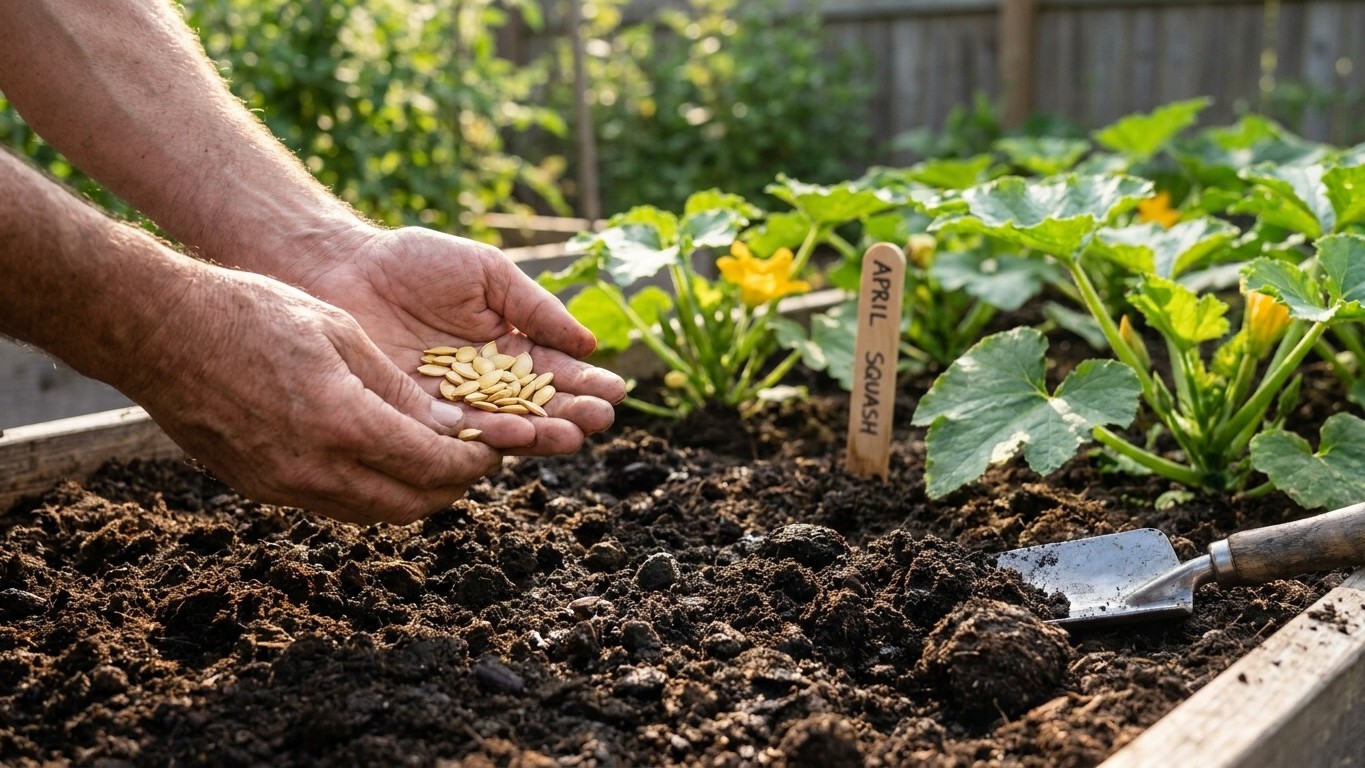

Summer squash goes in the ground in Tennessee once the danger of frost has passed, which for most of the state falls between the last week of March and mid-April. Because the growing season here stretches nearly seven months, gardeners have room for a second planting in early summer for a fresh fall crop before the first freeze arrives.
The short answer for Tennessee
Sow summer squash outdoors after the last spring frost, which at the reference station runs March 31 to April 12. That’s not a single date but a probability band: NOAA’s 1991-2020 climate normals mark it as the window where a 32F freeze has a 30 to 70 percent chance of still occurring. Planting before that window closes risks a late cold snap wiping out tender seedlings; planting well after it wastes early-season growing days squash doesn’t need to waste.
On the other end, the first fall frost lands between October 28 and November 8, again a 30-70 percent probability band rather than a hard cutoff. Between those two windows sits roughly seven months of frost-free growing time. Summer squash reaches harvest in about 50 to 65 days from seed, so the Tennessee season isn’t the limiting factor most gardeners assume it is. The real constraint is heat and pest pressure building through midsummer, not a shortage of calendar days.
That extra season length is why a lot of experienced Tennessee gardeners don’t stop at one planting. A second direct-sowing in early June, timed to mature before the days-above-90 stretch peaks, often outproduces a single April planting that gets tired and disease-prone by August. The state averages 40.0 days a year at or above 90F at the Nashville reference station, and that heat load is what wears plants down mid-season more than any date on a calendar.
What the frost dates are really telling you
These are probabilities, not guarantees. A 30-70 percent freeze chance on April 5 means exactly that: on some years, frost still shows up after that date, and on others it’s long gone by mid-March. Treat the window as a planning range, not a green light for a single day. Gardeners who push seed into cold, wet soil the moment the calendar says “safe” often find their squash sits and rots rather than sprouts, because soil temperature, not the calendar page, decides when squash seeds actually germinate.
What will not work here
Planting too early is the most common failure, and it’s a self-inflicted one. Summer squash seed germinates poorly in cold soil, and a seedling that survives a light frost often stalls for weeks afterward rather than growing on schedule. Given the March 31-April 12 frost window, anything sown in mid-March is gambling against odds that, per NOAA’s own data, still favor a freeze.
Watering on a fixed weekly schedule is the second failure, and it’s specific to how Tennessee summers actually behave. The region gets about 12.3 inches of rain across June, July and August, with August the driest month at 3.79 inches against June’s 4.36 and July’s 4.16. That sounds like plenty until you factor in the heat: 40 days a year above 90F drive evaporation hard, and much of that summer rain arrives as a single thunderstorm that runs off rather than soaking into the root zone. A once-a-week watering habit built around that rainfall total, without checking whether the last storm actually reached the roots, leaves squash under-watered right when it needs water most, usually in the stretch between fruit set and the driest month of August.
Soil type changes that math again. The same inch of rain that disappears within a day on sandy ground can sit in clay for a week, so a garden on sand in a wet-on-paper summer can still need water every other day, while a clay bed nearby stays damp on the same schedule. There’s no single watering rule for “Tennessee summer squash” that survives contact with both soil types.
Crowding plants close together is the third failure, and it’s a humidity problem as much as a spacing one. Squash grown shoulder to shoulder in a state that sees regular summer thunderstorms holds moisture on its leaves longer after each rain, which is exactly the condition powdery mildew and other foliar diseases need to take hold. Wider spacing than the seed packet’s minimum, with airflow between rows, matters more here than in a drier climate where the same spacing would be fine.
What changes across Tennessee
Tennessee’s hardiness zone range runs from 5b to 8a on the USDA Plant Hardiness Zone Map, a spread built entirely on average annual extreme minimum winter temperature. That’s a wide range for one state, and it means there is no single “Tennessee planting date” that fits every county. A gardener at the cooler end of that range is working a different calendar than one at the warmer end, even though both live in the same state.
The frost dates cited above, March 31 to April 12 for spring and October 28 to November 8 for fall, come from a single reference station representing Middle Tennessee. East Tennessee and the Cumberland Plateau run cooler and later in spring than that station shows, which means gardeners in those areas should expect their own safe planting window to open later than the state figure suggests, not on the same date. Higher elevation in those regions cools the air further, pushing both the last spring frost later and the first fall frost earlier, which shortens the safe growing window from both ends at once compared to the valleys and lower ground further west.
West Tennessee, closer to the Mississippi River, tends toward the warmer end of that 5b-8a range and typically clears its last frost earlier than the reference station’s dates. That’s a meaningful shift when a two-week difference in safe planting date can mean the difference between a squash crop that fruits well ahead of the worst midsummer heat and one that’s just getting going as the 90-degree days pile up.
None of this points to a single number a reader should adopt. The honest answer is that the state’s frost dates and hardiness zones span a real range, and where a given garden falls inside that range shifts the calendar by a couple of weeks in either direction, which for a 50-to-65-day crop is not a trivial margin.
Where to check this for your own county
The University of Tennessee Institute of Agriculture Extension is the state’s land-grant extension service, and it’s the source built to answer what this page can’t: what actually happens in your specific county. That’s a state-level resource, but it’s structured around county offices, and that’s where the useful detail lives.
Look for two things once there. First, a county-specific planting calendar, which will reflect the local frost dates rather than the single reference-station figures used here, and will account for the elevation and regional shifts described above. Second, look for summer squash varieties that have actually been trialled by extension agents in your part of the state. Varieties that perform well in a humid, lower-elevation county don’t always hold up the same way on the Cumberland Plateau, and county extension trial data is where that difference gets documented rather than guessed at.
A county recommendation will always beat a state one, because it’s built on local soil, local elevation, and local pest pressure rather than a statewide average. This page works from statewide climate normals covering a range of five hardiness zones and two frost-date windows that can differ by weeks depending on where in Tennessee a garden sits. That’s useful for understanding the shape of the season, but it’s not a substitute for the number your county office publishes for your zip code.
Checking this against your own garden
Every date above is a regional average, and a reader’s own garden will confirm or contradict it faster than any calendar. Three things to watch, none of which require anything beyond a shovel and attention.
Soil warmth by feel is the first and most direct check. Push a hand a few inches into the planting bed on a morning after a few consecutive warm days. Soil that still feels cold and damp, even weeks after the calendar frost date has passed, means that particular spot (a low corner, a shaded bed, heavy clay that holds cold longer than loam) is running behind the regional average, and seed sown there will sit rather than sprout.
The first flush of male flowers on an existing planting is the second signal, and it tells a gardener something about their own microclimate’s pace rather than the plant’s health. Squash typically produces male flowers before female ones, and a burst of them arriving noticeably earlier or later than a neighbor’s garden a few miles away is a sign that a given yard runs warmer or cooler than the regional average this page is built on.
The first true leaves, the ones that appear after the initial rounded seed leaves, are the third check. Slow, stalled true-leaf growth after germination usually means the soil hasn’t warmed enough yet even if the seed managed to sprout, and it’s a better signal to hold off on a second planting than any date on a chart. A garden that reads warmer or cooler than these regional figures isn’t wrong. It’s just its own place, and worth trusting over a station average once the two start to disagree.