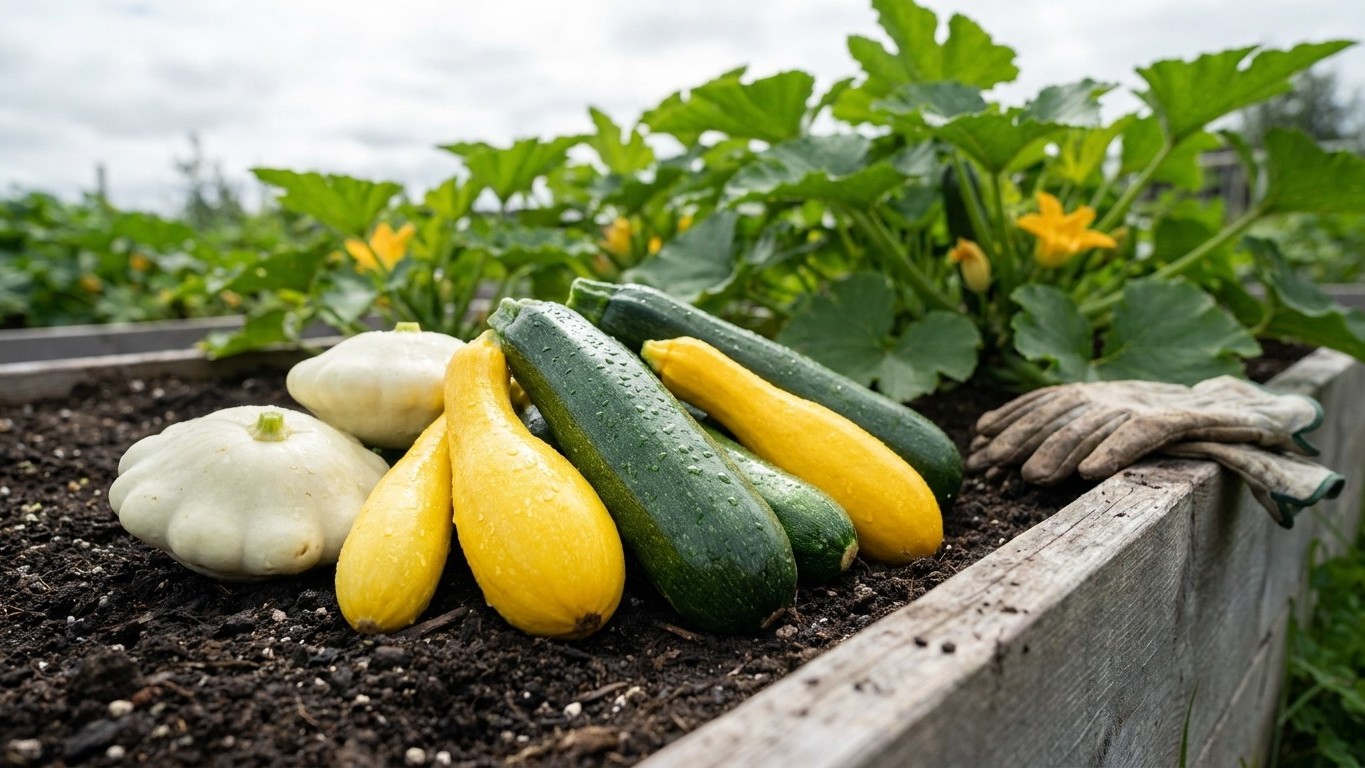

Tennessee gardeners get the good end of the squash math: a frost-free window that runs roughly 200 days, from early April to early November. That length favors bush-type yellow squash and zucchini hybrids bred for disease resistance and heat tolerance, planted twice, once in April and again in July. The limiting factor here isn’t season length, the way it is in colder states. It’s the 40 days a year of 90-degree heat and the humidity that rides along with Tennessee summers.
The short answer for Tennessee
For Tennessee, the type to plant is a bush-habit yellow squash or zucchini bred for powdery mildew resistance, not a trailing heirloom vine. That’s the direct answer. The rest of this page explains why.
Start with the season. The last spring frost across the state falls somewhere between March 31 and April 12, and first fall frost lands between October 28 and November 8. Stack those dates and you get a frost-free stretch of roughly 200 to 220 days, depending where in that band your county sits. Summer squash needs 45 to 65 days from seed to first harvest for most bush varieties. Even the slowest yellow crookneck or pattypan type fits inside that window with more than 100 days to spare. Season length is not the constraint here the way it is in northern New England or the Mountain West. The state has enough calendar room for two full plantings: one seeded after the spring frost clears in April, and a second seeded in late June or early July to replace plants that decline from vine borer or mildew pressure by August.
The constraint that actually shapes variety choice here is heat. The reference station averages 40 days a year at or above 90F. That heat load does two things. Sustained heat during flowering can cause blossom drop and reduce fruit set even in a plant that looks healthy. And heat stress combines with the humidity carried in Tennessee’s summer rainfall, about 12.3 inches across June, July and August, to create ideal conditions for powdery mildew, one of the most common reasons a squash planting collapses by late July. That combination argues for hybrids bred specifically with mildew resistance, sold under that description on seed packets and in extension trial lists, rather than older open-pollinated types bred for flavor or storage and not for disease pressure.
Bush habit matters too. Bush varieties keep fruit and foliage more open than trailing vines, which helps air move through the canopy in humid weather and makes the base of the plant easier to check for the entry holes squash vine borer leaves behind. In a state with this much summer humidity, that airflow is often the difference between a planting that produces through August and one that quietly rots at the crown in July.
What will not work here
Slow-maturing vine squash is the first casualty, but not for the reason it would be in a shorter-season state. Tennessee has the days to spare for a 65-day trailing variety. What it doesn’t have is the airflow. Trailing vines planted at heirloom spacing, often three to four feet between hills, trap humid air low in the canopy through a summer that averages 40 days above 90F. That combination of heat and stagnant humidity is exactly what powdery mildew needs, and by the time white film shows on the upper leaves, the plant has usually already lost a meaningful share of its productive life. A trailing variety planted here still has time to mature. It typically doesn’t have the ventilation to stay healthy long enough to use that time.
Weekly watering is the second failure. Summer rainfall averages 12.3 inches across June, July and August, but that number is misleading on its own. It falls unevenly: June averages 4.36 inches, July 4.16, and August, the hottest stretch of the season, drops to just 3.79 inches, the driest of the three months. A squash plant watered once a week on the assumption that summer rain will fill in the gaps is gambling on a month that, on average, doesn’t deliver. Combine that August dip with 40 days a year of 90-degree heat driving evaporation, and a once-a-week schedule frequently leaves the root zone dry for days at a stretch during exactly the period when fruit is sizing. The result shows up as blossom-end rot, misshapen fruit, or a plant that stops setting new squash in the second half of summer.
Tight spacing is the third failure, and it compounds the first two. Squash packed in close, bush or trailing, restricts the airflow that would otherwise help dry leaves between rain events and cut the hours of leaf wetness fungal disease needs to establish. In a climate carrying this much summer humidity, the spacing printed on the seed packet is worth following exactly, not treated as a suggestion to be crowded for a bigger harvest.
What changes across Tennessee
Tennessee spans USDA Plant Hardiness Zones 5b through 8a, a range built on one measurement, the average annual extreme minimum winter temperature. That’s a three-zone spread inside a single state, which means there is no single planting date, no single frost-risk window, and no single variety recommendation that fits both ends of it equally well. The frost dates and heat-day figures used above describe conditions at the reference station, roughly the Nashville area. East Tennessee and the Cumberland Plateau run cooler and later in spring than that reference point, sometimes by two to three weeks at higher elevations.
For a gardener in the higher, cooler parts of the state, that shift cuts two ways. Spring planting should wait longer past the state-level frost window, since a seed set out on the Nashville-area date can sit in soil still too cold for germination at elevation. Cooler high-ground summers likely mean fewer than the 40 days above 90F averaged at the reference station, which eases disease and blossom-drop pressure, but it also compresses the safe window for a second, mid-summer planting, since fall frost arrives sooner at altitude than the state-level date suggests.
For a gardener in the milder, lower-elevation parts of the state, closer to zone 8a conditions, the opposite applies. Spring planting can often start a little earlier than the state-level window, the heat load likely runs at or above the 40-day average, and a second planting has more room to mature before fall frost.
None of this resolves from a state-level page, because the zone range itself, 5b to 8a, is the honest answer: this state doesn’t have one climate, it has several, layered by elevation and by how far west or east a county sits. Placing your own county on the USDA Plant Hardiness Zone Map is the only way to know which end of that spread you’re gardening in.
Where to check this for your own county
The University of Tennessee Institute of Agriculture runs the state’s Cooperative Extension Service, and its site, UT Extension, is where the state-level figures on this page get replaced with county-level ones. Two things are worth pulling from it before committing to a planting date.
The first is the county planting calendar. Extension offices build these from decades of local frost records and soil temperature data specific to their county, not the single reference station behind the state-wide figures cited throughout this page. If your county office publishes a spring date two weeks later than the window given here, that isn’t a contradiction. It’s a correction, built from data closer to your own soil.
The second is the variety trial list. County and regional extension programs across Tennessee run their own summer squash trials, testing hybrids for yield, disease resistance and heat tolerance under local conditions, and results often differ from one part of the state to another because growing conditions differ. A mildew-resistant hybrid that performed well in a Middle Tennessee trial isn’t automatically the best performer on the Cumberland Plateau or in the bottomland counties of the far west.
That’s the honest relationship between this page and your local extension office: this page describes Tennessee. It can’t describe your county, because no single page can, given a state that spans three hardiness zones and a temperature range that shifts meaningfully between the Smokies and the Mississippi River. Use this page to understand the mechanism. Use your county extension office to get the number.
Checking this against your own garden
Every date and figure on this page describes an average built from decades of regional records. Your own garden is one data point, not an average, and it often runs warmer, cooler, wetter or drier than the reference station by enough to matter. Three signs from the plant and the soil itself will tell you more than any calendar date.
Soil warmth by feel is the first. Summer squash seed germinates poorly in cold soil regardless of what the calendar says about frost risk having passed. Push a finger a couple of inches into the bed in the morning. Soil that still feels cold to the touch, even on a day well past the state’s frost window, is telling you that a raised bed, a shaded spot, or a heavy clay soil is holding onto spring cold longer than the average conditions these figures describe. Waiting a few more days for that soil to warm on its own usually beats fighting it with an early planting date.
The first flush of male flowers is the second sign. Squash plants typically produce several male flowers before the first female flower, the one with the small swollen bulb at its base, appears. A long run of male-only flowers isn’t itself a problem, but it’s worth watching, since female flower production, and therefore fruit set, tends to lag further behind in a plant under heat or water stress.
The first true leaves are the third. The rounded seed leaves that emerge first aren’t the plant’s real foliage. The jagged, squash-shaped leaves that follow are the ones showing the plant has moved past germination stress and is growing on its own terms. A plant stuck at the seed-leaf stage for an unusually long stretch is signaling that something in that specific bed, cold soil, poor drainage, too much shade, is holding it back, regardless of what the state-level dates above suggest should be happening by that point in the season.