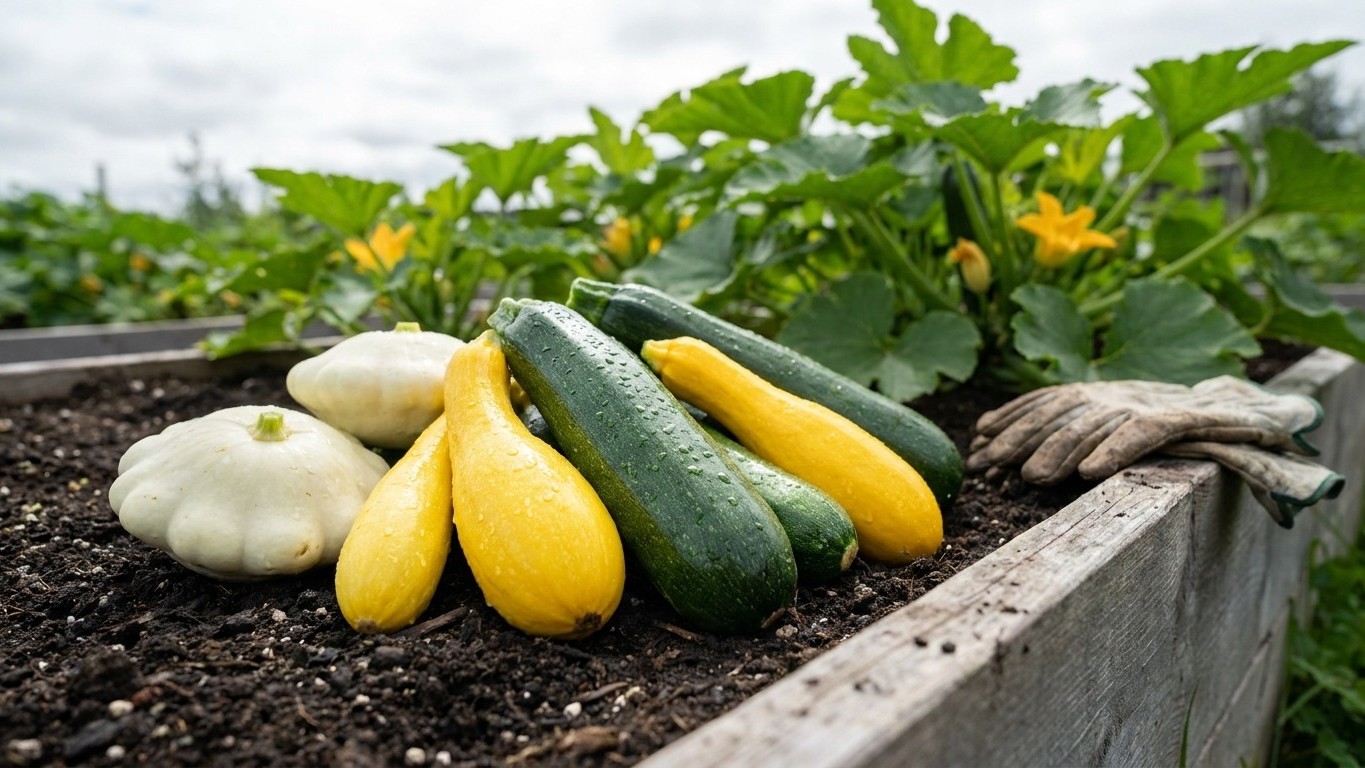

Texas summer squash comes down to heat tolerance more than speed. Zucchini and yellow crookneck both work across most of the state, but the varieties bred for sustained heat and humidity, tatuma-type squash and heat-resistant crookneck strains, outlast standard garden-center picks once August settles in. The Gulf Coast, where the state’s climate data is anchored, sees over 100 days a year above 90F. That number decides more than any seed packet does.
The short answer for Texas
Start with the two numbers that matter most for a Houston-area garden, since that’s where this territory’s verified climate data comes from: a last spring frost falling between February 4 and March 1, and a first fall frost arriving December 1 to 19. That’s a frost-free window stretching nine months or more at the mild end of the state. Squash maturity time (45 to 65 days for most varieties) isn’t the bottleneck here. Heat load is. The reference station logs 102.4 days a year at or above 90F, which means the real question isn’t “will it mature in time” but “will it survive July and August.”
That reframes the variety decision by type. Yellow crookneck and straightneck squash carry thicker stems and slightly more disease resistance than standard zucchini, which helps them push through the worst heat stretch. Tatuma and other Mexican-heritage summer squash, often sold as calabacita, were selected for exactly this kind of sustained heat and tend to keep producing when standard zucchini stalls out in July. Zucchini itself still works, but it performs best as two separate plantings, one in early spring and a second after the worst of midsummer heat breaks, rather than one long run.
| Type | Best fit for Houston-area heat load | Practical note |
|---|---|---|
| Yellow crookneck / straightneck | Strong | Thicker stems resist heat stress better than zucchini |
| Zucchini | Moderate | Plant in two windows rather than one continuous run |
| Tatuma / calabacita types | Strong | Bred for sustained heat, common in South Texas gardens |
| Pattypan / scallop | Weak-to-moderate | Tends to slow production once days above 90F stack up |
None of this applies evenly statewide. Texas hardiness zones run 6a to 10a, and the frost dates above describe the Gulf Coast reference station, not the Panhandle or the Hill Country. More on that spread below.
What will not work here
The failure most Texas gardeners run into isn’t a squash that never matures. It’s a squash that dies mid-season from pests and disease that thrive in exactly the heat-and-humidity combination this region produces. Squash vine borer and squash bug populations build fast once daytime highs stay above 90F for weeks at a stretch, and a plant that looked fine in June can collapse by late July. Planting one crop and expecting it to carry through the whole frost-free window is the mistake. Succession planting, a second sowing timed to replace plants lost to borers, is standard practice here, not an extra step.
Watering on a fixed weekly schedule also fails in this climate, and the rainfall numbers explain why. Summer rain totals around 14.6 inches across June, July and August sound reasonable, but July, the hottest stretch, is also the driest month at just 3.77 inches. Combine that with 102 days above 90F driving heavy evaporation, and a single weekly soaking gets lost to the air before it reaches the root zone, especially on sandy coastal soils that drain within a day. Squash needs consistent soil moisture to set fruit; inconsistent watering under this heat load produces blossom drop and misshapen fruit rather than outright plant death, but the effect on yield is the same.
Tight spacing is the third common failure, and it’s a humidity problem specifically. Powdery mildew and bacterial wilt spread fastest where air can’t move between plants, and Gulf Coast humidity keeps leaf surfaces damp long after a summer thunderstorm has passed. Spacing recommendations printed for drier states don’t hold up here; crowded rows that would be fine in a low-humidity climate turn into a mildew outbreak within weeks once August humidity sets in. Wider spacing than the seed packet suggests, plus watering at the soil line rather than overhead, address the same underlying problem: wet leaves in heat are what powdery mildew needs to spread.
What changes across Texas
Texas has no single squash-growing climate, and the hardiness zone range makes that plain: 6a in the Panhandle up to 10a in the Rio Grande Valley. That’s not a small variation. It’s the difference between a garden that sees hard freezes well into what other regions call spring, and one that barely freezes at all. The frost dates and heat-day figures cited above come from the Houston-area reference station, which sits at the mild, humid end of that range. A Panhandle garden works on a shorter, drier season with a much later last frost and much earlier first fall frost, closer to a standard Midwestern squash calendar than to a Gulf Coast one.
Hill Country and North Texas fall somewhere between those two extremes, with less humidity than Houston but still real summer heat, which shifts the disease pressure lower but keeps the heat-stress problem largely the same. South Texas, toward the Valley, pushes toward true subtropical conditions where a fall planting can sometimes outperform a spring one, since spring heat arrives earlier and burns plants out faster than it does farther north.
None of this means a reader should guess which zone applies to their own yard from a state-level description. The USDA Plant Hardiness Zone Map is built for exactly that lookup, using average annual extreme minimum temperature as its single variable, and it’s the tool that turns “Texas is 6a to 10a” into a specific answer for a specific address.
Where to check this for your own county
This page describes Texas at the state level, using Houston-area data as the reference point because that’s where the verified climate normals come from. A county in the Panhandle or the Hill Country will see different numbers for every figure cited above, and the only way to get those numbers is to check locally. Texas A&M AgriLife Extension runs county offices across the state, and each one publishes planting guidance built around its own local frost dates rather than a statewide average.
Two things are worth pulling from a county office specifically. First, the local planting calendar, which will give a spring and fall squash window built on that county’s own frost data rather than the Gulf Coast numbers used here. Second, the variety trial results for that county, since AgriLife’s regional offices often test squash cultivars under their own soil and pest conditions and publish which ones actually held up against local squash bug or vine borer pressure. A county recommendation always beats a state one for this exact reason: it’s tested against the pests, soil and rainfall pattern that will actually show up in that garden, not an average drawn from one reference station three hundred miles away.
Treat this page as the starting framework, the state-level shape of the problem, and the county office as the source that fills in the real numbers for a specific address.
Checking this against your own garden
Every date and figure above describes an average. A specific yard, with its own soil, sun exposure and microclimate, will run ahead of or behind that average, sometimes by weeks. Three direct observations settle it faster than any calendar.
Soil warmth by feel is the first. Squash seed germinates poorly in cold soil regardless of what the calendar says, so pressing a hand into the planting bed each morning for a week gives a better read than a frost date does. Soil that still feels cool to the touch in mid-morning, well after sunrise, isn’t ready yet, no matter what the average last frost date suggests for the county.
The first flush of male flowers is the second signal. Squash plants typically produce male flowers days before the female flowers that actually set fruit appear, and a strong early flush of males is a reliable sign the plant has settled into active growth rather than sitting stressed. A plant that skips straight to a handful of female flowers without much male bloom first is often still adjusting to transplant shock or heat stress.
The first true leaves matter for a different reason: they show whether the seedling has moved past its fragile early stage. The two rounded leaves that emerge first are seed leaves, not true leaves, and a plant that stalls before producing its first serrated true leaf is telling the gardener something about soil temperature or moisture that no regional average can capture. That plant, watched closely, is a better guide than any date on this page.