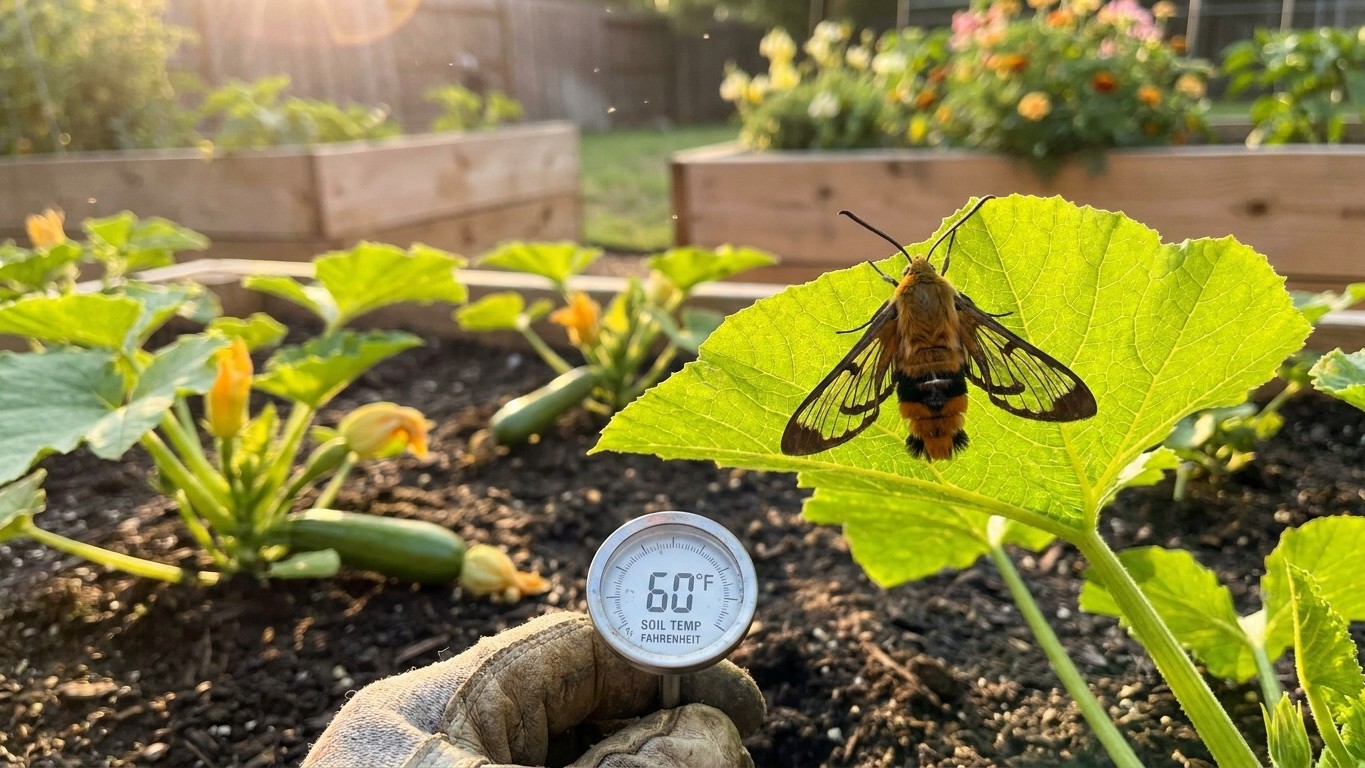

Squash vine borer moths start emerging in Texas as early as late April in the Rio Grande Valley and Gulf Coast, and as late as mid-June in the Panhandle and High Plains. The trigger isn’t the calendar, it’s soil temperature: once the top few inches of soil hold steady in the 60s Fahrenheit for about two weeks, the overwintering pupae wake up and adults start flying. In the southern third of the state, a second generation often follows in July or August, which is why fall squash plantings get hit just as hard as spring ones.
What actually stops this pest isn’t one product or one trick. It’s timing your defenses to match the moth’s flight windows, checking stems before damage is visible, and using a mix of barriers, targeted insecticide applications, and plant selection. None of that works well if you’re guessing at when the moths show up in your specific part of Texas, so the regional timing matters more here than almost anywhere else in vegetable pest management.
Why Texas Timing Is So Different Region to Region

Texas spans roughly 800 miles from the Panhandle to the Rio Grande Valley, and that distance covers three or four distinct climate zones. A gardener in Amarillo is dealing with a completely different insect calendar than someone gardening in Brownsville or Houston, even though it’s the same pest species.
In South Texas and the Gulf Coast (think Corpus Christi, Harlingen, Houston), soil warms early. Moth emergence frequently starts in late April, sometimes even earlier during a mild spring. Because the growing season stretches long and warm, a second generation of moths often emerges in late July through August, targeting fall-planted squash and pumpkins. Gardeners in these areas are essentially fighting the pest twice a year.
Central Texas, including Austin and San Antonio, usually sees first emergence in mid-to-late May. The window is a little more forgiving than the coast, but a second flight still shows up most years by late July, especially after a wet spring that keeps soil moisture and temperature in the pest’s favor.
North Texas and the Panhandle lag behind. Around Dallas-Fort Worth, moths typically don’t appear until late May or early June. In the High Plains near Lubbock and Amarillo, cooler spring soil can push emergence into mid-June. These areas usually get just one generation per season, which is one small break for gardeners already dealing with hail, wind, and a short frost-free window.
Why the Life Cycle Makes This a Moving Target
Adult squash vine borer moths look nothing like the gray, fuzzy moths most people picture. They’re day-fliers with an orange abdomen dotted in black, orange hind legs fringed in black hairs, and a wingspan around an inch and a half. Because they’re active in daylight and resemble a wasp more than a moth, plenty of gardeners miss them entirely until the damage shows up.
A female moth lays eggs at the base of squash, zucchini, and pumpkin stems, usually singly, over a period of a few weeks. Eggs hatch in about a week, and the larva bores directly into the stem, where it feeds for four to six weeks before tunneling out to pupate in the soil. That pupation stage is what overwinters, sometimes for the full year, which is why the pest reappears reliably in the same garden bed season after season if nothing interrupts the cycle.
The practical result: by the time you notice wilting leaves on an otherwise healthy-looking plant, the larva has usually been feeding inside the stem for two or three weeks already. Waiting for obvious symptoms means you’re already behind.
Spotting an Infestation Before the Plant Collapses
The classic sign is sudden wilting of one runner or the entire plant, even though the soil is moist and the plant looked fine the day before. That’s often the first thing gardeners notice, and by then, prevention has already failed for that plant.
Earlier warning signs are subtler but worth checking weekly once moths are active in your region:
- Small holes near the base of the stem with a sawdust-like material (called frass) pushed out, resembling wet green or orange sawdust
- A slightly swollen or discolored section of stem close to the soil line
- Tiny white or cream-colored eggs, roughly the size of a pinhead, stuck to the stem near the base or on the underside of leaf stalks
- Adult moths hovering near the base of plants during daylight hours, particularly midday
Gardeners who grow the same squash varieties every year in Texas often start checking stems by hand starting in April in southern counties, and by late May farther north. A quick visual check, splitting the stem gently at the base with a fingernail if frass is visible, takes less time than losing a full plant to an infestation that went unnoticed for a month.
What Actually Stops Squash Vine Borer in Texas Gardens
No single method eliminates this pest completely once it’s established in an area, but combining several approaches cuts losses dramatically. The methods that hold up best in Texas conditions fall into four categories: timing, barriers, targeted treatment, and plant choice.
Planting Around the Moth’s Schedule
Because moth flights are tied to soil temperature rather than a fixed date, some Texas gardeners plant squash extra early, aiming to get plants past the vulnerable seedling stage before moths become active. This works better in North Texas, where the frost-free window still allows an early start, than in South Texas, where moths can already be flying by the time soil is warm enough to plant.
A second strategy, more reliable across most of the state, is a delayed planting for a fall crop, timed so the plant’s stem hardens off before the second-generation moths arrive in late July or August. Stems that are thicker and more mature resist egg-laying and larval entry better than tender young stems.
Physical Barriers That Actually Work
Row covers placed over young plants block moths from reaching the stems entirely, but they have to come off once flowers appear, since squash needs pollinators to set fruit. Timing the cover removal to just before bloom, and reapplying it if a second generation is expected, requires more attention but prevents the bulk of egg-laying.
Wrapping the lower 4 to 6 inches of stem in aluminum foil or a section of nylon stocking, right at planting or as soon as seedlings emerge, physically blocks the female moth from reaching skin she can pierce with her ovipositor. It’s a low-cost method that a lot of longtime Texas vegetable growers still swear by, particularly for smaller home gardens where wrapping a dozen stems isn’t a huge time investment.
Targeted Insecticide Timing
Because larvae are protected inside the stem within days of hatching, insecticides only work during a narrow window, from egg-laying through the first day or two after hatching, before the larva tunnels in. Once you see frass at the stem base, spraying won’t help that plant.
The Penn State Extension guide on squash vine borer notes that applications need to target the stem base specifically, not the whole plant, and should begin once egg-laying is confirmed or once local extension offices report moth flight activity. Texas gardeners can track this through county extension offices or by checking pheromone traps if available locally, since first-generation flight dates shift by weeks depending on where you are in the state.
Choosing Varieties That Resist Damage
Not all squash is equally vulnerable. Butternut squash and other Cucurbita moschata varieties have solid, less hollow stems that borers struggle to tunnel through compared to the hollow stems of zucchini and yellow summer squash, which are Cucurbita pepo. Gardeners who’ve lost multiple zucchini plantings to borers in past seasons often switch at least part of their planting to butternut or a similar moschata variety, accepting a different flavor and texture in exchange for a plant that survives to harvest.
Cleaning Up After an Infestation Matters as Much as Prevention
Since the pupa overwinters in soil near where the infested plant grew, removing and destroying infested vines at the end of the season, rather than tilling them under or leaving them in place, reduces the population available to emerge the following spring. Composting infested stems in a home pile that doesn’t reach high enough temperatures to kill pupae just relocates the problem to next year’s garden.
Rotating where squash and pumpkins are planted each year, even a modest 10 or 15 feet within the same garden, makes it slightly harder for emerging moths to find host plants immediately, though it won’t stop a determined, flying adult from covering that distance in a season. Combined with fall cleanup, crop rotation is one more layer that reduces the baseline pest pressure a Texas garden carries into the next year.
Related guides
- Squash vine borer in Arkansas: When It Shows Up and What Stops It
- Squash vine borer in Louisiana: When It Shows Up and What Stops It
- Squash vine borer in Wisconsin: When It Shows Up and What Stops It
- Squash vine borer in Alabama: When It Shows Up and What Stops It
- Squash vine borer in Michigan: When It Shows Up and What Stops It