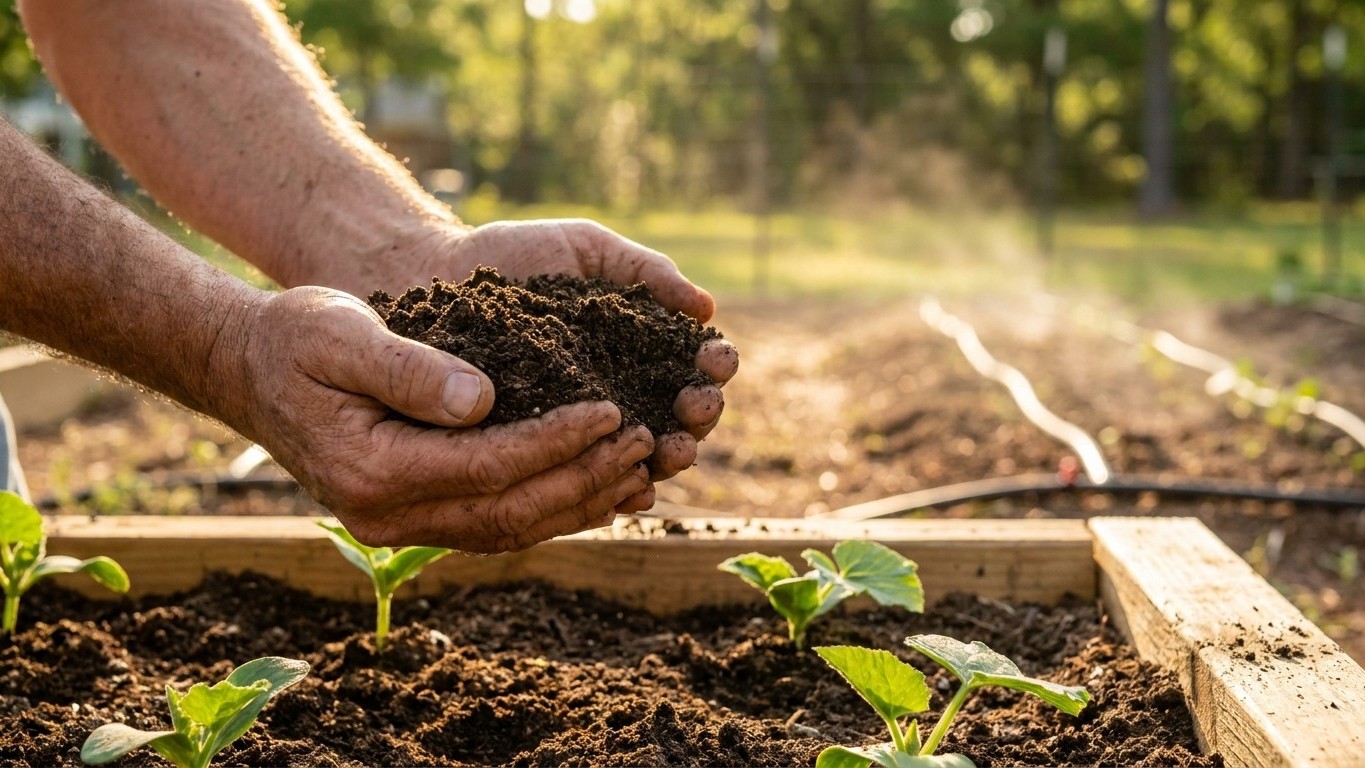

In most of Texas, summer squash can go into the ground anytime from early February through early March, but the calendar date matters less than what the soil is doing underneath it. Soil temperature, not the frost calendar, is what actually decides germination and early growth.
When the soil is warm enough in Texas
At the Houston reference station (USW00012960, Bush Intercontinental Airport), NOAA’s 1991-2020 Climate Normals put the last spring freeze in the window between February 4 and March 1, based on the 30-70% probability band for a 32F freeze. That’s a real, sourced figure for one station, not a Texas-wide planting date. Texas spans four USDA hardiness zones, from 6a to 10a, and the Houston figures sit at the mild Gulf end of that range. The Panhandle freezes months earlier in the fall and thaws months later in spring. Hill Country and North Texas run on their own separate freeze calendars. Even inside the Houston metro, Hobby Airport typically runs about two weeks milder than the IAH station used here, so a homeowner ten miles away is already working with a different number.
Treat that February-to-March window as a probability, not a promise. A 30-70% freeze chance means a late cold snap is still entirely plausible in any given year, and summer squash seedlings have zero tolerance for frost. That’s the whole reason growers use frost dates as a proxy in the first place, not because frost itself is what the plant needs to avoid, but because frost risk and soil temperature move together on the calendar.
The soil, though, lags behind the air. Ground takes longer to warm than the atmosphere above it, especially clay soils that hold onto winter cold. Summer squash seed germinates poorly in cold soil and can rot before it ever sprouts if pushed into ground that’s still in the 50s. The practical fix costs nothing: push a soil thermometer a couple of inches down at midmorning for several days running. Warm, consistently warm soil, not a date circled on a calendar, is the real green light.
Because the frost window here is a single-station figure and the state is so large, the more useful move for anyone outside the immediate Houston area is checking a local planting calendar rather than borrowing this one. Texas A&M AgriLife Extension keeps county-level guidance that accounts for the zone differences this page can’t resolve on its own.
How long the season lasts here
Pairing the last spring frost (February 4 to March 1) with the first fall frost at the same Houston station (December 1 to December 19, same NOAA 1991-2020 Normals, same 30-70% band) gives a frost-free window that runs, depending on where each year falls inside those bands, from roughly nine months to a little over ten and a half months. That’s an enormous stretch by national standards, and it’s the single biggest thing separating gardening in coastal and southern Texas from most of the rest of the country.
A window that long changes the whole strategy. Where a short season forces a single sowing and makes every week of delay costly, a nine-to-ten-month window turns squash into a crop you can plant more than once. A first round set out once the soil is reliably warm can be followed by a second sowing in mid to late summer, timed to mature before the fall frost risk climbs back up in the December window. That second planting also tends to dodge the worst of the early-season squash vine borer pressure that builds through spring, since a fresh planting starts its clock later. The site’s succession sowing guide walks through the timing math in more detail, including how to count backward from a fall frost date to know the last safe sowing point.
It’s also worth being honest about what this window does and doesn’t say. It’s a Houston-station calculation, and nothing here should be read as a Panhandle or Hill Country number. Those regions get meaningfully shorter frost-free stretches, which pushes the decision toward a single well-timed sowing and makes transplants, rather than direct seeding, worth considering since they buy back a few weeks that a shorter season doesn’t otherwise allow. In the Houston-length window, direct seeding is usually the simpler and cheaper route, since there’s time to spare if an early round struggles.
The length of the season is also why succession sowing matters more in a place like this than in a short-season northern state: it’s not a nice-to-have technique here, it’s the natural consequence of having so many extra weeks on the clock.
Heat and water in Texas
The Houston reference station averages 102.4 days a year at or above 90F, per NOAA’s 1991-2020 Climate Normals. That’s more than three months of the calendar spent above the threshold where squash pollen starts to lose viability fast, since pollen grains are short-lived organic material and heat degrades them within hours of release. Flowers can open, look healthy, and still fail to set fruit simply because the pollen didn’t survive long enough to do its job. That’s a heat problem, not a disease or a watering problem, and it’s one of the most common reasons a squash plant flowers heavily in July and August but sets almost nothing.
Water compounds it. Summer squash carries broad, thin leaves that lose moisture quickly, and its root system sits shallow and spread out rather than deep, so it can’t chase water the way a taproot crop can. At the same Houston station, summer rainfall averages about 14.6 inches across June, July, and August, out of 51.8 inches for the year. But that total isn’t distributed evenly:
| Month | Average rainfall |
|---|---|
| June | 6.0 inches |
| July | 3.77 inches (driest summer month) |
| August | 4.84 inches |
July is the dry pinch point, arriving right in the middle of the highest heat load of the year. And rainfall totals alone don’t tell the whole story: a wet-season inch that falls as one heavy thunderstorm mostly runs off a hot, dry surface instead of soaking in, especially on the region’s clay-heavy soils, where water can pool on top rather than reach the root zone. A sandy garden bed drains that same rain within a day and needs refilling sooner, even in a season with decent totals on paper.
None of this describes a cool, damp climate problem. In a territory with fewer hot days and heavier, more even summer rain, the bigger risk would be powdery mildew, slow ripening, and rot from soil that never quite dries out between waterings. Houston’s numbers point the other way entirely: irrigation scheduling and afternoon shade are what decide whether a planting sets fruit through the hottest stretch, and a rain gauge on the actual plot, not the regional average, is what should set the watering routine week to week.
Which summer squash suit Texas
Given a season this long, heat this intense, and rainfall this uneven, three traits matter more than any brand or catalog name: how early a type matures, how well it tolerates heat stress at flowering, and how it handles humidity-driven disease pressure once the canopy thickens.
- Early-maturing types get a crop set before the worst of the 90-plus-degree stretch hits pollen viability, which matters most for a first spring sowing.
- Heat-tolerant types with open, airy growth habits hold up better through July and August, when airflow around the plant and some afternoon shade can mean the difference between a plant that keeps setting fruit and one that stalls out.
- Types bred for disease resistance, particularly against powdery mildew, matter most where humidity lingers after the June and August rains, since a wet canopy in warm air is exactly the condition mildew needs.
What this page won’t do is hand over a specific variety name, and that’s a deliberate choice, not an oversight. Texas is too large and too climatically split for any single cultivar recommendation to hold up from the Panhandle to the Gulf Coast. A type that shrugs off Houston’s humidity might struggle with Hill Country’s swings, or simply never get trialled against West Texas heat at all. The only recommendation worth trusting is one built on local trial data, comparing how different types actually performed in a specific county’s soil and climate over multiple seasons.
That data exists, and it’s free: Texas A&M AgriLife Extension publishes county-level variety trial results and planting guides built for exactly this kind of regional split. Matching the traits above (early maturity, heat tolerance, disease resistance) against what’s actually been trialled nearby will do more for a season’s harvest than any generic list ever could.