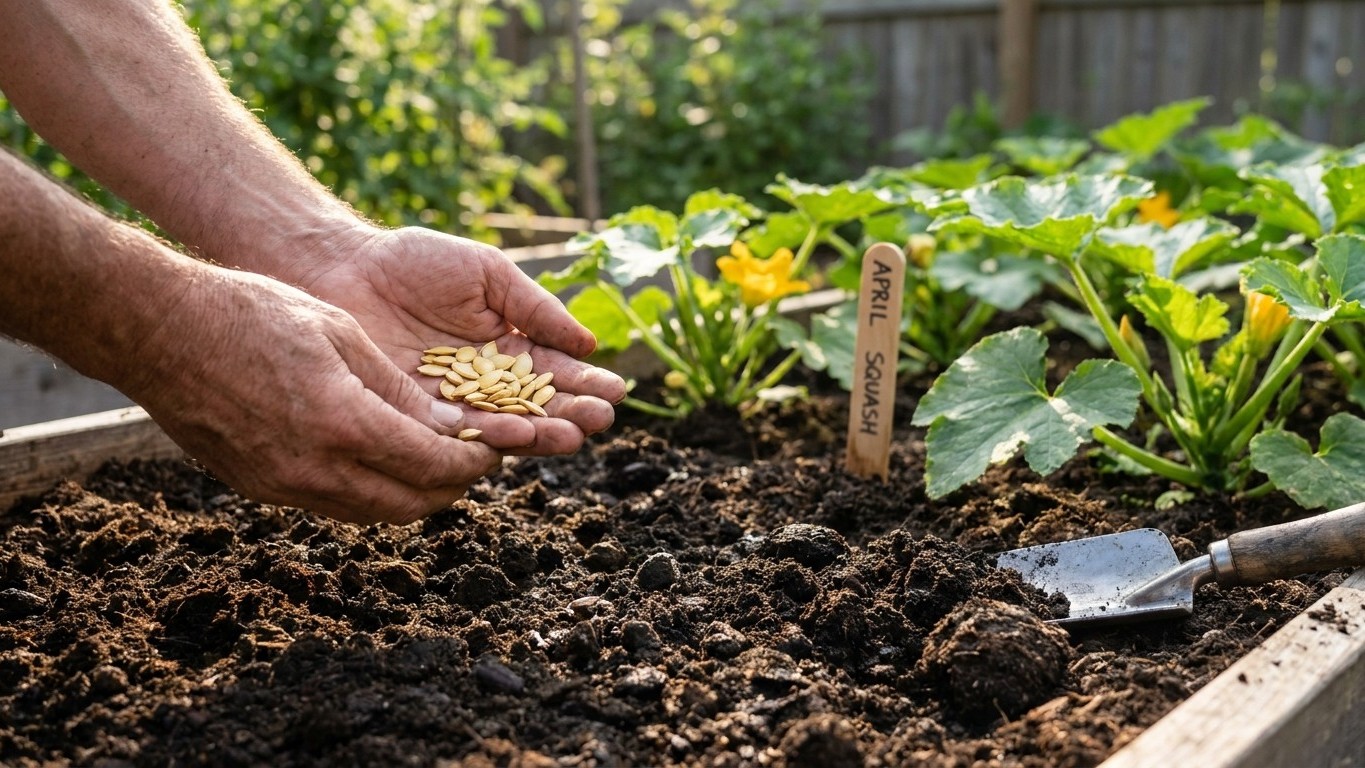

Summer squash goes into Virginia ground once the soil has shaken off its spring chill, roughly matching the window when the last frost has already passed. At the coastal reference station, that means waiting until early April at the earliest, and treating anything before that as a gamble against a freeze that still has real odds of happening.
The short answer for Virginia
Sow summer squash directly outdoors starting March 20 to April 3, the window NOAA’s 1991-2020 Climate Normals mark as the 30-70% probability band for a 32F freeze at station USW00013769 (NAS Oceana, near Virginia Beach). That is not a calendar date picked for convenience. It is the range during which a freeze is neither a sure thing nor a long shot, roughly a coin flip depending on the year. Gardeners who plant right at the start of that window are accepting real freeze risk; those who wait until it closes are trading a few days of growing season for a lot less anxiety.
On the other end of the season, the same station’s data puts the first fall frost between November 10 and November 24, again a 30-70% probability band rather than a hard stop. Summer squash needs roughly 50 to 60 days from seed to first harvest under good conditions, so working backward from mid-November gives a comfortable last-sowing date somewhere in early September at this coastal reference point, with enough cushion for a slow week or two of weather.
That math describes the mild end of Virginia. NAS Oceana sits near the coast, which the source data flags explicitly as the warmest, latest-frost part of the state. Anyone gardening in the Blue Ridge or in southwest Virginia is working with a spring that arrives later and a fall that closes in sooner, which shortens the whole window from both directions. Nothing in the available data gives an exact date for those regions, and guessing one would be worse than saying plainly that the coastal window does not transfer inland without adjustment.
Because summer squash grows fast and germinates poorly in cold soil, the practical move is to treat the end of the frost-probability window, not the start, as the safer target. A gardener sowing in late March at the coastal reference is planting into soil that may still be too cool for reliable germination even if a hard freeze does not arrive. Waiting the extra week or two into April costs little and buys more even germination.
What will not work here
Sowing right at the front edge of the frost window, the March 20 side rather than the April 3 side, is the first mistake specific to this state’s data. A 30-70% probability band means a freeze is still plausible through the whole range, and squash seedlings have no tolerance for a hard freeze at all. Planting on day one of that window is planting into odds that have not yet turned in the gardener’s favor.
Weekly watering is the second failure point, and it comes straight out of the summer rainfall numbers. June, the driest of the three summer months, averages only 4.15 inches of rain across the entire month, roughly an inch a week if it fell on a perfectly even schedule, which it never does. Combine that with 26 days a year that reach 90F or higher, and the water lost to evaporation on the hot days easily outpaces what a once-a-week soaking replaces. Summer squash sets fruit poorly under moisture stress, so a garden watered on a weekly calendar rather than by soil feel is likely to see blossom drop and stunted fruit right through the hottest stretch of July and August.
Close spacing is the third trap, and it is a humidity problem more than a heat problem. August averages 5.09 inches of rain, often arriving in the thunderstorm pattern typical of a Virginia summer rather than as gentle, soaking rain. Water sits on leaves and in tight air pockets between plants, and that dampness is exactly what powdery mildew and other fungal problems need to take hold. Crowded squash plants in a humid August are fighting disease pressure that wider spacing and better airflow would have avoided.
Finally, choosing a slow-maturing variety without checking the local season length is a mistake that hits hardest away from the coast. A variety bred for a long growing season can still finish fine near Virginia Beach, where the frost-free stretch runs well over 200 days. In the Blue Ridge or southwest Virginia, where spring arrives later and fall arrives earlier, the same variety can run out of season before it ever produces a full harvest.
What changes across Virginia
Virginia’s USDA Plant Hardiness Zone range runs from 5a to 8b, a spread built on average annual extreme minimum winter temperature. That is a wide enough range that no single planting date works for the whole state at once. A zone 8b garden near the coast and a zone 5a garden at higher elevation are not variations on the same season, they are functionally different climates sharing a state line.
The frost dates cited earlier come from the mild end of that range, the coastal reference station near Virginia Beach. The source data is explicit that the Blue Ridge and southwest Virginia run weeks later in spring and earlier in fall, which compresses the whole growing season from both sides. A gardener at higher elevation should expect to push the sowing date back and pull the last safe sowing date forward compared to the coastal figures given above, though the exact number of weeks depends on elevation and local terrain that a statewide dataset cannot capture.
The zone range spans four full hardiness zones across the state, which is the difference between a garden that can push spring plantings early and one that needs to wait out a much longer cold season. The USDA’s Plant Hardiness Zone Map is the tool built to answer that question at the local level, using the same extreme-minimum-temperature data cited here, just resolved down to a specific location rather than a statewide range.
What this means practically: treat the coastal frost dates in this article as one end of a spread, not a statewide average. A reader gardening near the coast can lean on them directly. A reader in the mountains or in the far southwest should assume both ends of the season arrive later and earlier respectively, and should look for a local source that narrows the range down to their own county rather than the whole state.
Where to check this for your own county
Virginia Cooperative Extension is the source built to close that gap. It exists precisely because a statewide range like 5a to 8b, or a single coastal frost date, is not precise enough for a planting decision in a specific county.
Two things are worth looking for once there. First, a county-level or regional planting calendar, which will translate the general frost-probability window used here into dates adjusted for local elevation and microclimate, something a statewide dataset cannot do. Second, information on which summer squash varieties have actually been trialled or recommended in that county, since a variety that performs well on the coastal plain is not automatically the best choice at higher elevation or on heavier inland clay soils.
The reasoning is straightforward: a county recommendation is built from conditions specific to that county, while the coastal frost dates are built from a single reference station applied across a state that spans four hardiness zones. That is not a flaw in either source, it is a difference in scale. A state-level page like this one is useful for understanding the mechanism, the frost probabilities, the heat load, the rainfall pattern, and why they matter. A county-level extension calendar is useful for pinning down the actual dates that apply to one specific garden.
Anyone gardening away from the coastal reference station used here, meaning most of Virginia’s land area, gains more from a call or visit to their local extension office than from squeezing more precision out of a statewide figure. That is exactly the kind of local knowledge extension services collect from years of trials that a climate-normals dataset cannot replicate.
If you follow the almanac, here is when to plant zucchini by the moon. It is a tradition, not a proven method.
Checking this against your own garden
Soil warmth by feel is the first and most direct check. Summer squash seed sits in cold soil without germinating rather than rotting outright, so a gardener who presses a hand into the top few inches of soil and finds it still cool to the touch, even after the calendar frost date has passed, is looking at a garden that is running colder than the regional average that year. That is worth waiting out rather than overriding with a sowing date pulled from a chart.
The first flush of male flowers is the second signal, and it tells a different story: that the plant has reached reproductive stage and pollinators need to be active for fruit to set. If male flowers show up during a stretch of unusually cool or wet weather, that is useful information about how this particular season is running compared to the 1991-2020 averages behind the dates in this article.
The appearance of the first true leaves, the leaves that emerge after the initial seed leaves and actually look like squash foliage, marks the point where the plant has moved past its most fragile stage. A slow arrival of true leaves, stretched out over more days than expected, often points to soil that is cooler or a spot that is shadier than the gardener assumed when choosing where to plant. All three observations are things any gardener can check without a thermometer or any other tool, just attention paid at the right moments.