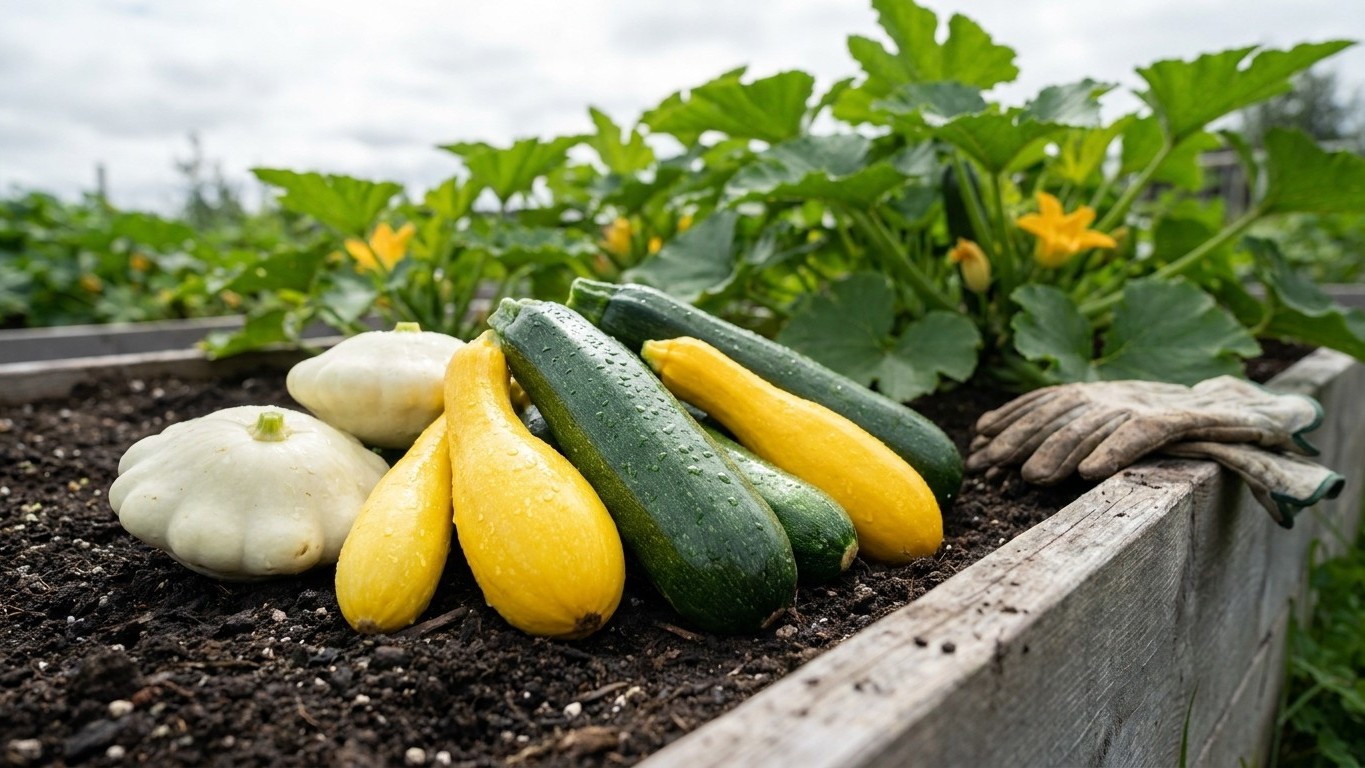

Yellow crookneck, straightneck and zucchini types bred for powdery mildew resistance are the safest bets across most of Virginia, given the state’s long, humid, moderately hot summers. Patty pan and other quick-maturing scallop types fill in the gaps at either end of the season, especially where frost dates run later or earlier than the coastal average.
The short answer for Virginia
Virginia Beach’s reference station shows a frost-free window that opens between March 20 and April 3 and closes between November 10 and November 24. That is a long season by East Coast standards, and it means most summer squash types have time to produce two, even three, plantings before fall shutdown. The number that actually shapes the decision, though, isn’t the frost window. It’s the humidity load stacked on top of 26 days a year at 90F or hotter and roughly 15 inches of summer rain falling in three wet, sticky months. That combination favors squash bred for disease tolerance over squash bred for raw speed.
Zucchini and yellow squash types selected for resistance to powdery mildew and downy mildew hold up longest here, because Virginia’s June-through-August humidity gives fungal disease a running start that dry-climate states never see. Straightneck and crookneck varieties, which tend to carry decent mildew tolerance in modern breeding lines, are a dependable middle-of-the-road choice for a first-time squash bed. Patty pan and scallop types mature fastest of the bunch, which makes them useful for a late-spring planting squeezed in after a wet April, or a second sowing in July aimed at beating the first frost in the interior.
Vining types and larger-fruited heirloom squash lines are a harder sell. They take longer to close a full harvest cycle, and that extra time in the ground is extra time exposed to squash vine borer and cucumber beetle pressure, both of which build through a long Virginia summer. If a reader is choosing one type to start with, a bush-habit yellow squash or zucchini with listed mildew resistance is the least risky entry point the facts support.
| Type | Relative speed to harvest | Disease pressure tolerance | Best fit in VA |
|---|---|---|---|
| Yellow crookneck / straightneck | Medium | Good, if mildew-resistant lines chosen | First planting, statewide |
| Zucchini (bush habit) | Medium-fast | Good, if mildew-resistant lines chosen | First and second planting |
| Patty pan / scallop | Fast | Moderate | Succession or late planting |
| Vining or large heirloom types | Slow | Lower, more exposure time | Warmer, longer-season pockets only |
What will not work here
Weekly watering on a fixed schedule is the fastest way to lose a squash bed in a Virginia summer. Summer rainfall averages about 15 inches across June, July and August, but it doesn’t arrive evenly: June is the driest of the three at 4.15 inches, and a lot of that can fall in one or two thunderstorms that run off a compacted bed instead of soaking in. Add 26 days a year at 90F or above, and a squash plant watered only once a week during a dry stretch in late June is already wilting by day four. Squash roots sit shallow, and shallow roots dry out fast under that kind of heat load.
Tight spacing is the second failure point, and it’s specific to a humid state like Virginia in a way it wouldn’t be in a drier climate. Squash foliage packed close together traps moisture after every rain and every morning dew, which is exactly the environment powdery mildew and downy mildew need to spread. A spacing plan copied from a seed packet written for the arid West will leave a Virginia planting shaded, damp and mildew-covered by mid-July. Wider rows and thinned plants matter more here than the label suggests.
The slowest-maturing squash types, including many large vining and heirloom varieties, run into a different problem: not a short season, but a long exposure window inside a season that’s hard on plants. The frost-free stretch at the coastal reference station is genuinely long, upward of 220 days, but every extra week a plant spends in the ground is another week of squash vine borer activity, another week of cucumber beetle feeding, and another week of humidity pressure on the leaves. A fast bush zucchini that’s harvested and pulled in six to eight weeks simply gives disease and pests less time to take hold than a sprawling vine that’s still fruiting in September.
Succession planting without a plan also backfires. Vine borer moths typically lay eggs in a wave partway through summer, and a single planting left standing through that wave can collapse all at once. Two or three staggered plantings, with the earliest pulled once it’s spent, spreads the risk instead of betting the whole harvest on one bed.
What changes across Virginia
Virginia’s hardiness zone range runs from 5a to 8b under the USDA Plant Hardiness Zone Map, and that spread is enormous for a single state. A 5a-to-8b range means the coldest pockets, likely at elevation in the Blue Ridge or in the far southwest, and the mildest pockets, likely along the coast, can differ by more than three full zones on a scale built around a single measure: the average annual extreme minimum temperature. That’s not a small variation. It’s close to the difference between a mid-Atlantic coastal garden and a garden in the upper Midwest.
The frost dates cited here, March 20 to April 3 for the last spring freeze and November 10 to November 24 for the first fall freeze, come from a coastal station at Virginia Beach, and they describe the mild end of the state. Inland and at higher elevation, both dates shift, later in spring, earlier in fall, which shortens the frost-free window a squash planting actually gets to work with. A reader gardening in the Blue Ridge or in far southwest Virginia should expect to plant later and expect the last practical sowing date for a second squash crop to arrive earlier than the coastal calendar suggests.
That shift changes which squash types make sense. In a shortened window, fast-maturing patty pan and bush zucchini keep their advantage, while slower vining types lose whatever margin they had at the coastal end of the state. A gardener at higher elevation gets fewer realistic succession plantings than one near the coast, simply because there are fewer weeks in the season to work with.
A yard a few miles from a river valley, or a few hundred feet higher than the surrounding county, can sit in a different zone than the town it’s listed under. The USDA Plant Hardiness Zone Map is the tool built to answer that question at the address level, and it’s worth five minutes before committing to a squash planting date.
Where to check this for your own county
A county recommendation will beat it every time, because Virginia Cooperative Extension staff in each county track local frost patterns, local disease pressure and which squash varieties actually perform in trial plots near the reader, not three hours away.
Virginia Cooperative Extension runs through ext.vt.edu, and that’s the starting point for two specific things. First, the local planting calendar for the reader’s own county or nearest office, which will adjust the frost-free window described here to match actual conditions closer to home rather than the coastal station cited above. Second, any variety trial results or recommended-cultivar lists the local office has published, which reflect what has actually held up against Virginia’s humidity and pest pressure in field conditions, not just on a seed packet.
A state-level answer like this one is a reasonable starting point for choosing a squash type. It’s not a substitute for what a county extension agent knows about the specific disease pressure, soil, and microclimate a few miles from a reader’s own garden. Anyone serious about narrowing the choice from “yellow squash or zucchini” down to a specific recommended line should treat the county office as the next and more useful step, not an optional one.
Checking this against your own garden
Three things a gardener can check without any special equipment will tell them more about their own plot than any calendar.
Soil warmth by feel is the first and most direct check. Squash seed sown into cold, wet soil sits and rots rather than germinating, no matter what the calendar says about frost risk being past. Soil that feels genuinely warm to the hand, not just frost-free, signals it’s ready. A bed that stays cool longer than expected, often a shaded spot or a low, damp corner, is running behind the rest of the property and behind the state average described here.
The first flush of male flowers is the second signal worth watching. Squash plants typically produce male flowers before female ones, and a burst of male blooms with no fruit set yet is normal, not a failure. It marks the plant settling into its reproductive stage, and it’s a useful marker for timing a second, staggered planting a few weeks behind the first.
The pace at which the first true leaves appear after the seedling stage is the third check. Leaves emerging faster than expected suggest a warmer microclimate than the state normals imply, maybe a south-facing bed against a wall. Leaves lagging behind suggest the opposite: a cooler pocket that may need later planting dates, and possibly a shorter effective season than the coastal frost dates would suggest.