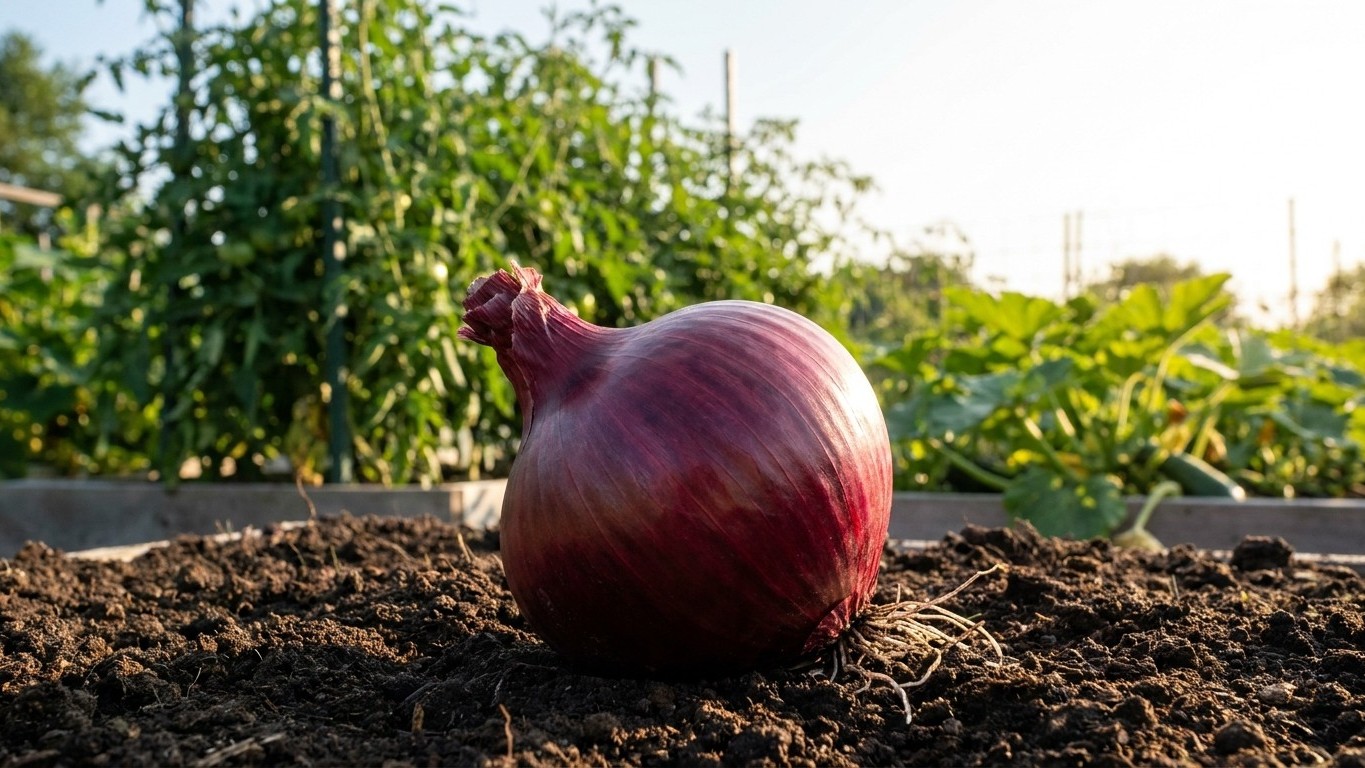

Pull onions when about half the tops have flopped over and the necks have gone soft. Then cure them in a dry, airy spot until the necks are tight and the skins rustle like paper. Only then do they go into storage. Kept cool and dry, pungent onions can last into March. Sweet ones will not make it that far. Most of the keeping happens before the bulbs ever leave the garden, so choice of variety and timing of the pull matter as much as the shelf.
Keeping them, and for how long
What temperature and humidity do cured onions need?
Clemson Cooperative Extension’s Home & Garden Information Center puts it this way: “Ideal conditions are between 45 °F and 55 °F, and 50 to 60 percent humidity.” That is cool and fairly dry. Onions are the opposite of carrots, beets and other root crops, which want cold and damp air. A single cellar cannot hold both well, so plan on two spots if you grow both.
Dry air matters because a cured onion is sealed by its dry outer skins and a shriveled, closed neck. Damp air softens that seal. Mold and rot then get in through the neck, and roots start to grow at the base. Cooler air slows sprouting, but going below that range risks freezing and mushy bulbs.
Any storage time is a ceiling set by perfect conditions. A bulb with a bruise, a thick green neck or a nick from a shovel will fail long before its neighbors. Check the pile every couple of weeks and pull out any bulb that feels soft at the neck. One bad onion is enough to spoil the ones touching it.
Why do some onions keep into March and others rot by Christmas?
The answer is chemistry. The bite of an onion comes from volatile sulfur compounds, and those same compounds help protect the bulb in storage. University of Missouri Extension says it plainly: “As a rule, ‘sweet’ onions do not store as well as the more pungent types.” A sweet variety has fewer of these compounds. It tastes better raw, but it will not last the winter, so eat it first. Never count on a sweet onion to store.
Day length lines up with this. Bulbing is triggered by hours of daylight, not by warmth. Clemson notes that short-day varieties start bulbing at about 12 hours, so they bulb early and run sweeter. Long-day varieties wait for 14 to 16 hours and keep longer. Cheyenne sits at 41.15 degrees north and gets 14 h 58 of daylight on the longest day of the year. That is enough to bulb a long-day onion, which is why a northern garden produces onions that feed you into March. Gardeners farther north, around Sheridan for example, get even longer days. Gardeners farther south or at the edge of the state should look up their own latitude. Our guide to The Best Onion Varieties for Wyoming sorts the long-day keepers from the sweet ones. For the bigger picture of the season, start with Onions in Wyoming.
How do you know onions are cured and ready to store?
Curing comes first. Bulbs go into storage only after the necks are tight and the skins are papery, never straight from the ground. After lifting, lay the onions in a single layer somewhere dry, shaded and breezy, such as a covered porch, a garage with the door cracked or a spare room with a fan. Strong high-plains sun can scald exposed bulbs, and rain undoes the work.
You are done when the neck is dry and so narrow you cannot squeeze any moisture from it, the outer skins crackle, and the roots are wiry and dry. Then trim the tops, leaving a short stub of neck, and brush off loose dirt without washing. Insect damage shortens storage life too, so set aside any bulb chewed at the base. What Eats Onion in Wyoming, and When covers what to look for.
Where in the house that actually is
Few homes offer a spot at 45 °F to 55 °F with moderate humidity. A domestic refrigerator runs colder than onions like and is damp inside, so bulbs go soft and the smell spreads. A heated living space is too warm, and the bulbs sprout or shrivel. A garage swings with the weather. It can sit in range on a mild October day and drop below freezing during a Wyoming cold snap, which turns onions to mush. Some homes have a basement or cellar. That is closer, but basements can be damp enough to ruin onions, and they sit near a furnace or water heater that warms one corner.
The room that usually comes closest is an unheated interior space in a heated house. Candidates include a cool basement room away from the furnace, a closet on an inside wall of a spare bedroom, or an enclosed porch that stays above freezing. The dry air of the high plains helps here, since a dry house is more likely to land in the 50 to 60 percent range than a coastal one. Mesh bags, slatted crates or a basket let air move around the bulbs. Plastic bags or sealed tubs trap moisture, so skip them.
Do not rely on guesswork. Put a thermometer with a humidity reading where the onions will sit and watch it for a few days before you move them in, or you may lose the whole crop to a spot that looked cool enough. Check it often, because a room that sits at 50 °F at dawn may climb on a sunny afternoon. If the reading runs warm, try a different corner. If it runs damp, add airflow. If you also store carrots or potatoes, keep the onions in a separate room.
Common questions
How do I know when to pull onions?
Watch the tops. When roughly half have fallen over and the necks look soft and thin, the bulbs have stopped growing. Pull them on a dry day. Easing off watering as the tops begin to yellow helps the skins dry. Do not bend the tops over yourself to force it, since green, thick necks cure poorly. If a hard freeze threatens before the tops fall, lift the crop anyway and cure the bulbs inside.
What if the weather is wet during curing?
Bring them under cover. A garage or covered porch works if the onions stay out of rain and direct sun, and a small fan speeds things up. Spread the bulbs in a single layer, because piles hold moisture. Your county extension office can tell you what local fall weather usually does to curing.
Can I store sweet onions through winter?
Not reliably. They have fewer of the sulfur compounds that protect the bulb, so they soften and rot sooner. Cure them the same way, keep them cool and dry, and eat them first. Save the pungent, long-day varieties for the winter shelf.
Why are my stored onions sprouting or going soft?
Sprouting points to warmth. Softness at the neck points to damp air, thick necks or bruises. Move the onions to a cooler, drier spot and sort through them now. Use anything with a soft neck right away, and keep the firm ones apart from it.