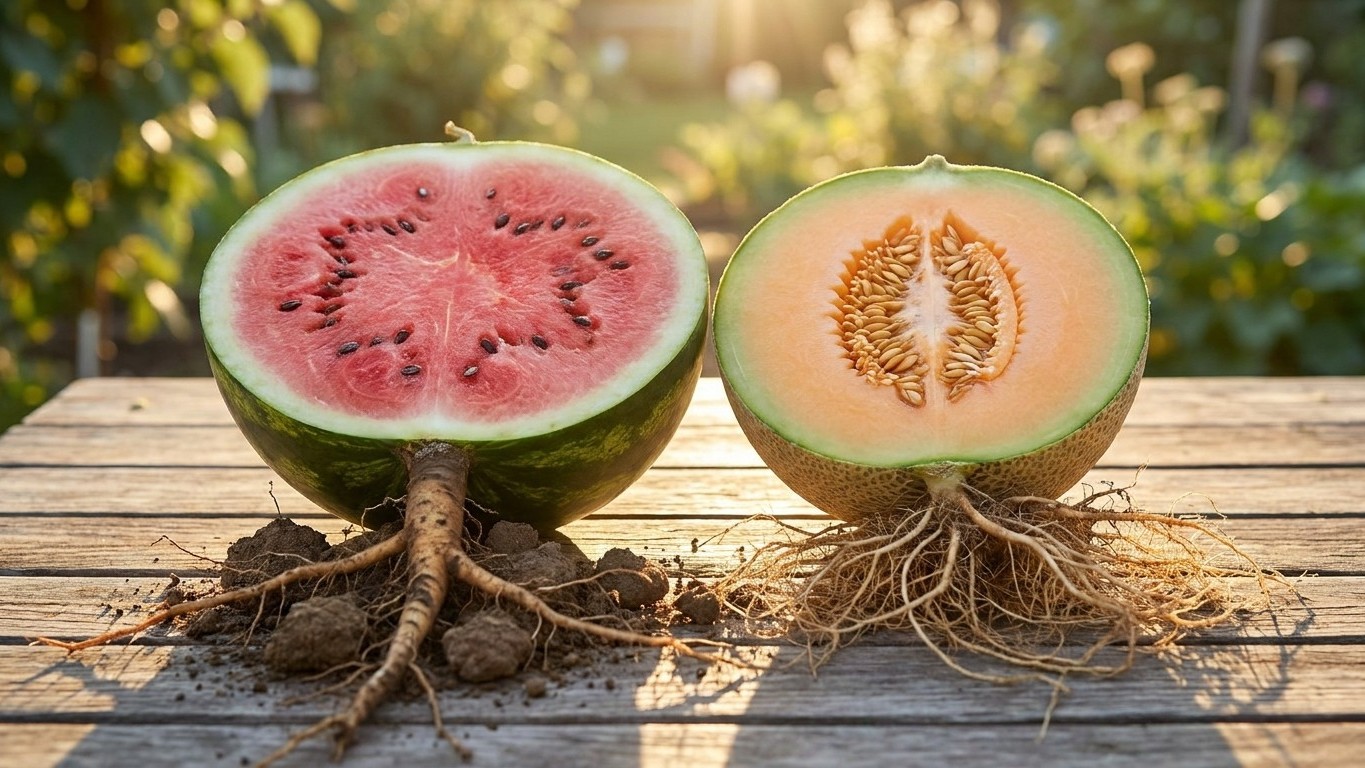

Watermelon and muskmelon aren’t just different varieties of the same plant. They’re different species entirely, from different genera, with different root systems, different heat needs, and ripening behavior that works in opposite directions. Growing them side by side and giving them the same care is the single fastest way to lose a harvest of one or both.
What is actually going on
Watermelon is Citrullus lanatus. Muskmelon, the category that includes cantaloupe and most of the netted or smooth-skinned melons sold at farm stands, is Cucumis melo. They share a family (Cucurbitaceae) the way a wolf and a fox share a family. That’s about where the resemblance ends.
The root systems tell the first part of the story. Watermelon sends down a long taproot and spreads a wide, aggressive lateral root system to chase water during a hot, dry stretch. That’s why old-timers could grow decent watermelon on sandy ground with minimal irrigation once the vines got established. Muskmelon roots stay shallower and more fibrous, closer to the surface, which means the plant depends on more consistent moisture near the crown and dries out faster in the same sandy soil that a watermelon vine shrugs off.
Heat requirements diverge too. Watermelon wants soil solidly warm before it will germinate or grow with any vigor, and it keeps pushing vine growth through the hottest weeks of summer. Muskmelon germinates and grows in slightly cooler soil and, in many regions, actually slows fruit quality when nights stay too warm for too long, because the sugars that build flavor accumulate better with some day-night temperature swing.
Then there’s the ripeness signal, and this is where most backyard growers get tripped up. A melon does not sweeten after it’s picked. It softens, and it can look prettier on the counter for a few days, but the sugar stops arriving the instant the stem separates from the vine. Everything the fruit will ever taste like, it tastes like at the moment of harvest.
Watermelon and muskmelon signal that moment in almost opposite ways. A ripe muskmelon develops an abscission layer at the stem and separates from the vine on its own with light pressure, a behavior growers call “slipping” and check by nudging the fruit at the base of the stem. A ripe watermelon does the opposite: it never slips. It has to be cut. Its ripeness shows up as a dulling of the skin’s sheen, a cream or yellow “ground spot” where it rested on soil, and a curled, browned tendril at the point where the fruit stem meets the vine. Waiting for a watermelon to release itself the way a muskmelon does means waiting past the point of overripe, sometimes past the point of edible.
In the garden
Because the two plants run on different clocks and different root strategies, garden advice written for one will actively work against the other. The differences show up most in spacing, watering, and how you decide it’s time to pick.
| Factor | Watermelon | Muskmelon | What goes wrong when swapped |
|---|---|---|---|
| Spacing | Needs more room; vines run long and lateral roots spread wide to find moisture | Can be grown tighter, including on trellis in smaller beds | Crowding watermelon stunts root spread and cuts fruit size; giving muskmelon the same wide spacing as watermelon wastes bed space without improving yield |
| Watering pattern | Deep, infrequent watering once established; taproot handles dry spells between soakings | Steadier, more frequent watering; shallow roots stress quickly if the surface dries out | Frequent shallow watering on watermelon encourages shallow roots and weaker plants in a hot spell; letting muskmelon dry out between waterings the way watermelon tolerates leads to blossom drop and small, cracked fruit |
| Ripeness check | Ground spot color, tendril drying and browning near the fruit, a dull rather than glossy rind | Fruit slips free from the vine with gentle pressure at the stem; skin under the netting shifts from green to tan or gold | Waiting for a watermelon to “slip” means it never comes, and by the time frustration sets in, the fruit is often overripe or hollow inside; picking a muskmelon before slip because it “looks big enough” locks in underdeveloped sugar for good |
| Harvest method | Cut cleanly with a knife or shears, leaving a short stub of stem | Lift or twist gently once it has already started to separate on its own | Pulling a watermelon off by hand tears the vine and often the fruit; forcing a muskmelon off before it slips bruises the stem end and speeds rot |
| Post-harvest handling | Holds its eating quality for a stretch at cool room temperature or refrigerated | Best used within a few days; texture softens quickly once cut or fully ripe | Treating a muskmelon like a watermelon and storing it for later leaves it mealy; refrigerating watermelon whole for too long can dull the flavor |
The pattern across every row is the same. Watermelon rewards patience and infrequent attention, built around a plant that stores water and waits. Muskmelon rewards closer, steadier attention, built around a plant that signals its own readiness if you’re watching for it. Applying one plant’s rhythm to the other doesn’t just lower quality, it changes the outcome from a good melon to a wasted growing season.
What it depends on where you are
Everything above is biology, and biology holds true everywhere. What doesn’t hold true everywhere is how long the growing season runs, how hot the daytime highs get, and how much rain falls during fruit set, and all three of those change which melon type performs well in a given yard and how forgiving the timing is.
A region with a long, consistently hot stretch through summer gives watermelon plenty of runway to build its extensive root system and push vines through peak heat without stalling. That same long hot stretch can work against muskmelon flavor if nighttime temperatures never drop enough to let sugars build properly, a factor tied to elevation and regional climate as much as to the calendar. A shorter season with cooler nights can favor muskmelon’s flavor development while leaving watermelon short on the total heat units it needs to finish a full-size fruit.
Rainfall timing matters just as much as total heat. Watermelon’s deep root system handles a dry spell mid-season better than it handles a wet one right at fruit set, when too much water dilutes sugar and can split rinds. Muskmelon’s shallow roots are more sensitive to inconsistent moisture generally, so a region with unpredictable summer downpours followed by dry stretches tends to produce more cracked or misshapen fruit in muskmelon than in watermelon.
None of this page can tell a reader in the Southeast, the High Plains, or the Pacific Northwest exactly when to plant or how many warm days to expect, because those numbers shift by state and even by county. That’s exactly the information a state’s cooperative extension service tracks: local frost dates, heat unit totals, and which melon types have performed well in regional variety trials. Pairing the biological explanation here with the local numbers from an extension service, or from the state-specific pages elsewhere in this melon guide, is what turns general advice into a planting decision that actually fits a specific yard.
The mistake that costs the most
The single costliest mistake is checking a watermelon for the slip that only a muskmelon will ever give. Growers who’ve had good luck with muskmelon learn to trust that gentle nudge at the stem, and it’s a genuinely reliable signal, so it’s tempting to lean on the same habit once watermelon vines start filling out the bed. But a watermelon stem never develops the abscission layer that causes a clean release. It will hang on tight at full ripeness and well past it, so a grower waiting for slip either picks far too early out of impatience or leaves the fruit too long out of a mistaken belief that it isn’t ready yet, hoping it will “finish” once cut. It won’t. The sugar level at the moment the fruit leaves the vine is the sugar level it keeps.
The fix is to drop the slip test entirely for watermelon and read the signals that species actually gives: the tendril nearest the fruit drying and turning brown, the skin losing its glossy shine and going matte, and the ground spot where the melon rests on soil shifting from white to a cream or pale yellow. Those three signs together are far more reliable than any single one alone, and they’re the closest thing watermelon has to the certainty a muskmelon’s slip provides. Learning to read them, rather than waiting for a release that will never come, is the difference between a melon that’s actually ready and one that’s been guessed at.