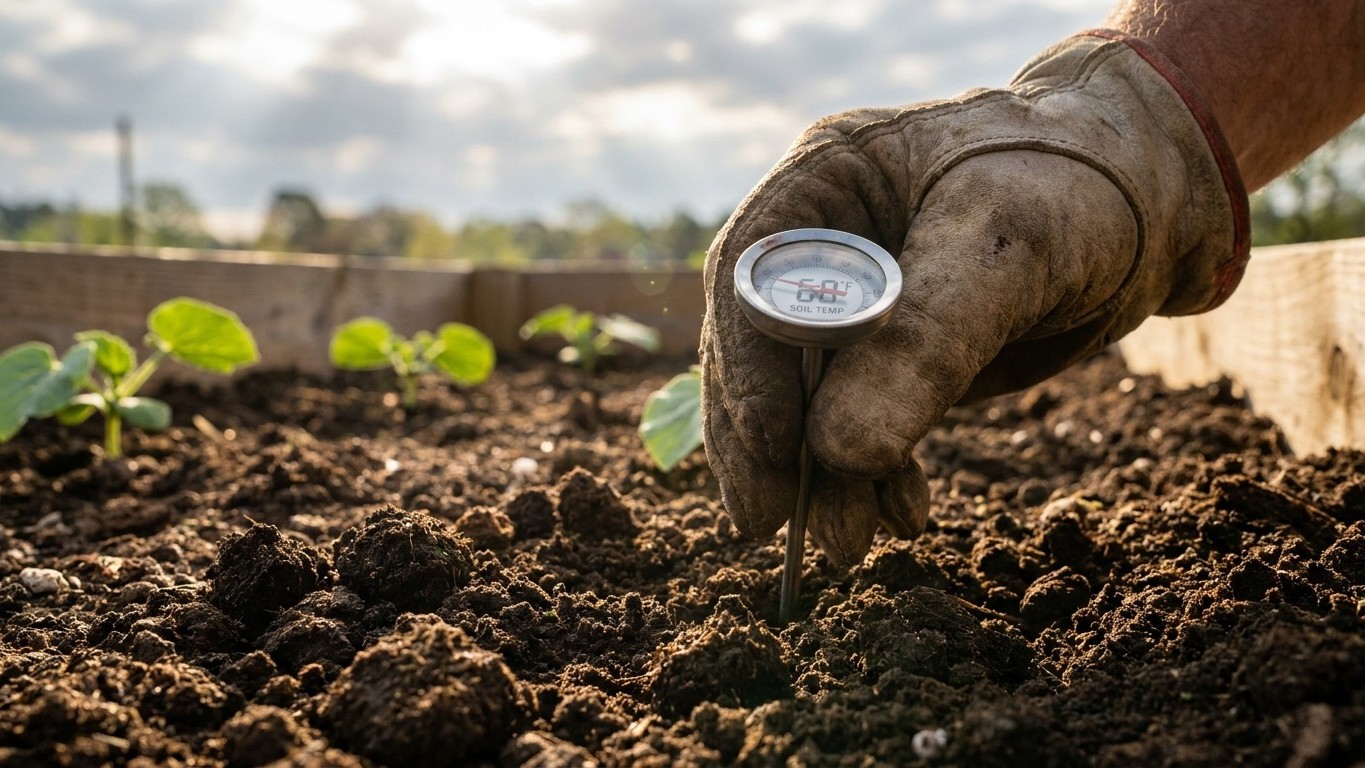

In the low desert around Phoenix, melons don’t wait for a frost date, because frost barely exists there. NOAA lists a 365-day frost-free season for the reference station, and only 6 of the last 30 springs even reached 32°F. The real deadline is summer heat, which shuts down fruit set for months. Everything below explains how that flips the usual planting logic.
When the soil is warm enough in Arizona

Ask a gardener in Ohio when to plant melons and they’ll give you a date tied to the last spring frost. Ask that question in Phoenix and the frost date barely matters, because it almost never happens. According to NOAA NCEI 1991-2020 Climate Normals and daily records at station USW00023183, the low desert sees no freeze in most years; when a cold snap does bring 32°F, it lands somewhere between late December and mid-January, not in spring at all. That same dataset lists the frost-free season at 365 days.
For most of the country, frost is the proxy that tells you when soil has warmed enough to start a melon seed. Here, the proxy breaks down, because the thing that stops melons isn’t cold, it’s the opposite extreme. A frost date is only ever a probability anyway, never a promise, and in this territory the probability is so low it stops being useful as a planting signal.
What matters instead is beating the heat. Low-desert growers push melon seed into the ground in late winter, well before frost would even register as a concern elsewhere, because the goal is to get roots established and flowers set before the string of 90°F-plus days locks in. Soil warms fast under Arizona sun once winter breaks, so the wait for “soil warm enough” is short and the window to act is narrow at the other end, not this one.
Why this doesn’t apply everywhere in the state
Arizona’s USDA hardiness zone range runs from 4b to 10b, a spread wide enough to cover two different growing worlds. That range, per the USDA Plant Hardiness Zone Map (2023 edition, built on 1991-2020 normals), is based on one variable only, the average annual extreme minimum temperature. Phoenix sits at the warm end of that range and anchors the frost-free reasoning above. Flagstaff and the high country sit at the cold end, and they do freeze hard, on a calendar that looks like a normal mountain-climate spring and fall. A gardener in the high country should follow a frost-based calendar much like the rest of the country. A gardener in the low desert should not, and the local Arizona Cooperative Extension office is the place to confirm which planting window applies to a specific address, since elevation changes the answer block by block in this state.
How long the season lasts here
NOAA’s own number for the frost-free season at the low-desert reference station is 365 days. Read literally, that means there’s no calendar gap at all, no dead stretch bookended by two frost dates the way a subtraction would work in most Territories. But that figure describes frost risk, not growing conditions, and for melons it’s close to meaningless on its own.
The season that actually matters for fruit set has two working windows instead of one continuous stretch. Spring planting runs from late winter through the point where daytime highs start stacking up in the 90s and above, a stretch that has to end before pollination and fruit set stall out under sustained heat. Then there’s a dead middle, roughly the heart of summer, when flowers may set but fruit quality and plant vigor suffer under relentless heat load. A second window opens as that heat load eases in early fall, short but often usable for a fast-maturing planting before any cooler weather arrives in the high country’s own calendar, not the desert’s.
That two-window structure changes the calculation on succession sowing. In a territory with one long, continuous frost-free stretch, a second sowing a few weeks after the first is a simple insurance policy. In the low desert, the second window isn’t a backup, it’s a separate opportunity shaped by the summer heat gap in between, and timing it well depends on watching the season’s second half rather than counting forward from the first planting date. The succession sowing guide on this site covers how to stagger plantings around a gap like that rather than through a single uninterrupted window.
This structure also affects whether transplants make sense. Where the spring window is short and heat arrives on a hard schedule, getting a head start with transplants (checked for root health before they go in the ground) can matter more than it would where a slow-warming season allows direct seeding at leisure.
Heat and water in Arizona

Melons ripen on accumulated warmth more than on a fixed number of days, and the low desert supplies plenty of it. NOAA NCEI Climate Normals (1991-2020) put the reference Phoenix station at 168.9 days a year reaching 90°F or higher. That’s not an average summer temperature, it’s a count of how many days cross that threshold, and it’s the number that drives water demand, heat stress on the plant, and how hard irrigation has to work to keep up.
Rain isn’t going to help much with that load. Summer rainfall across June, July and August averages about 1.9 inches at the same station, against 7.2 inches for the whole year. The three months don’t behave alike, and the breakdown matters for planning:
| Month | Average rainfall |
|---|---|
| June | 0.02 inches |
| July | 0.91 inches |
| August | 0.93 inches |
June is essentially rainless, while July and August pick up monsoon moisture that arrives as brief, heavy thunderstorms rather than steady soaking rain. That kind of rainfall tends to run off rather than sink in, especially on the loose, fast-draining soils common in the low desert, so it can’t be counted on to replace irrigation even in the wetter months.
In a hot territory with this little reliable summer rain, irrigation stops being a supplement and becomes the main lever. How much water the plant gets largely decides how big the melons get, and the final two weeks before harvest, when growers typically ease off water, are what decide how much sugar concentrates in the fruit. This is the opposite situation from a cool, damp-summer territory, where the concern would be mildew and slow ripening under overcast skies. In the low desert, disease pressure from excess moisture is rarely the problem; running out of water during a 90°F-plus stretch is.
Which melons suit Arizona
None of this points to a single variety, and it shouldn’t. The honest answer is to choose by type and let the local Arizona Cooperative Extension office (extension.arizona.edu) confirm which specific varieties have actually performed well in county trials, because that’s the only recommendation grounded in real local results rather than a guess dressed up as advice.
What the territory’s own numbers suggest is a direction. Since the season isn’t short here in the frost-based sense, the earliest-maturing types aren’t forced on the grower the way they would be in a short-summer state; the constraint is heat load, not calendar days. That favors types bred or traditionally grown for hot, dry conditions, and it favors giving whatever type is chosen airflow around the vines and some shade at the root zone, since 168.9 days above 90°F a year is a stress test most cool-summer melons simply weren’t selected for.
Humidity-driven disease, the first filter a grower in a muggy state has to apply, matters less here than in a wetter territory, given how dry the summer air runs outside the brief monsoon storms. That doesn’t mean disease resistance is irrelevant, only that it isn’t the first sorting criterion the way heat tolerance and water management are. A type that can hold fruit quality through sustained 90°F-plus stretches, paired with consistent irrigation through the last weeks before harvest, is doing more work in this territory than any resistance to fungal disease would.
Refusing to hand over a variety name here isn’t a dodge. County-level trial results change from year to year and from one part of the state to another, low desert against high country, and a name printed on a general page can’t account for that. The extension office can, because it’s testing in the same soil and the same heat the reader is actually gardening in.