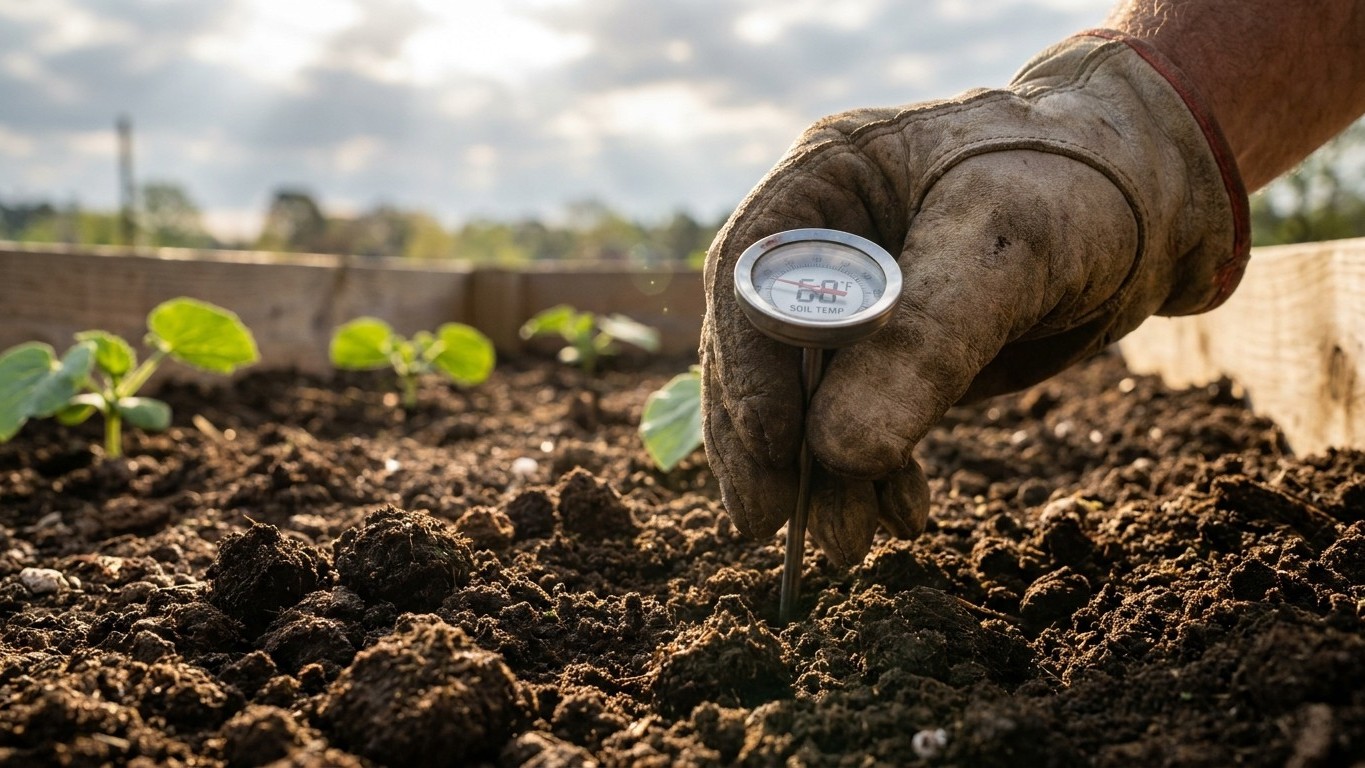

In Michigan, melon seed goes into the ground once the soil itself has warmed past the mid-60s, typically two to three weeks after the local last spring frost has passed and only after nights hold reasonably steady. Because the reference last frost for the Detroit area lands around April 30, most growers wait until mid-to-late May to direct-seed or set out transplants, with the rest of the Lower Peninsula, where frost lingers into early or mid-May, pushing that date later still.
When the soil is warm enough in Michigan
Reading a frost-free date as probability, not promise
The calendar date most gardeners circle is the last spring frost, but that date is a stand-in for something melons actually respond to: soil temperature. According to MSU Extension’s Frost-Free Dates, the last spring frost lands around April 30 in the Detroit area, while most of the Lower Peninsula sees it arrive early to mid-May. That’s a real spread, two to three weeks, across a single state, and it matters more for melons than for most vegetables because melon seed germinates poorly in cold ground.
A frost-free date is built from decades of weather records, and it describes a probability, not a guarantee. Treat it as the earliest reasonable starting line, not a signal to rush seed outdoors the same week it arrives.
What actually decides planting day is the soil several inches down, not the air. Melons germinate poorly, if at all, in soil below the low 60s, and transplants set into ground that hasn’t caught up with the air temperature tend to sit pale and stalled rather than grow. In most of Michigan, soil lags behind the last-frost date by one to three weeks, since it takes sustained sun and warmer nights to move heat down through the profile. That’s why growers across the Lower Peninsula, working from a last-frost window of late April to mid-May, commonly wait until the back half of May before committing seed or transplants outdoors.
Warming the soil ahead of the calendar
Warming the soil ahead of that natural timeline is one of the few moves that genuinely shifts the planting date in a cool climate. Black plastic mulch laid over the bed a week or two before planting, and floating row cover pulled over young plants afterward, both raise soil and air temperature without any chemical input, a mechanical head start rather than a genetic one. Raised beds and south-facing slopes warm faster too, simply because they shed cold air and drain excess spring moisture instead of holding it.
Michigan’s USDA hardiness zone range, 4a to 6b under the current USDA Plant Hardiness Zone Map, is wide enough that a date suited to the Detroit area can be two or three weeks too early near Lake Superior or in a low-lying frost pocket downstate. Hardiness zone is built on one number, the average extreme winter minimum, so it says nothing about spring warm-up speed by itself; it’s a cross-check against the frost data, not a planting calendar on its own. For the actual window in a given county, MSU Extension’s local frost data is the more useful reference than the statewide zone map.
How long the season lasts here
What the window allows
Subtract one frost date from the other and the growing window becomes concrete. Using the Detroit-area last spring frost of around April 30 and the zone 6a first fall frost window of October 6 to October 21 given by MSU Extension’s Michigan Garden Calendar, the frost-free season there runs roughly 159 to 174 days. That’s a comfortable stretch by Michigan standards, but it’s tied to a specific reference point. Areas where the last frost slides into early or mid-May, as it does across most of the Lower Peninsula, are working with a shorter version of that same window, even without an exact date available to subtract.
A season in the 150-to-175-day range is enough to carry a full melon crop through to ripening and still leave room to consider a second, faster-maturing planting of some other vegetable, though melons themselves are usually a one-shot crop in this climate. They need most of the frost-free window just to flower, set fruit, and finish ripening before the first fall frost cuts them off. That changes how a Michigan grower should think about succession. Rather than staggering melon plantings the way one might with lettuce or beans, the more useful move is staggering melon types by earliness, so an early-maturing sowing and a mid-season sowing both have a real shot at finishing before October.
Direct-seeding versus transplanting
The length of the window also decides whether transplanting is worth the trouble. In a shorter local season, starting seed indoors four to five weeks ahead of the projected outdoor date and setting out sturdy transplants buys back days lost to a late spring, provided the young plants get a careful root check and a hardening-off period so transplant shock doesn’t erase the head start. In a longer window, like the one anchored to the Detroit-area date, direct-seeding once soil has warmed is simpler and skips the transplant stress, since there’s enough season left to absorb a slower start.
Anyone weighing a second sowing of a faster crop after an early melon planting, or building a fuller succession calendar around Michigan’s frost dates, will find the mechanics, spacing plantings, and reading days-to-maturity against the remaining window in this site’s guide to succession sowing.
Heat and water in Michigan
A modest heat budget
Ten days. That’s roughly the average number of days per year the Detroit-area reference station reaches 90°F or higher, according to NOAA’s 1991-2020 Climate Normals, 10.3 days to be precise. For a crop that ripens on accumulated warmth rather than on the calendar, that’s a modest number. Michigan isn’t a territory where melons coast to sweetness on sheer heat load the way they might in a hotter, drier region; it’s one where every warm stretch needs to be used well, and where the soil-warming techniques covered above matter as much as, or more than, the exact sowing date.
Rainfall tells a similarly moderate story. Summer rain at the same reference station averages about 10.0 inches across June, July and August, split fairly evenly: 3.26 inches in June, 3.51 in July, and 3.26 in August, the driest of the three. That’s not a drought pattern, and it isn’t the kind of dry summer that makes irrigation the single deciding factor in fruit size. It’s a climate that delivers regular rain through the fruiting period, which keeps vines from stressing but comes with its own cost: humidity.
Managing wet, not dry
Where heat is limited and rain arrives reliably through summer, the bigger threat to a melon crop usually isn’t drought stress but foliar disease. Powdery and downy mildew both thrive in warm days, cool damp nights, and leaves that stay wet into the evening, and a Michigan summer supplies that mix more often than it supplies a genuine heat wave. Ripening can also drag longer than a seed packet’s optimistic estimate suggests, since the accumulated warmth those estimates assume isn’t guaranteed here the way it is farther south.
None of that makes irrigation irrelevant, only different in role than it would be in a hot, dry territory. Here, water management is less about topping up a thirsty crop and more about controlling how wet the foliage gets: watering at the base rather than overhead, spacing vines for airflow, and keeping mulch under the fruit so it isn’t sitting on damp soil. Those choices, plus siting the patch where morning sun dries leaves quickly, do more for a Michigan melon crop than extra water ever would.
The figures above describe one weather station’s normal, not a guarantee for any single yard. A slope, a nearby lake, or a low spot that holds cold air can shift both the heat count and the effective rainfall a garden actually receives, which is why a rain gauge on the actual plot tells a grower more, over a season, than the 1991-2020 average ever will.
Which melons suit Michigan
What the climate argues for
Everything above points to the same conclusion: Michigan’s melon-growing case rests on a moderate season, modest heat, and reliably damp summers, and each of those facts argues for a type of melon rather than a specific variety.
A season of roughly 150 to 175 frost-free days, shorter in much of the Lower Peninsula than in the Detroit-area window used to calculate it, favors the earliest-maturing types over long-season ones bred for hotter, drier climates. Waiting on a slow-ripening type is a bigger gamble here than in a territory with a longer heat season backing it up. With only about 10 days a year reaching 90°F, a Michigan grower gets more benefit from choosing a type known to set and ripen fruit under moderate warmth, paired with the soil-warming and airflow practices already covered, than from chasing a type bred for sustained, dry heat. With summer rain landing reliably through June, July and August, disease resistance, particularly to powdery mildew, becomes one of the first things worth checking on a seed packet or plant tag, ahead of size or flavor claims.
Where the real recommendation lives
None of that translates into a single variety name, and that’s deliberate. Which specific melon performs best changes from one Michigan county to the next, depending on microclimate, soil, and the disease pressure of a given year, and the people who track that reliably are the researchers running trial plots across the state. MSU Extension, at canr.msu.edu/outreach, publishes exactly that kind of regionally tested variety information, updated as new trials come in, a resource this page, describing the state’s climate rather than running its own trial garden, simply can’t replace.
The practical path is to treat this page as the climate briefing and the extension office as the variety list: settle on an early-maturing, mildew-resistant type based on what’s outlined here, then check the current recommended varieties for the specific county before buying seed. Climate logic first, local trial data second, that combination holds up against a Michigan growing season better than either one alone.