
Missouri gardeners can put melon transplants or seeds in the ground once soil temperatures hold steady, typically from late April in the southern part of the state to mid-May farther north. The growing window that follows runs long enough for a full melon crop and, in many years, room for a second planting.
When the soil is warm enough in Missouri
The question every Missouri gardener asks in spring isn’t really “when’s the last frost” but “when can I stop worrying about the soil being cold.” Those are related, but they’re not the same thing. According to NOAA NCEI 1991-2020 Climate Normals for station USW00003947, the last spring frost (32°F) falls somewhere between April 6 and April 20, based on the 30-70% probability band. That’s a wide window, and it needs a caution attached: this station sits at Kansas City International Airport, which is well north of the city itself. Downtown Kansas City tends to warm up about five days earlier in spring, and southern Missouri, closer to the Arkansas line, is milder still.
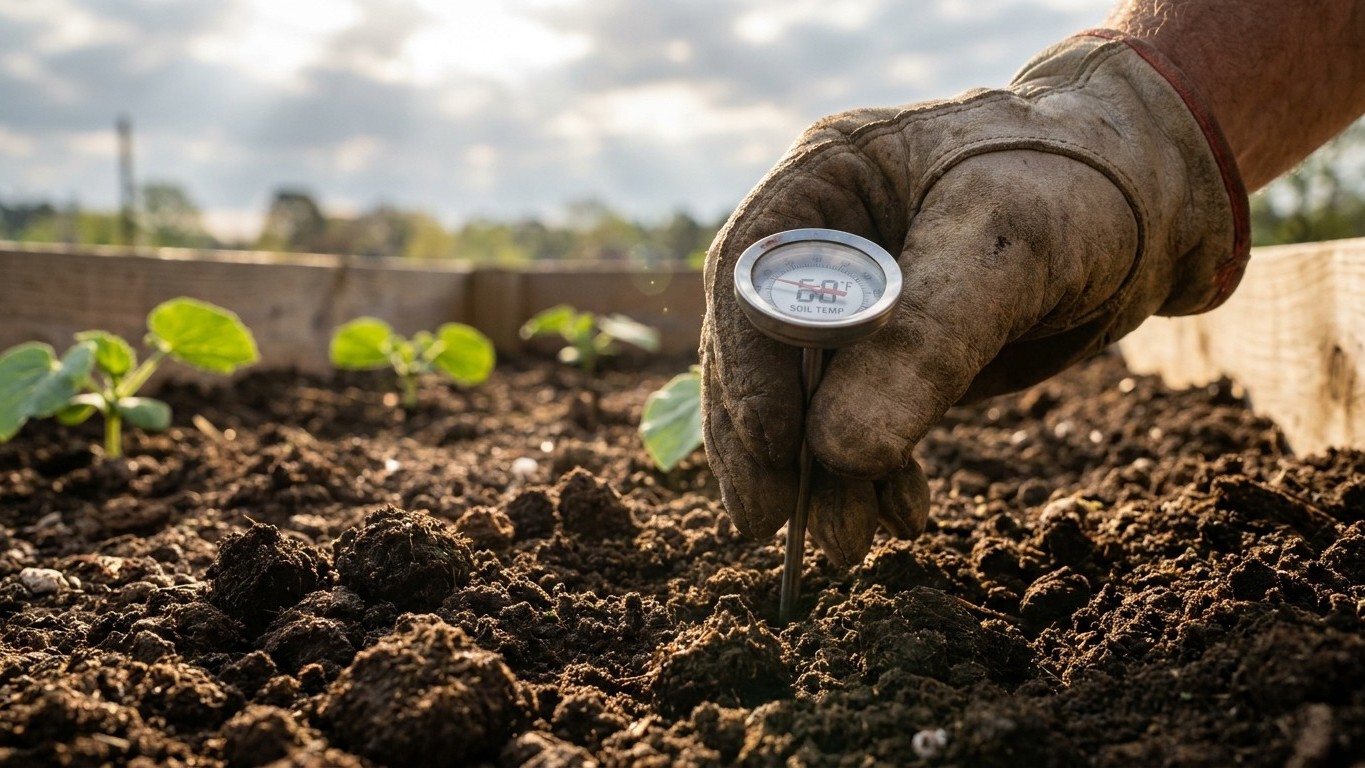
A frost date is a probability, not a promise. Even inside that April 6 to April 20 band, a late cold snap can still show up in a given year, and it has before. That’s why the real trigger for planting melons isn’t the calendar date at all, it’s the soil itself. Melon seed germinates poorly in cold, wet ground, and transplants set out too early just sit there sulking while weeds take off around them. Soil needs to hold in the mid-60s Fahrenheit at a few inches deep, consistently, not just on one sunny afternoon. That threshold is usually reached one to two weeks after the last frost date passes, once the ground has had time to catch up with the air.
Zone and region matter more than the calendar
Missouri spans USDA Hardiness Zones 5b through 7b, a range wide enough that a planting plan built around one city won’t fit the whole state. The USDA Plant Hardiness Zone Map is built on a single variable, the average annual extreme minimum temperature, so it tells you about winter survival more than spring planting timing, but it’s still a useful signal of how much earlier the southern Bootheel warms compared to the northern counties near Iowa. Anyone gardening outside the immediate Kansas City area should treat these dates as a starting point, not a fixed rule, and confirm timing against local observations or a soil thermometer.
For melons specifically, gardeners often use black plastic mulch or clear row cover to push soil warming along by a week or two, letting an earlier planting date work without the seedling sitting in cold ground. That’s a technique worth knowing regardless of which part of the state you’re in, since it buys margin against a late frost without forcing you to wait out the entire probability window.
How long the season lasts here
Stack the two frost dates from the same NOAA NCEI 1991-2020 Normals and Missouri’s frost-free window runs from the April 6 to April 20 last-frost band to a first fall frost between October 18 and October 29. Depending on exactly where those two dates land in a given year, that works out to somewhere around 192 to 195 days of frost-free growing, close to six and a half months. That’s a genuinely long season by national standards, and it changes the planning conversation in a meaningful way.
A season that long doesn’t just fit one melon crop comfortably, it leaves room for a second one. Melons started from seed directly in the ground in early May, once soil has warmed, can be harvested well before the October frost window arrives, often with six to eight weeks of season left over. That surplus is exactly what makes succession sowing worth considering rather than optional: a second direct-seeded planting in June can extend the harvest into September and spread out the workload of picking, rather than facing one large flush of ripe melons all at once. Gardeners weighing whether that second sowing makes sense, and how to time it against the first, should look at the succession sowing guide on this site, since the mechanics of staggering plantings apply across melon-growing Territories even though the exact dates shift.
The length of the season also affects a smaller but practical decision: whether to start melons indoors as transplants or seed them directly outside. In a short-season territory, transplanting is often the only way to get a mature crop before frost shuts things down. In Missouri’s roughly 190-day window, direct seeding after the soil has warmed is a reasonable default for most of the state, since there’s enough time for the crop to mature without the root disturbance that comes from transplanting a vine crop that resents having its roots checked. Transplants still have a place for gardeners wanting an earlier first harvest, but they’re a choice here, not a necessity forced by a short calendar.
Heat and water in Missouri
Melons ripen on accumulated heat, not on the calendar, and Missouri’s numbers put it solidly in heat-adequate territory rather than the cool, marginal zones where sugar development struggles. At the Kansas City reference station, NOAA NCEI Climate Normals for 1991-2020 put the average count at 32.7 days a year reaching 90°F or higher. That’s a meaningful heat load, not a token handful of hot afternoons, and it means most of the state gets enough sustained warmth to push melon vines through flowering, fruit set and the sugar-building final stretch without the crop stalling out from lack of heat units.
Rainfall is where the picture gets more particular. Summer rainfall across June, July and August averages about 14.1 inches at the same reference station, with June the wettest month at 5.25 inches, July at 4.58 inches, and August, the driest of the three, at 4.24 inches. That August dip matters more than it might look on paper, because it lines up with the exact stretch when melon fruit is sizing up and finishing its ripening. A hot month with the least rain of the summer is a month where the crop depends on whatever water the gardener supplies, not on what falls from the sky.
None of this is a forecast for any particular backyard. These are 1991-2020 normals for one reference station, and a slope, a sandy patch, or a spot that catches more afternoon shade will behave differently. A sandy bed lets an inch of rain drain through within a day; a clay-heavy one holds that same inch for a week, which changes how often watering is actually needed even under identical rainfall. Add in that days above 90°F drive evaporation and that a summer thunderstorm often runs off rather than soaking in, and the honest takeaway is that a rain gauge on the actual garden bed tells a gardener more than any regional average. What the numbers do confirm is that irrigation decisions, especially through August, are what decide fruit size and final sweetness in most Missouri gardens, not the total summer rainfall figure alone. Watering deeply and less often, rather than a light daily sprinkle, keeps the sugar concentration where it should be rather than diluting it right before harvest.
Which melons suit Missouri
Given a season pushing 190 to 195 days, a heat load north of 30 days above 90°F, and June rainfall heavy enough to keep foliage damp, three things should guide a Missouri gardener’s choice of melon type rather than any single variety name: enough season length to finish a full-season type, some tolerance for sustained summer heat, and resistance to the fungal diseases that thrive when warm nights meet wet leaves. Powdery and downy mildew both find Missouri’s early-summer humidity comfortable, so a type or variety bred with resistance to those diseases is worth prioritizing over one chosen purely for size or flavor claims.
Within the broad categories, muskmelon and cantaloupe types generally handle Missouri’s season well since they mature faster than large watermelon types and give some margin against a wet, disease-pressured spring. Watermelon types, both the large picnic sort and the smaller icebox kinds, do fine given the season length here, though they benefit from wider spacing and good airflow to keep foliage drier in a humid June. Honeydew and other late-season melon types are workable too, but they leave less margin if a cool, wet spring delays planting past the ideal window.
This page won’t name specific cultivars, and that’s a deliberate choice rather than an omission. Variety performance shifts from one growing season to the next and varies by soil and microclimate even within the same county, so a name printed here would be a guess dressed up as advice. The Missouri gardener’s actual next step is University of Missouri Extension, which runs regional variety trials and publishes results for the melon types that have actually performed well against local disease pressure and heat load, county by county. That’s the recommendation that means something. A generic list copied from a national gardening site is not.