
Melons can grow in Montana, but only within a narrow window and mostly in the warmer valleys like the Yellowstone and Missouri River bottoms. Success depends less on the calendar date than on soil temperature, heat accumulation through summer, and picking an early-maturing type suited to a short season.
When the soil is warm enough in Montana

Gardeners always ask for a planting date, but that’s the wrong question to start with. What matters for melons is soil temperature at seed depth, and that lags behind the air by weeks. Around Billings, the reference station for southern Montana’s warmer valleys, NOAA’s 1991-2020 Climate Normals put the last spring frost (32°F) between April 29 and May 10, based on the 30-70% probability band. That’s a range, not a date circled on the calendar, and it describes probability, not a promise: some years the freeze risk clears earlier, some years it lingers past mid-May.
The frost date is a proxy for something else entirely. Melon seed germinates poorly, if at all, in soil under roughly 65°F, and the vines sulk in cold ground even if the air feels warm during the day. Soil at seed depth typically doesn’t hit that mark until one to three weeks after the last frost risk has passed, which in the Billings area often pushes real melon-sowing weather into late May or even early June. Gardeners further from that reference station, especially in mountain valleys at higher elevation, should expect the lag to be longer still. NOAA’s own data flags this directly: Billings sits among the milder valleys in the state, and other Montana valleys can see frost in almost any month of the year.
That’s why raised beds, black plastic mulch, or floating row cover aren’t cosmetic choices here, they’re the difference between soil that reaches germination temperature in May and soil that’s still too cold in June. A grower who works the ground with dark mulch two to three weeks ahead of the intended sowing date is giving the seed an actual head start, rather than betting on the frost date alone. Direct-seeding melons in most of Montana is a gamble; starting transplants indoors three to four weeks before the soil is expected to warm, then hardening them off, is the more reliable route for gardeners outside the mildest valleys.
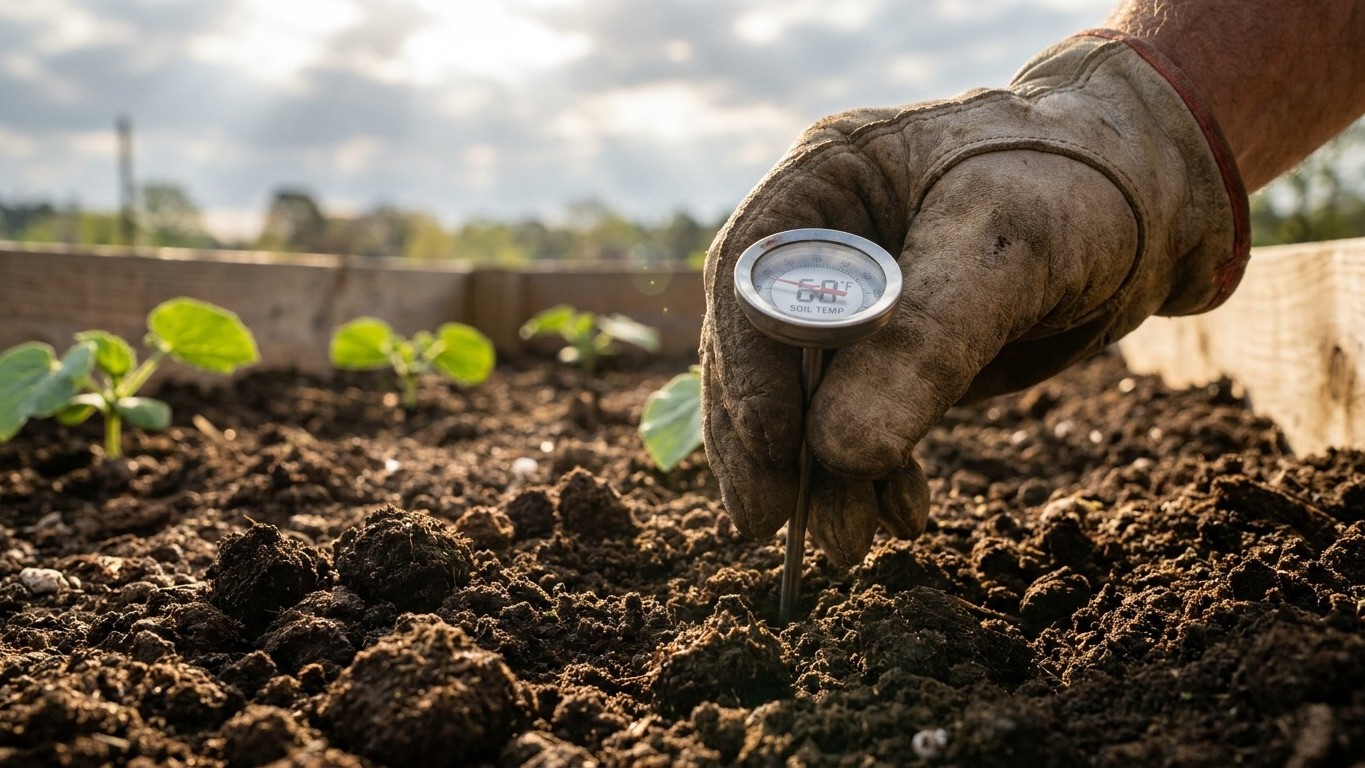
None of this changes by variety name or brand, it’s a soil physics problem before it’s a seed-catalog problem. The practical habit is simple: check soil temperature with a probe thermometer at the depth you intend to sow, rather than trusting the date on a seed packet written for a milder state.
How long the season lasts here
Take the two frost dates NOAA provides for the Billings station and the arithmetic tells the real story. Spring frost risk clears between April 29 and May 10; fall frost risk begins between October 1 and October 14. Depending on which end of each range actually plays out in a given year, that leaves a frost-free window of somewhere between about 144 and 168 days, roughly four and a half to five and a half months. That’s a wide swing for a single number, and it’s exactly why melon growers in this territory plan for the shorter end rather than the longer one.
A window in that range is workable for melons, but it isn’t generous. Compare it to a longer-season territory further south, where a frost-free stretch of 200-plus days leaves room for a second sowing if the first one fails to germinate, gets eaten by cutworms, or simply runs behind. In Montana’s valleys, that safety margin mostly doesn’t exist. The first sowing, or the first transplant, generally has to be the only one. That reality changes how much a grower should worry about disturbing roots at transplant time: with no real fallback sowing available later in the season, protecting the root ball during transplant matters more here than it would in a place where a failed batch can simply be replanted in July.
It also means succession sowing, staggering plantings every couple of weeks to spread out the harvest, isn’t really an option for melons the way it is for lettuce or beans in this territory. Readers looking at stretching a harvest window through repeated sowings should check the site’s succession sowing guide for crops where that technique actually pays off; melons in a 144-to-168-day window generally aren’t one of them.
The practical takeaway is to treat the shorter end of that window, the 144-day estimate, as the planning assumption, and treat anything beyond it as a bonus rather than something to count on.
Heat and water in Montana

Melons are a warmth-accumulation crop before they’re anything else. They don’t just need a certain number of frost-free days, they need enough hours above a heat threshold to convert flowers into ripe, sweet fruit. At the Billings reference station, NOAA’s 1991-2020 normals count an average of 28.3 days a year at or above 90°F. That’s a meaningful number of hot days for a northern state, and it puts the warmer Montana valleys in a very different category from the state’s mountain districts, where that count would be far lower and where melons become a much harder proposition.
Even at 28.3 days, that heat isn’t spread evenly across the whole growing window described above. Most of it clusters in July and into August, meaning the early weeks after transplant and the final ripening stretch in September often run cooler than the crop would prefer. This is the gap that soil-warming techniques and early-maturing types are built to close: in a territory where the days above 90°F are counted in the twenties rather than the sixties or seventies, the sowing date matters less than getting the soil hot early and choosing a type that doesn’t need a long hot tail to finish ripening.
Water tells a related but separate story. Summer rainfall at the same station averages about 4.3 inches across June, July, and August, with August, the month melon vines are usually filling fruit, the driest of the three at just 0.87 inches. June brings the most, at 2.22 inches, then it drops off steadily through July’s 1.22 inches. That pattern, wetter at the start of summer and dry right when the fruit needs consistent moisture to size up, means irrigation isn’t optional in most Montana melon patches. A single summer thunderstorm in August also tends to run off rather than soak in, especially on the clay soils common in some valley bottoms, so the rain-gauge total on paper overstates what actually reaches the root zone.
None of this makes Montana a wet-summer, mildew-prone melon climate the way a humid eastern state can be. It’s the opposite problem: dry air, a driest month landing at exactly the wrong time for fruit sizing, and a heat count that rewards deliberate soil-warming over the accidental warmth a longer, hotter season would provide elsewhere. A rain gauge on the actual plot, not the regional average, is what should decide watering frequency during that critical August stretch.
Which melons suit Montana
Given a frost-free window that can run as short as 144 days and a heat count around 28.3 days above 90°F, the type that makes sense here is the earliest-maturing category available, not the type prized for size or storage life in a longer, hotter state. Compact, quick-finishing types are built for exactly this combination: enough warmth to ripen, but not enough season to spare on a slow one.
Airflow and root warmth matter more than shade here, which is the reverse of the priority in a genuinely hot southern territory. With rainfall this modest through summer and August running driest at 0.87 inches, disease pressure from humidity is rarely the limiting factor in most Montana gardens; cold, slow-draining soil early in the season is. That argues for raised beds or mounded rows that warm and drain quickly, paired with mulch that holds soil warmth once it’s achieved rather than mulch chosen to conserve moisture in a wetter climate.
Seed catalogs list dozens of melon types under maturity-day claims that were never tested against Montana’s actual soil-warming lag or its 28.3-day heat count, and a name that performs well in a 200-day Georgia season can fail outright in a 150-day Montana one. The trial data that actually matters, which types finished reliably in Montana test plots over multiple seasons, sits with Montana State University Extension, the state’s land-grant extension service. Their county offices track which melon types have actually ripened locally, county by county, which is the only recommendation worth following for a crop this sensitive to a short, cool-edged season.
The state’s hardiness zone range, 3a to 6a on the USDA map, is a reminder of how much this varies within Montana itself: that figure is built on winter minimum temperatures, not summer melon-growing conditions, but the spread it represents, from harsh mountain valleys to milder river-bottom towns like Billings, is the same spread that separates a Montana garden where melons are realistic from one where they’re a long shot no matter the type chosen.