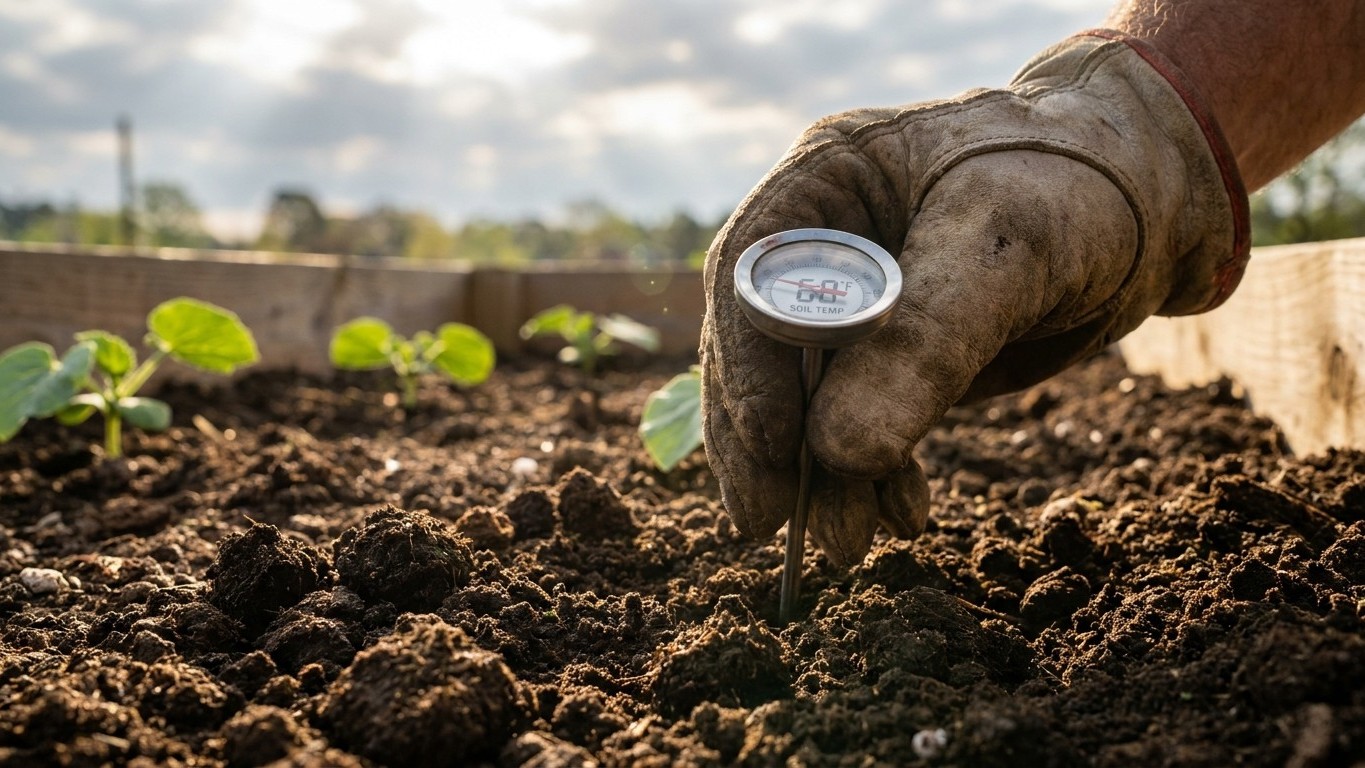

Soil needs to hold steady heat before melon roots will grow, not just avoid frost. In West Virginia’s Kanawha Valley, that point usually arrives in the second half of May, once the last frost risk has faded and the ground itself has caught up. Higher ground across the state runs later, sometimes by two or three weeks.
When the soil is warm enough in West Virginia

NOAA’s 1991-2020 Climate Normals put the last spring frost at the Charleston reference station (USW00013866) somewhere between April 9 and April 23, based on the 30-70% freeze probability band for 32°F. That’s a real number from a real weather station, but it answers the wrong question for a melon grower. Frost is about air temperature at a given hour. Melon germination and root growth are about soil temperature sustained over days, and soil lags behind air by two to four weeks depending on how much sun the bed gets and how wet the ground stays.
Frost is a probability, not a promise
That April window is a probability band, not a guarantee. Some years the last frost lands before April 9; other years it sneaks in after April 23. Treating either end of that range as a fixed calendar date is how a tray of transplants ends up damaged in a cold snap that statistics said was unlikely, not impossible.
Once frost risk has genuinely passed, the soil itself still needs to climb into the range melons actually use, which is well above what lettuce or peas tolerate. Waiting an extra week or two after the last frost date, until the top few inches of soil feel warm to the hand and stay that way overnight, does more for germination than any calendar date. Black plastic mulch or a low tunnel can push that soil-warming timeline earlier, which matters more here than trying to outguess the frost band.
Elevation changes everything a valley reading can’t show
Charleston sits in a river valley, and the station behind these normals reflects that. West Virginia’s hardiness zones run from 5a to 7a under the USDA Plant Hardiness Zone Map (based on 1991-2020 averages), and the warmer end of that range belongs to valley floors like Charleston’s, not to the ridges and plateaus that make up much of the state. A gardener at higher elevation should expect both a later spring warm-up and an earlier fall cutoff than the Charleston numbers suggest, sometimes by a substantial margin. Checking a local weather station or the extension office for a site closer to home beats extrapolating from a valley reading.
How long the season lasts here
Layering the fall side of the same NOAA dataset onto the spring side gives the actual growing window. First fall frost at the Charleston station falls between October 18 and November 1, using the same 30-70% probability band. Subtracting the spring range from the fall range produces a window that runs from roughly 178 days at its shortest (a late spring frost paired with an early fall one) to about 206 days at its longest (an early spring frost paired with a late fall one). Call it six months at the tight end, closer to seven at the generous end.
| Milestone | Date range |
|---|---|
| Last spring frost | April 9 – April 23 |
| First fall frost | October 18 – November 1 |
| Frost-free window | about 178 to 206 days |
What the length allows
A window that stretches past six months, even at its shorter end, gives most melon types enough room to mature from transplant without racing the calendar. That’s the practical dividing line: territories with a frost-free stretch this long can usually support one solid planting with margin left over, and in a favorable year, room for a second sowing timed off the first harvest rather than off the calendar. A shorter window, closer to the 178-day end, makes the first sowing the one that matters most, and it tips the scale toward starting indoors and transplanting rather than direct-seeding, since a transplant with an established root system buys back the days a direct-sown seed would spend just germinating.
Anyone weighing whether a second planting is realistic, or how to stagger sowings to spread out harvest instead of getting everything at once, should read the site’s guide to succession sowing for melons before committing bed space.
Heat and water in West Virginia

Melons ripen on accumulated warmth, not on the number of days since planting, and that distinction matters more in a place like this than in a place with a long, scorching summer. The Charleston reference station averages just 16.0 days a year at or above 90°F, per NOAA’s 1991-2020 Climate Normals. That’s a modest heat load. It means the sowing date and the choice of an early-maturing type carry more weight here than in a hot southern territory, because there simply isn’t a long stretch of blazing days to make up for a late start or a slow-ripening type.
Sixteen days over 90 degrees changes the strategy
Where summer heat is limited, soil-warming techniques do the work that heat would otherwise do on its own. Black plastic mulch, row cover pulled off during the day, and siting the melon bed on the sunniest, best-drained ground available all push soil temperature up in a way that compensates for a summer that won’t reliably deliver stretches of 90-degree days. Skipping those steps in a cool year is how a planting sits at the same size for weeks with no ripening to show for it.
Where the summer rain actually goes
Rainfall tells the other half of the story. Summer here averages about 13.8 inches across June, July and August combined (June 4.72 inches, July 5.38 inches, August 3.75 inches, against 46.2 inches for the full year), per the same station’s monthly normals. That’s a reasonably wet summer by national standards, and paired with limited heat, the bigger risk isn’t drought. It’s the opposite: foliage that stays damp too long, powdery and downy mildew finding a foothold, and fruit that ripens slower than expected because cloud cover and rain interrupt the steady warmth melons need to finish sweetening. Spacing vines for airflow, watering at the soil line instead of overhead, and picking a bed with good drainage matter more here than rigging up irrigation for a drought that this climate doesn’t typically deliver.
Which melons suit West Virginia
Given a moderate frost-free window, limited days above 90°F, and a humid summer with mildew pressure, the type that fits West Virginia best is one bred for disease resistance and earliness before anything else. Types that need a long, sustained hot stretch to finish sweetening are fighting the climate here rather than working with it. Types selected for shorter maturation and known tolerance to foliar disease are working with what the Charleston normals actually describe: a season long enough to finish a crop, but not a heat load generous enough to bail out a slow one.
Let disease resistance choose the type, not the name
Cultivar performance depends on trial data from the exact region, soil type, and disease pressure a gardener is dealing with, and a name printed on a general page like this one can’t account for any of that. What does account for it is the West Virginia University Extension Service, which runs its own variety trials and publishes recommendations suited to the state’s actual growing conditions, elevation by elevation. A cultivar that performs well in a Charleston valley garden may lag on a ridge two counties over, and the extension office is positioned to know the difference in a way a broad territory guide isn’t.
What a gardener can decide without a variety list in hand is the type: early-maturing over late, disease-resistant over ornamental, and suited to a vine trained for airflow rather than left to sprawl in damp shade. Those three choices, made before ever looking at a seed catalog, do more to guarantee a harvest in this climate than any single variety name could promise on its own.