
Yes, melons can be grown in New Hampshire, but the payoff depends on timing more than on luck. The state’s cool spring nights and a heat-shy summer mean the plant needs help getting started: warmed soil, quick-maturing types, and a grower willing to treat the sowing date as a starting negotiation rather than a fixed rule. Get that part right and a backyard patch can still ripen fruit before the fall chill returns.
When the soil is warm enough in New Hampshire
At the airport weather station in Manchester (USW00014710), the last spring frost typically falls somewhere between April 16 and April 27, based on the 30-70% probability band in NOAA’s 1991-2020 Climate Normals. That’s a useful marker, but it answers the wrong question for a melon grower. Frost tells you when the air stops freezing. Melons don’t care about the air. They care about the soil, and soil takes weeks longer to climb into the range where melon roots actually grow rather than sulk.
A frost date is also a probability, not a promise. The 30-70% band means the risk of a freeze is roughly even around those dates, not that frost stops on a dime the day after. Treat late April as the point where the odds start tipping in your favor, not as a green light by itself.
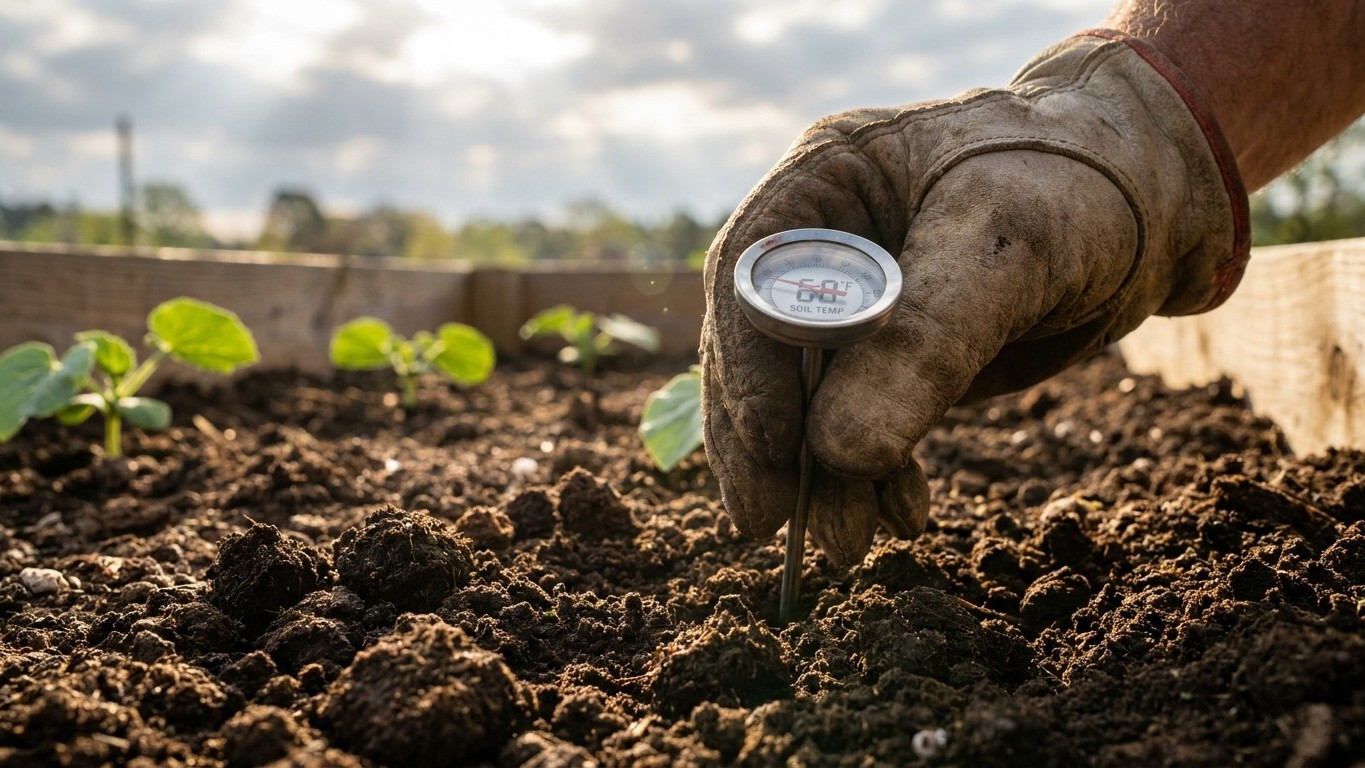
This matters because melon seed sown into cold, wet soil mostly rots or sits dormant while weeds take the head start. The plant wants soil that’s been reliably warm for a stretch, which in a New Hampshire spring often doesn’t happen until mid-to-late May, sometimes into early June depending on how the soil is managed. Gardeners here narrow that gap with a handful of practices: laying black plastic mulch over the bed two to three weeks before planting to trap solar heat, using raised mounds or hills so the soil drains and warms faster than flat ground, and covering the seed rows or transplants with floating row cover to buffer cool nights early on. Starting melon plants indoors as transplants, rather than direct-seeding, is also common practice here precisely because it sidesteps weeks of waiting on cold ground.
None of this changes the frost date itself. It changes how much of the short window after that date actually counts as usable growing time. A grower who preps the bed and transplants into warmed soil in mid-May is often a full month ahead of one who waits and direct-seeds after the average frost date passes. For which specific melon types have performed well in trials for New Hampshire’s climate, the UNH Cooperative Extension keeps that information current by county, and it’s worth checking before buying seed, since the right choice shifts with elevation and local microclimate more than a statewide guide can capture.
How long the season lasts here
Put the two frost dates together and the frost-free window in the Manchester area runs from as short as 169 days (late spring frost on April 27 to early fall frost on October 13) up to about 193 days (early spring frost on April 16 to late fall frost on October 26), based on the same NOAA 1991-2020 Normals cited above. That’s roughly five and a half to six and a half months, and where any given year and garden falls in that range depends on local terrain as much as luck.
For most vegetables that’s a generous season. For melons, it’s tighter than it looks. Melons are a warm-season fruit that needs sustained heat to size up and sweeten, not just a long stretch of frost-free calendar. A 169-day window sounds ample until you subtract the weeks lost waiting for soil to warm in spring and account for the fact that melon fruit ripening slows sharply once nights cool in September. In practice, that means New Hampshire gardeners are usually working with one real planting per season, not two.
That single-shot reality changes a few decisions. It’s what makes starting plants indoors as transplants, rather than direct-seeding outdoors, worth the extra effort here: a transplant that’s already six weeks old when it goes into warmed soil effectively borrows time the outdoor calendar doesn’t offer. It also means a failed first planting, from a late cold snap or a rot-out in soggy soil, doesn’t leave much room for a do-over the way it would with a quick crop like lettuce or radishes. Gardeners who want to hedge that risk with staggered plantings of faster crops elsewhere in the garden can find more on timing multiple sowings in the succession sowing guide on this site, though melons themselves are usually the exception to that strategy rather than a candidate for it.
Heat and water in New Hampshire
The Manchester reference station averages just 10.9 days a year at or above 90°F, per NOAA’s 1991-2020 Climate Normals. That’s a modest heat load. Melons ripen on accumulated warmth, not on the calendar, and a state that rarely sees ten days of real heat is one where the sowing date matters less than the techniques that push soil and air temperature up around the plant. Black plastic mulch, hoop-covered tunnels early in the season, and siting the bed against a south-facing wall or fence all do more heavy lifting here than they would in a state that clears 90°F thirty or forty times a summer.
Rainfall tells a different part of the story. Summer here brings about 10.7 inches of rain across June, July and August at the same reference station, with July running driest at 3.3 inches, June at 4.04 and August at 3.35. That’s a reasonably wet summer by national standards, and combined with those few 90°F days, it points toward a cooler, damper growing environment rather than a hot, dry one. The risk in that kind of summer isn’t drought stress on the vine. It’s powdery and downy mildew taking hold on melon leaves in humid stretches, fruit that’s slow to ripen because heat units accumulate slowly, and a higher chance of fungal disease moving through a dense planting that doesn’t get enough airflow.
That reshapes what a New Hampshire grower should actually watch for. Spacing plants generously, keeping foliage as dry as practical by watering at the base rather than overhead, and choosing a planting site with good air movement all matter more here than rigging up drip irrigation to fight drought. The 10.7-inch summer figure is a regional normal, not a guarantee for any one yard: soil type changes how far that rain goes, since a sandy bed drains it away within a day while clay holds it for a week, and a single heavy thunderstorm often runs off rather than soaking in. A rain gauge on the actual plot, checked through the season, tells a grower more than the regional average ever will.
Which melons suit New Hampshire
Nothing in these facts points toward a specific variety, and that’s not an oversight. The types trialled and recommended for New Hampshire’s short, cool, humid season change from one part of the state to another, and a name that performs well near the coast may struggle at elevation in the White Mountains. The state’s own hardiness zone range, 3b to 6a under the USDA Plant Hardiness Zone Map, spans enough winter-cold variation that growing conditions for a summer fruit like melon shift meaningfully across it too, even though that zone map itself is built purely on winter minimum temperatures, not summer heat or rainfall.
What can be said with confidence is the type of melon this climate rewards. A short season with limited heat accumulation favors the earliest-maturing types available, the ones bred to size up and ripen fast rather than the long-season varieties that need a full hot summer to develop sugar. A humid, mildew-prone summer makes disease resistance the first thing to check on a seed packet, ahead of flavor claims or fruit size, because a plant that succumbs to mildew in August never gets the chance to ripen anything. And because the state rarely delivers sustained heat, techniques that concentrate warmth around the root zone, plastic mulch, raised beds, a south-facing microclimate, do more for a melon crop here than variety selection alone ever could.
For the actual names that have held up in New Hampshire trials, county by county, the UNH Cooperative Extension is the source that carries weight, since its recommendations are drawn from local testing rather than a national seed catalog written for a different climate. Any variety name offered here instead would be a guess dressed up as advice, and a New Hampshire gardener deserves better than that.