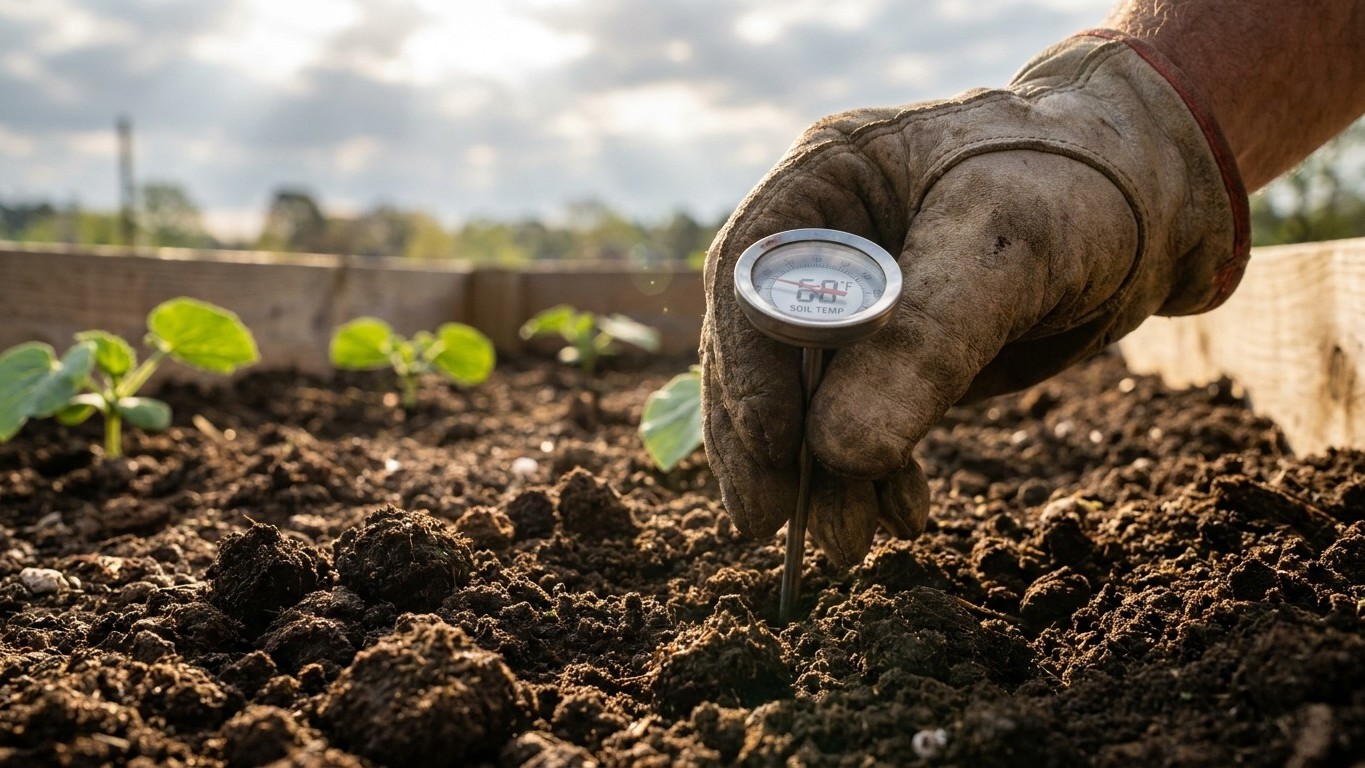

In central Ohio, melons go into the ground once soil temperatures hold steady in the 65 to 70°F range, which typically falls in mid-to-late May after the frost risk has passed. That single fact drives almost every other decision a melon grower in this state has to make, from which type to plant to how much watering to plan for.
When the soil is warm enough in Ohio

Ohio State University Extension’s Ohio Gardening Calendar sets the last spring frost across the state’s zone 6a areas at May 5 to May 15. That’s the number most gardeners reach for first, and it’s a reasonable starting point. But it’s the wrong number to plant by.
Frost dates measure air temperature at a specific height above the ground. Melon seed doesn’t care about air temperature. It cares about soil temperature, and soil warms on its own schedule, usually a week or two behind the last frost, depending on how much sun a bed gets and whether it’s covered in mulch, plastic, or bare dirt. A gardener who sows melon seed the day after the last frost date is often sowing into soil still too cold for the seed to do anything but sit and rot. Waiting until the soil itself reads warm, not just frost-free, is the difference between a stand of seedlings and a patchy bed that needs replanting.
It also helps to remember that a frost date is a probability, not a promise. May 5 to May 15 describes when the odds of frost drop to an acceptable level in a typical year, not a guarantee that nothing colder will happen. Ohio sits within USDA Hardiness Zone 5b to 6b statewide, based on the USDA Plant Hardiness Zone Map’s 1991-2020 averages, and that range matters here mainly as a reminder that conditions vary across the state. A garden in the Ohio River valley in the south warms up measurably earlier than one in the Lake Erie snowbelt, even though both might fall under the same general frost-date guidance.
Two ways to work around cold soil
Growers who want to push their planting date earlier than the soil naturally allows generally lean on one of two approaches: warming the soil ahead of time with black plastic mulch, or starting seed indoors and transplanting once conditions outside catch up. Both are standard practice, not shortcuts, and either one buys a week or two of extra growing time without gambling on an early frost. Which approach makes more sense depends on how much of a head start the season actually needs, which is really a question about how long the window runs in the first place.
How long the season lasts here
Ohio State University Extension puts the first fall frost at October 5 to October 15 for zone 6a locations, against that same May 5 to May 15 spring date. Subtracting the two gives a frost-free window of roughly 143 to 163 days, depending on which end of each range a given year lands closer to. Call it a little under five months on the short end, a little over on the long end.
That’s a meaningful window for melons, which generally need a long, warm stretch to go from seed to ripe fruit, but it isn’t an unlimited one. A 143-day year and a 163-day year are different growing seasons, and the gap between them is exactly the kind of margin that determines whether a second planting is realistic or whether the first sowing is the only shot a gardener gets.
On the shorter end of that range, the smart move is usually to lean on transplants rather than direct-seeding, since transplanting effectively buys back two or three weeks that a shorter season doesn’t otherwise allow. On the longer end, there’s enough runway to consider a succession planting, staggering a second sowing a few weeks behind the first so the harvest doesn’t all land in the same two-week stretch of August. Whether that second sowing is worth the trouble, and how to time it against the season’s actual length, is covered in more detail in this site’s succession sowing guide.
Either way, the frost dates only set the outer edges. What happens inside that window, meaning how hot it gets and how much rain falls, is what actually decides whether the melons planted inside it size up and ripen properly.
Heat and water in Ohio

At the Columbus reference station, NOAA’s 1991-2020 Climate Normals record an average of 15.3 days a year at or above 90°F. That’s a modest heat load. It’s nowhere near the sixty-plus days a Deep South garden might rack up, and it means Ohio isn’t a place where melons coast to ripeness on sheer accumulated warmth. Melons respond to heat units built up over the whole season, not to a handful of scorching days scattered through July and August, and with just over two weeks’ worth of 90-degree days to work with, that accumulated warmth arrives more slowly here than in warmer states.
That single fact reshapes the priority list. In a territory with 15.3 days above 90°F, the type of melon chosen and the techniques used to warm the soil early matter more than shaving a few days off the planting date. Black plastic mulch, row covers pulled early in the season, and siting the bed in the spot that catches the most sun all do more for a Ohio melon crop than trying to squeeze the calendar.
Rainfall tells a related story. The same NOAA station records about 12.7 inches of rain across June, July and August, out of 41.6 inches for the year, broken down as 4.33 inches in June, 4.67 in July, and 3.74 in August, the driest of the three. That’s not a drought-prone summer by any stretch, but it isn’t evenly distributed either, and August, the exact month when fruit is sizing up and sugars are concentrating, is also the driest of the growing season. A gardener counting on natural rainfall alone can end up watering less than the plants actually need right when it matters most.
Whether that shortfall becomes a problem depends on soil more than on the rain gauge. Clay soil, common across much of Ohio, holds onto that early-summer rain for days; sandy soil lets it drain within hours. The only way to know which situation a given garden is dealing with is to watch how the bed behaves after a storm, since NOAA’s normals describe the region, not any one backyard.
The June and July rain totals bring a second concern that has nothing to do with drought: humidity. Regular summer rainfall combined with warm nights is exactly the combination that favors powdery mildew and other fungal disease on melon foliage, which is where the choice of type starts to matter as much as the watering schedule.
Which melons suit Ohio
Three facts about this state point toward the same conclusion: a frost-free window in the 143-to-163-day range, a modest heat load of 15.3 days above 90°F, and a summer rainfall pattern wet enough in June and July to raise disease pressure. Together, they favor earlier-maturing melon types over the largest, longest-season kinds, and they put disease resistance near the top of the list rather than treating it as an afterthought.
Muskmelon and cantaloupe types, generally quicker to mature than large watermelon types, fit a season that isn’t guaranteed to run past 143 days in a shorter year. Types bred or selected for resistance to powdery mildew and other foliar disease make sense in a state where June and July regularly deliver over four inches of rain each. Beyond that, this page won’t name a specific variety, and that’s a deliberate choice rather than an oversight.
Variety performance shifts from one growing season to the next and from one part of a state to another, and the only data that actually reflects what grows well in a given Ohio county comes from trials run there. Ohio State University Extension maintains exactly that kind of testing and guidance, available at extension.osu.edu. A gardener in the Ohio River valley and one near Lake Erie are working with different microclimates even inside the same statewide frost-date range, and the extension office covering each area is positioned to say which types have actually held up there season after season. That’s a more reliable answer than any name printed on a seed packet or a gardening website with no way to verify it against local trial results.