
The short answer: in north Florida, around Jacksonville, melon seedlings can go into the ground once the frost risk passes, typically between mid-February and early March. But south of Orlando, Florida is essentially frost-free, and the whole calendar flips: melons are a winter-and-spring crop there, not a summer one. Which answer applies depends entirely on where in the state you’re standing.
When the soil is warm enough in Florida

The frost date everyone reaches for first is the last spring frost. For north Florida, using NOAA’s 1991-2020 Climate Normals from station USW00013889 (the Jacksonville reference station), that date falls somewhere between February 16 and March 7. That’s a probability window, not a promise, three years in thirty at this station saw no real fall freeze at all, which tells you how borderline “frost” even is in this part of the state.
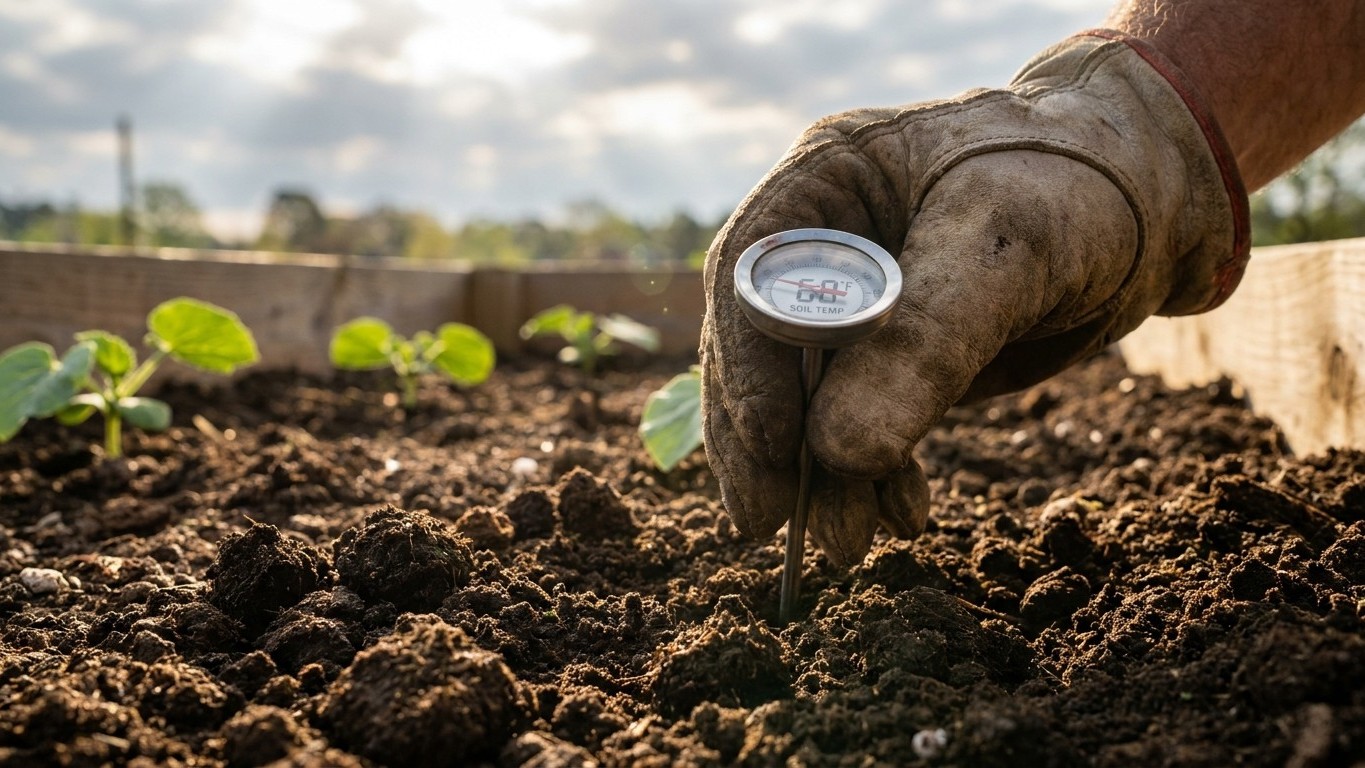
Frost, though, is a stand-in for the number that actually matters: soil temperature. Melon seeds and transplants stall in cold ground even after the air has stopped freezing. Soil takes days, sometimes a couple of weeks, to catch up once nighttime lows stop dropping to freezing. So treat that February-to-March window as the earliest the air allows, not the day to plant. Waiting a week or two past the last frost date, until the soil itself feels warm to the hand a few inches down, avoids the slow, sulky start that cold soil causes.
Why this window doesn’t apply everywhere in the state
This matters more in Florida than almost anywhere else in the country, because the state doesn’t have one climate, it has at least two. The frost dates above come from an inland north Florida station. Central and south Florida, Orlando south to Miami, rarely see frost at all. There, the growing calendar inverts entirely: melons go in during fall and winter, and the real limiting season is summer, when heat and humidity, not cold, shut things down. Applying the Jacksonville frost window to an Orlando or Miami garden would have a gardener planting at exactly the wrong time.
The state’s USDA Plant Hardiness Zone range, 8b to 11b, reflects that same split: it’s built on average annual extreme minimum temperature, and Florida’s range covers everything from occasional hard freezes in the north to conditions where frost is a non-event in the south. For a dated planting recommendation, the reference city matters more than the statewide range, since a zone number alone doesn’t tell you which calendar you’re on.
How long the season lasts here
For north Florida, the two frost dates from NOAA bracket the frost-free window. Using the more cautious ends of each range, the last spring frost at March 7 and the first fall frost at November 26, that’s roughly 264 days, close to nine months, without a freeze. That’s a long stretch by national standards, and it changes what’s worth planning for.
A window that long allows more than one planting. Melons sown in early spring can finish well before the heat of high summer peaks, opening a second sowing in late summer aimed at a fall harvest before the November frost date arrives. That second window is tighter, so it’s worth counting backward from the fall frost date rather than assuming there’s endless time. For guidance on staggering those sowings so the garden isn’t overwhelmed at once, or left with a gap, the succession sowing guide on this site walks through the timing logic in more detail.
Whether transplanting makes sense also shifts with season length. Early in a long window, when soil is still cool, starting indoors and transplanting gives melons a head start without asking seeds to sit in cold ground. Later in the season, with warm soil already established, direct sowing skips the root disturbance transplanting risks, and melon roots are sensitive to that kind of check.
In central and south Florida, where frost barely factors in, the “season length” question answers differently: the constraint isn’t a countdown to a fall freeze, it’s the stretch of tolerable heat before summer humidity and disease pressure take over. That’s covered in the next section, since it’s really a heat problem wearing a season-length disguise.
Heat and water in Florida

At the Jacksonville reference station, the average is 73.2 days a year at or above 90°F. That’s a heavy heat load, well over two months of the year where daytime temperatures push into stress territory for a lot of garden crops. Melons handle heat better than most vegetables, but 73 days above 90°F still means the growing season isn’t just warm, it’s demanding, and it puts real weight on how much water the soil holds onto.
Summer rainfall in this part of Florida isn’t scarce. June, July and August bring about 21.2 inches combined, out of 53.4 inches for the year, with July, the driest of the three summer months, still delivering 6.77 inches. On paper, that’s generous. But it rarely arrives evenly. Florida’s summer rain comes largely as thunderstorms, short, heavy bursts that shed as much water off the surface as they put into the ground, especially on the sandy soils common across much of the state. A sandy bed can look freshly watered after a downpour and be dry again within a day.
That combination, high heat load plus rain that runs off faster than it soaks in, means irrigation decides fruit size more than rainfall totals do. Melons swelling during the hottest stretch of summer need a steady, deep soil moisture supply, not an occasional thunderstorm. And the final two weeks before harvest are where sugar content is made or lost: uneven moisture in that stretch, alternating drought and sudden downpour, is a common reason a melon that looked promising turns out bland.
The heat and humidity together also raise disease pressure. Warm, wet conditions are exactly what fungal problems favor, powdery mildew and downy mildew both move fast through melon foliage when nights stay warm and leaves stay damp into the morning. Watering at the base rather than overhead, and giving vines enough spacing for air to move through the foliage, does more to manage that risk than any product applied after the fact. A rain gauge on the actual plot, not the regional average, is what tells a gardener whether that week needs supplemental water or not.
Which melons suit Florida
None of this points to a single variety, and that’s deliberate. Florida’s split personality, a frost-defined season in the north, a frost-free but heat-defined one everywhere south of Orlando, means the right melon type depends on which climate a garden actually sits in, not on a name that sounds good in a catalog.
In north Florida’s roughly nine-month frost-free window, there’s enough time for types that take longer to mature, and enough time to try a second planting if the first is done by mid-summer. In central and south Florida’s frost-free but heat-bound calendar, the priority flips: types suited to a winter-into-spring cycle, finishing before the worst of summer’s heat and humidity arrive, make more sense than anything counting on a long warm season.
Across the whole state, the heat load and the humid, thunderstorm-driven summer push disease resistance and airflow tolerance to the top of the list. Melon types bred or selected for resistance to powdery and downy mildew hold up longer through a Florida summer than ones chosen for size or flavor alone. Vines that get open spacing, and fruit lifted off damp soil rather than left sitting on wet ground, fare better regardless of type.
This page won’t name a specific variety, and that’s the honest answer rather than an evasive one. Cultivar performance shifts year to year and county to county, and a name that thrives in Jacksonville’s clay-influenced soils can disappoint on the sand further south. The University of Florida’s IFAS Extension network, reachable through sfyl.ifas.ufl.edu, publishes the varieties actually trialled in local conditions, updated as new options are tested. That local trial data, not a generic list, is the only recommendation that means much for a specific yard.