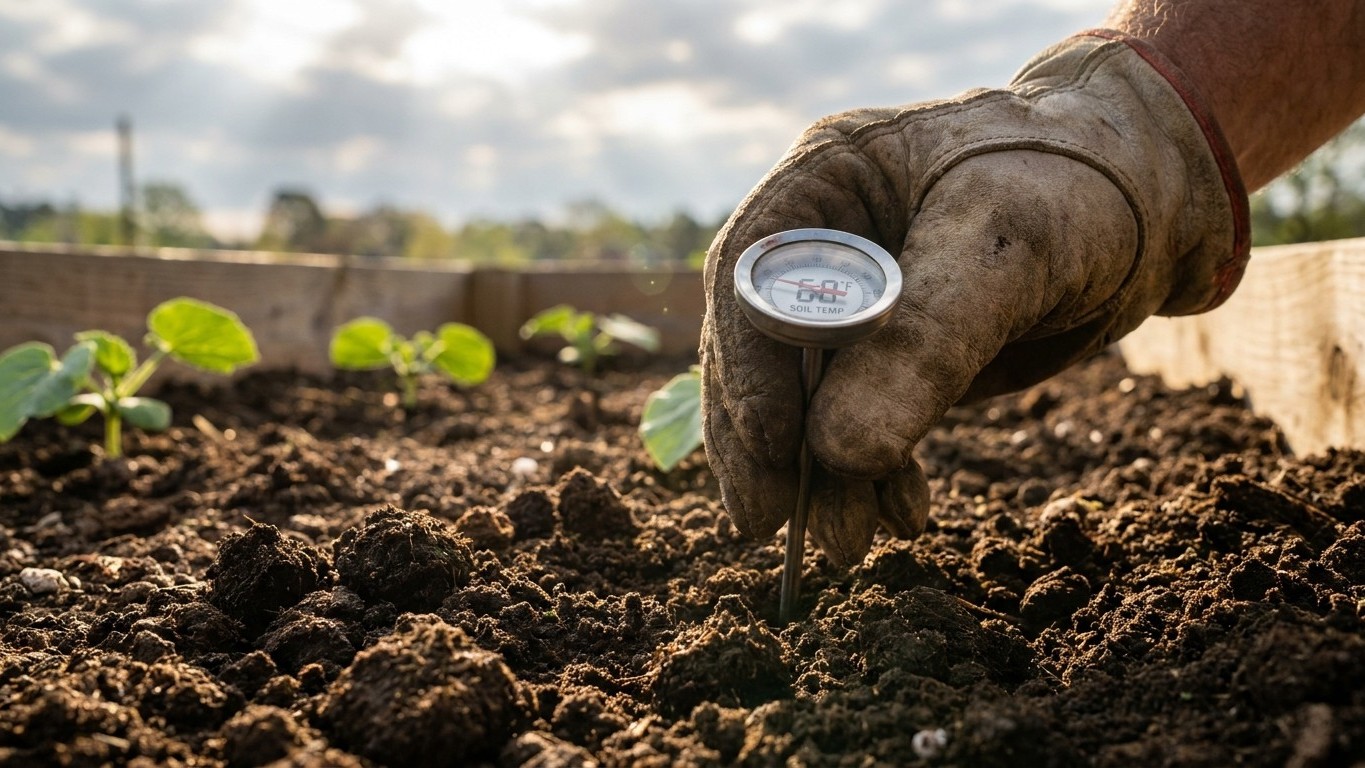

The short answer: plant melons outdoors in western Oregon once soil temperature holds above 65°F, typically late May into early June in the Willamette Valley, and expect one full crop rather than two, since summer heat is modest and cool nights slow sugar development. Central and eastern Oregon run on a different clock entirely.
When the soil is warm enough in Oregon
NOAA’s 1991-2020 climate normals put the last spring frost at the Portland reference station (USW00024229) somewhere between March 6 and March 21, based on the 30 to 70 percent freeze-probability band for 32°F. That’s a real, sourced window, not a guess, and it’s worth repeating exactly: early-to-mid March, not April, not “around Easter.”
Here’s the catch nobody puts on the seed packet. Frost date tells you when the air stops freezing. It says nothing about the soil. Melon seed germinates poorly, if at all, in soil below the mid-60s, and that threshold usually arrives a full six to eight weeks after the last frost in western Oregon’s marine-influenced climate. A calendar that says “safe from frost” in mid-March is not a calendar that says “safe for melon roots.” Gardeners who direct-sow the week after their last frost date are usually rewarded with seed that sits and rots rather than seed that sprouts.
A frost date, it should be said once, is a probability drawn from thirty years of records, not a promise for this particular spring. Some years the soil warms early; some years a cold snap in late April sets everyone back regardless of what the almanac says.
Two very different Oregons
The window above describes Portland and the Willamette Valley, west of the Cascades. Central and eastern Oregon sit at higher elevation in high-desert conditions, with a noticeably shorter frost-free season and colder nights even in summer. Applying a Willamette Valley planting date to Bend or Burns will get a gardener burned by a late frost or an early one. If you garden east of the mountains, treat every date in this piece as a Portland-basin figure and check your own local extension office data before you commit seed to the ground.
In practice, most western Oregon gardeners raise the odds by starting melon seed indoors three to four weeks before the soil-warm date, then transplanting into pre-warmed soil, often under black plastic mulch or a floating row cover to trap heat. That technique matters more here than the exact sowing date, because it’s the soil-warming step, not the frost date, that decides whether the crop gets a real head start.
How long the season lasts here
Put the two frost dates from the Portland normals together and the frost-free window runs, at its shortest, from March 21 to November 11, about 235 days, and at its longest, from March 6 to November 27, about 266 days. Either way, that’s close to eight months without a freeze on paper, which sounds generous for a crop that needs roughly two to three months from transplant to ripe fruit.
But melons don’t use that whole window. They can’t go in until the soil is warm (see above), and the last four to six weeks before the fall frost date are usually too cool and too dark for a melon to finish sizing up or sweetening, even if the plant survives. Strip out both ends and the real working season for melons in the Willamette Valley lands closer to four months, roughly early June through late September.
That length is enough for one full melon planting, comfortably, with margin for a slow spring or an early fall. It is not generous enough to bank on a second sowing succeeding a spring crop, the way a gardener in a longer, hotter climate might. A second sowing in July would need to reach maturity before the cool, wet weather typically returns in October, and in most years there simply isn’t enough warm daylight left to pull it off reliably.
What the window does support is careful staggering within a single planting, rather than a true second crop, sowing two or three batches of transplants a week or two apart in spring so the harvest doesn’t all land the same week. For the mechanics of that kind of staggered planting and when it does or doesn’t make sense for a given crop, the site’s succession sowing guide walks through the timing in more detail.
Heat and water in Oregon
At the Portland reference station, the average year sees only 11.9 days at or above 90°F. That’s a modest heat load, well short of what melons prefer. Melons don’t ripen on the calendar, they ripen on accumulated warmth, and a territory logging fewer than a dozen 90-degree days a year is a territory where every one of those hot days counts, and where the type of melon and the soil-warming technique matter more than getting the sowing date exactly right.
Summer rainfall tells the other half of the story, and in western Oregon it runs the opposite direction from what many gardeners expect. June, July and August together average only about 2.7 inches of rain, with July, the driest month, seeing just 0.51 inches. That’s a dry summer by any national standard, closer to the water budget of a desert garden than a rainy Pacific Northwest stereotype would suggest.
Put the two together and the picture is specific: not enough heat to force fast ripening, but not enough summer rain either to let the crop coast on natural moisture. That combination means irrigation is doing real work here, not backup work, through the driest stretch of the season, while the heat side of the equation is what actually caps how large and how sweet the fruit gets by the finish line.
A cool, damp spring, which is normal in this climate even with a dry summer ahead, brings its own problems before the heat question ever comes up: powdery mildew on the leaves, slow early growth, and fruit that sits green longer than a gardener used to a hotter climate would expect. None of that is a sign of doing something wrong. It’s the ordinary cost of gardening melons in a marine-influenced climate rather than a continental one, and it’s the reason airflow, morning sun exposure and a warm microclimate (a south-facing slope, a spot against a wall) matter as much here as watering schedule does.
Which melons suit Oregon
Given a modest heat load and a season that supports one planting rather than two, the earliest-maturing melon types, the ones bred to size and sweeten on fewer accumulated warm days, are the safer bet in most of western Oregon. Slower, later types built for long hot summers are the ones most likely to still be green when the season runs out here.
Airflow and a warm root zone matter more in this climate than in a hotter one, since cooler nights and spring dampness raise the risk of foliage disease before heat ever becomes the limiting factor. That pushes disease resistance and good spacing up the list of priorities, alongside earliness, when choosing what to plant.
This page won’t name a specific variety, and that’s a deliberate choice rather than an oversight. Cultivar performance shifts by soil, microclimate and even by which side of a single valley a garden sits on, and a name printed on a page with no local trial behind it is a guess dressed up as advice. What does hold up across the state is the category: earliest-season types, chosen for disease resistance, given the warmest, best-drained spot available.
The reliable source for which specific varieties have actually performed well in Oregon trials is the state’s own extension service, which runs county-level programs and publishes results tied to real local conditions rather than generic seed-catalog claims. It’s worth checking their current recommendations before buying seed, since trial results shift from year to year as new types come to market: Oregon State University Extension Service.
Oregon’s hardiness zones run from 4a in the coldest mountain pockets to 9b along parts of the coast and southern valleys, a range wide enough that a planting plan built for one corner of the state can misfire badly in another. Whatever the zone map says for a given address, the working rule stays the same: match the melon type to the season length actually available, warm the soil before the seed goes in, and let the local extension office settle the variety question.