
Melons can succeed in Idaho, but the state’s answer depends entirely on elevation. In the Boise valley, warm-season melons ripen reliably with the right type and a bit of soil warming; climb into the state’s higher valleys and foothills, and the season shrinks fast, favoring only the earliest types started well ahead of the last frost.
When the soil is warm enough in Idaho

The question every melon grower asks first is when to actually put plants or seed in the ground. For the Boise area, NOAA’s 1991-2020 Climate Normals put the last spring frost, station USW00024131, at April 23 to May 7, based on the 30-70% probability band for a 32F freeze. That’s a real, sourced window, and it’s tempting to treat it as the planting date. It isn’t.
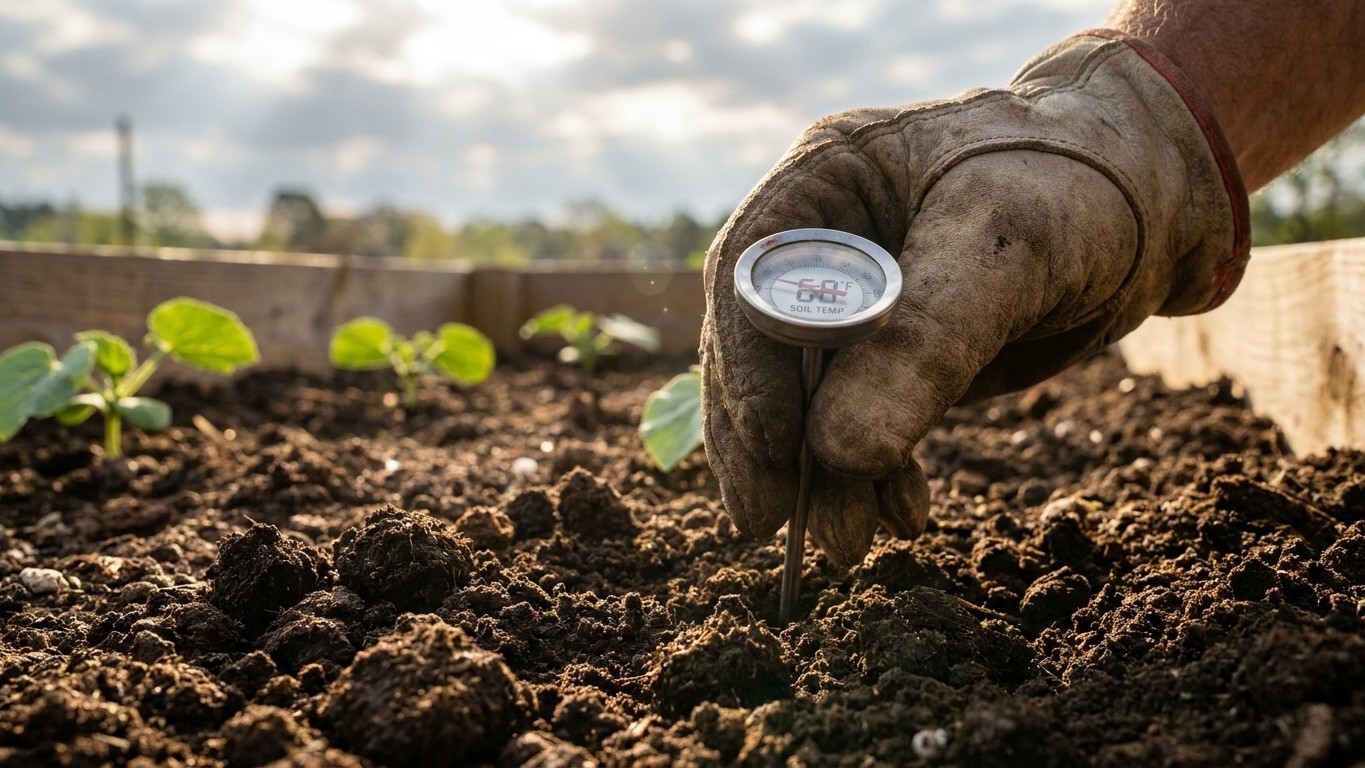
Frost date is a proxy, not the actual trigger. Melons don’t care about frost risk; they care about soil temperature, and soil warms on its own schedule, well after the danger of a freeze has passed. A patch of ground can be entirely frost-safe and still too cold for melon roots to do anything but sulk. That’s why growers who transplant or direct-seed the moment the frost-free window opens often watch their plants sit motionless for two or three weeks while the soil catches up.
It’s also worth saying plainly: that April 23 to May 7 range is a probability, not a promise. Some years the last frost lands earlier, some years later, and a single late cold snap after a warm spell is exactly the kind of event averages don’t protect against.
What actually gets soil ready
Warming the soil ahead of the calendar date is the more useful move for Idaho gardeners. Black plastic mulch, row cover tunnels, or simply raised, south-facing beds all raise soil temperature faster than bare ground exposed to spring wind. These are standard practices, not proprietary products, and they matter more in a state where elevation swings mean the “average” planting date for one town can be weeks off for a neighbor thirty miles up a canyon.
None of this changes with variety selection so much as with technique. Rather than chase a specific cultivar name, it’s more useful to think in terms of type, since the earliest-maturing types tolerate a slightly cooler start better than long-season ones. For which specific varieties have actually performed well in University of Idaho trials, the state’s Extension service is the source that matters, because their recommendations are grounded in local trial data.
How long the season lasts here
Idaho’s growing window, at least at the Boise reference station, runs from a last spring frost of April 23 to May 7 to a first fall frost of October 7 to October 21, per the same NOAA 1991-2020 Normals. Doing the subtraction honestly, using the earliest and latest ends of each band, the frost-free season runs somewhere between about 153 days (a cautious May 7 start to an early October 7 finish) and 181 days (a bold April 23 start stretched to an October 21 finish). That’s a meaningful spread, and which end of it a garden actually experiences depends on local microclimate as much as luck.
What that length allows matters more than the number itself. A season near the 180-day end gives real room for a second sowing, staggering plantings a few weeks apart so the harvest doesn’t all land in a two-week rush. A season closer to 150 days makes the first sowing the only realistic one, and shifts the decision toward transplants over direct seeding, since a young plant already established in a cell tray banks several weeks the soil itself can’t provide.
That transplant decision isn’t automatic, though. Melons resent root disturbance more than most garden crops, so a shorter window has to weigh the time gained against the setback risk of transplant shock. Growers working the tighter end of Idaho’s season generally do better starting transplants in biodegradable or paper pots that go into the ground root and all, avoiding the disturbance entirely. For the mechanics of staggering plantings and deciding whether a second sowing is realistic, the site’s succession sowing guide walks through the timing in more detail.
One more thing worth repeating: Boise sits in a low, relatively mild valley by Idaho standards. Most of the state sits higher and colder, and a gardener in a mountain valley or higher-elevation town should treat the Boise figures as a best-case scenario, not a statewide default. The season length calculated above may simply not apply a few thousand feet higher.
Heat and water in Idaho

Boise, the reference station for these figures, averages 47.5 days a year at or above 90F, per NOAA’s 1991-2020 Climate Normals. That’s a genuinely warm summer signature, not a marginal one, and it means melons in the valley get real accumulated heat, the thing they actually need more than any specific number of days on a calendar. A crop that’s slow every single day of a mild summer can still fail to ripen properly, while the same crop under consistent 90-degree stretches builds sugar and size on schedule.
Rainfall tells the other half of the story, and in Boise it’s sparse. Summer rain across June, July and August totals only about 1.1 inches, against 11.5 inches for the full year, meaning nearly all of Idaho’s precipitation falls outside the growing season. Month by month it’s June at 0.75 inches, July at 0.21 inches, and August, the driest month, at just 0.17 inches. That’s not a garden that can lean on the sky.
Put those two facts together and the conclusion is straightforward: in a hot, low-rainfall territory like the Boise valley, irrigation is what decides how big the melons get, and the final two or three weeks before harvest are what decide how sweet they end up. Inconsistent watering during that home stretch, alternating drought stress with a sudden soak, is a common way to end up with fruit that’s large but bland, or worse, split at the stem end.
It bears repeating that 47.5 days above 90F is a count at one reference station, not a description of the whole state. Idaho’s higher valleys and mountain towns see far fewer hot days and correspondingly slower melon development. In those cooler, damper microclimates, the concern shifts away from irrigation math and toward the problems that come with a cool, slow summer: powdery mildew taking hold on leaves that stay damp longer, fruit that ripens weeks later than a seed packet’s expectations, and a shorter window to recover if disease sets back the plants early. A gardener at elevation is fighting a different battle than one in the valley floor, even though both are technically Growing Melons in Idaho.
Which melons suit Idaho
The type that makes sense depends on where in the state the garden actually sits, and on which of the two problems above is the real threat: too little season, or too little rain.
In the Boise valley, with its warm 150-to-180-day window and its dry, hot summer, the earliest-maturing types make the safest bet even though the season is comparatively generous, simply because an early finish buys insurance against a cool spring or an early fall snap. Types bred for airflow and grown with attention to keeping foliage dry, rather than overhead watering, hold up better under that heat load, and giving the developing fruit a bit of shade from its own foliage, or a layer of straw beneath it, helps avoid sunscald during the hottest stretches.
At higher elevations, where the season is shorter and cooler and the frost-free window may not stretch nearly as far, the earliest types aren’t optional, they’re the only realistic choice. In those gardens, disease resistance becomes the first thing to check for, since cooler, slower-drying conditions give powdery mildew and other foliar diseases more time to establish before harvest arrives.
None of that points to a specific variety name, and that’s intentional. The types trialled and proven to actually perform in Idaho’s specific mix of elevation, heat and rainfall are documented by people who run those trials locally, not by a general guide. The University of Idaho Extension service publishes exactly that kind of regionally tested variety information, and it’s the only recommendation worth trusting over a name picked off a seed rack. Given how much Idaho’s climate varies between a Boise garden and one three thousand feet higher, a state-specific list from local trials will always beat a generic pick, and that’s the honest answer this page can give.