
Melons need warm soil more than a calendar date, and in Quebec that means waiting until well after the average last frost of May 6, then several more weeks for the ground itself to catch up. The short, cool growing season narrows the choice to early types and heat-trapping techniques rather than to any particular variety.
When the soil is warm enough in Quebec

The number gardeners reach for first is the last spring frost, and for the Montreal region that average sits at May 6, according to Environment and Climate Change Canada’s Canadian Climate Normals 1981-2010 for station MONTREAL/ST-HUBERT A. That date is worth writing down. But it is a mean, not a guarantee: in roughly one year out of two, the last frost actually falls after May 6, sometimes by a week or more. Treat it as the midpoint of a window, not a green light.
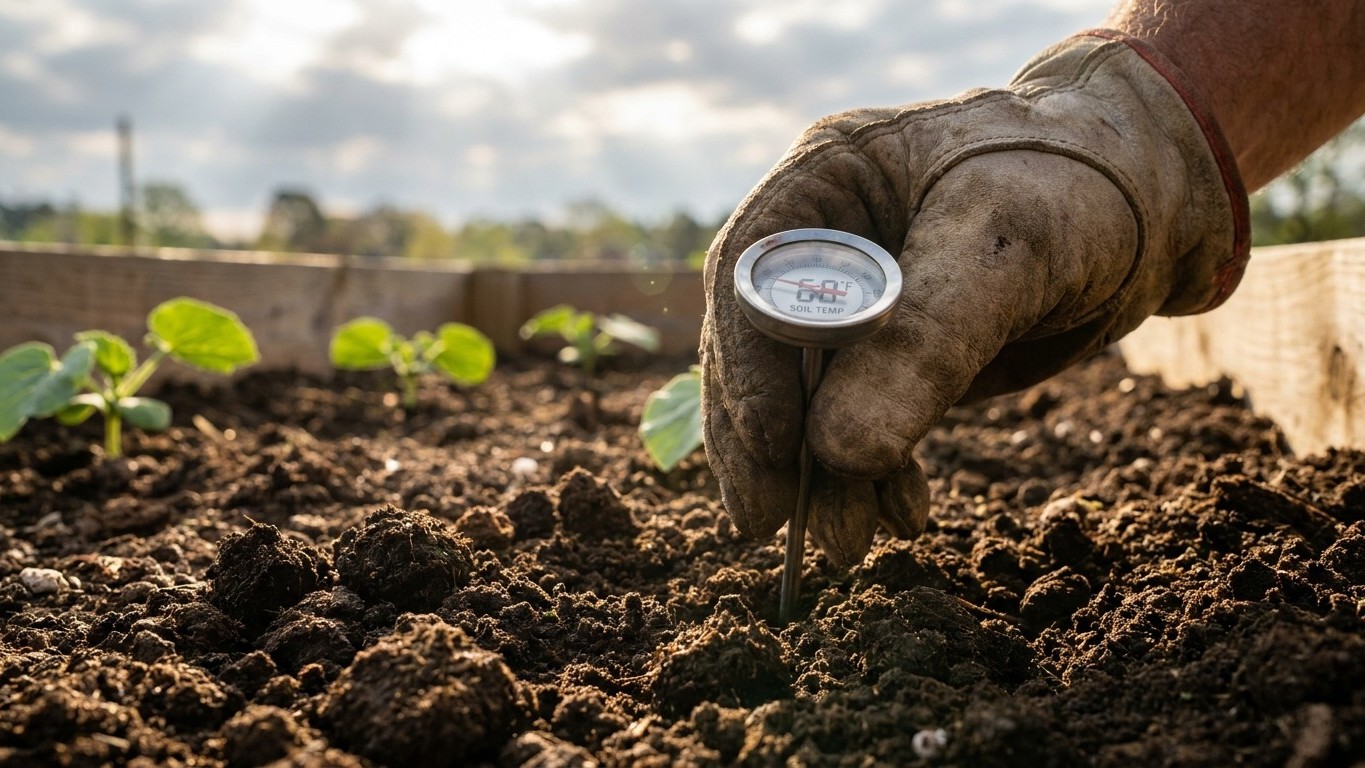
Frost is only a proxy for what melons actually care about, which is soil temperature. A morning with no frost risk can still leave the ground in the low 50s Fahrenheit, and melon roots stall in soil that cold. Air can warm in a day; soil takes longer, especially in clay-heavy ground that holds winter chill. The practical rule in a climate like this one is to let the frost date pass, then give the soil another two to three weeks under black plastic mulch or a cold frame before setting out transplants or direct-sowing. Raised beds help too, since they drain and warm faster than flat ground.
This region sits in Canadian hardiness zone 5b, based on Natural Resources Canada’s Plant Hardiness Site using 1991-2020 normals for the reference city. That number is worth a caution of its own: the Canadian zone system is built from seven climate variables, not the single minimum-temperature reading behind the USDA system used elsewhere on this site, so 5b should never be read as equivalent to a same-numbered USDA zone. It is a rough guide to winter survival for perennials, and it says nothing directly about summer heat, which is the actual constraint for melons here.
None of this points to a single sowing date that works everywhere in the province. A garden in the Montreal lowlands can push transplants out earlier than one in the Laurentians or along the north shore, where cold air pools and frost lingers into late May. The honest approach is to use the soil, not the sky, as the signal: push a thermometer four inches down, and don’t plant melons until it holds steady in the 65 to 70 degree range for several consecutive days. Black plastic mulch, laid a week or two ahead of planting, is the standard practical shortcut for getting there faster without waiting on the weather alone.
How long the season lasts here
Subtract the two frost dates from Environment and Climate Change Canada’s normals for MONTREAL/ST-HUBERT A and the frost-free window comes to roughly 152 days, running from the average last spring frost on May 6 to the average first fall frost on October 5. That is the outside limit of the growing season, not the melon-growing season, since real planting has to wait for the soil to warm well past the frost date itself.
A window of that length changes what is worth attempting. In territories with a much longer frost-free stretch, gardeners can sow a first melon crop, harvest it, and still have time to get a second sowing to maturity before fall cold arrives. Quebec’s 152 days, once trimmed by the soil-warming delay at the start and the ripening slowdown that comes with shortening September days, leaves little room for that kind of succession. For most gardens here, the practical target is one well-timed sowing rather than two, which puts more weight on getting the first planting right: starting transplants indoors four to five weeks before the intended set-out date rather than direct-sowing, so the plant arrives in the garden with a head start the season itself can’t offer.
That timing decision, transplant versus direct-seed, matters more in a short-season climate than in a long one, because melons dislike root disturbance and a poorly hardened-off transplant can lose a week or two recovering from transplant shock, a setback a 152-day window can’t easily absorb. Hardening plants off gradually over several days, and choosing biodegradable or peat pots that let roots go undisturbed into the ground, reduces that risk. Readers weighing whether a second sowing is realistic in their own garden, or whether row covers and cloches can stretch the effective season enough to justify trying, should check the site’s succession sowing guide for how that calculation shifts with local frost windows.
Heat and water in Quebec

Heat load, not day count, is what actually limits melons, and by that measure the region has almost none to spare: the ECCC Canadian Climate Normals 1981-2010 for the Montreal reference station put the average number of days reaching 90°F or higher at 0.0 per year. That is not a rounding artifact. It means a typical summer here rarely, if ever, delivers the kind of sustained heat that pushes melon vines into rapid growth and concentrates sugar in the fruit during the final ripening stretch.
That single fact reframes almost everything else about Growing Melons in this territory. Where a hot-summer region can rely on ambient heat to do the work, a cool-summer one has to manufacture it: black plastic mulch to warm the root zone, floating row covers to trap heat around young plants, and south-facing or wall-sheltered planting sites that pick up extra radiant warmth. The type of melon chosen matters more here too, since an early-maturing type bred for shorter, cooler seasons has a real chance of ripening before fall cold sets in, while a type bred for long, hot summers elsewhere may simply run out of warmth.
Rainfall tells a second part of the story. Environment and Climate Change Canada’s normals for station Montreal/Pierre Elliott Trudeau Intl A put summer rainfall (June through August) at about 10.6 inches, out of 39.4 inches for the year, with June the driest of the three months at 3.42 inches, July at 3.52, and August at 3.71. That is a moderate, fairly steady supply, not a drought, and it means irrigation is rarely the deciding factor in fruit size the way it is in a hot, dry climate. The risk runs the other way: combined with limited heat, that rainfall keeps humidity around the foliage higher for longer, which favors powdery and downy mildew and slows the drying-out that melon leaves need after a rain or a heavy dew. Spacing vines generously, keeping foliage off wet soil with mulch, and watering at the base rather than overhead all matter more in a cool, damp summer than they would in a hot, arid one.
Which melons suit Quebec
Given a short frost-free window, essentially no days above 90°F, and summers damp enough to favor mildew, three qualities matter more than any brand name on a seed packet: earliness, disease resistance, and tolerance of cooler nights. Early-maturing types, bred to set and ripen fruit before the accumulated warmth runs out, are the only realistic category for a single-sowing season like this one. Types with some resistance to powdery mildew are worth prioritizing given the humidity pattern described above, and types that tolerate cooler night temperatures without stalling growth hold an edge over ones bred purely for hot, dry climates.
Variety trials run by provincial and state extension services test named cultivars against local soil, local pest pressure, and local weather in a way a general climate page cannot replicate; a name dropped in without that testing behind it is a guess dressed up as advice, and gardeners who’ve been burned by a mismatched variety notice the difference immediately. What holds true everywhere in this territory, from the Montreal lowlands to cooler outlying regions, is the type profile: early, mildew-tolerant, cool-night-hardy.
For the actual list of cultivars trialled and recommended for Quebec conditions, the province’s own agriculture ministry maintains variety and technique guidance through the Ministère de l’Agriculture, des Pêcheries et de l’Alimentation du Québec (MAPAQ). Pairing that local variety list with the season-length and heat realities laid out here, the black plastic mulch, the row covers, the transplant-not-direct-seed approach, gives a Quebec garden the best realistic shot at ripe melons before the average October 5 frost closes the window.